















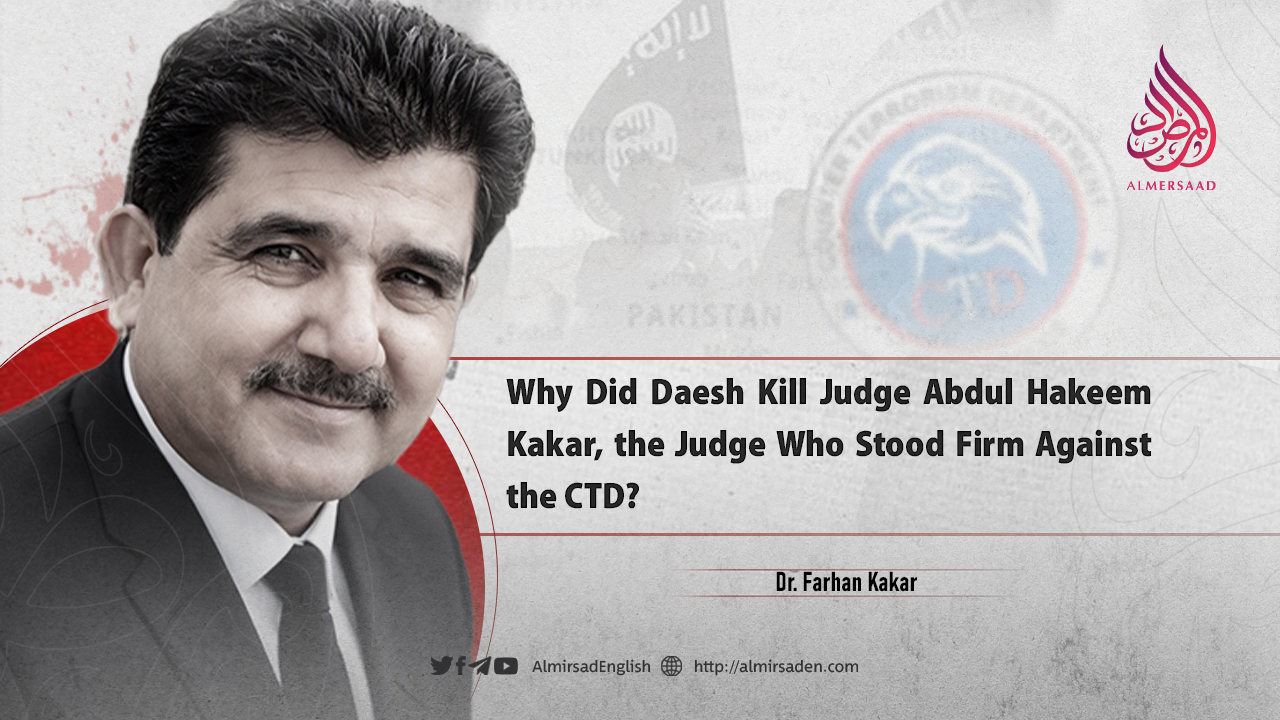
By Dr. Farhan Kakar
The history of Balochistan has always been tied to its rugged mountains, deep political secrets, and stories written in blood. But in recent days, an incident in the Wali Khan Bypass area of Mastung district has pushed the region’s military politics, geopolitical contradictions, and the ongoing battle of competing narratives into a new phase, one in which the line between friend and foe has become increasingly blurred.
The killing of District and Sessions Judge Abdul Hakeem Kakar is not merely the assassination of a judicial figure. It is a clear sign of the deeper crisis into which Balochistan’s entire political and security structure is sinking with each passing day. If the background to this incident, the motives behind it, and the facts that surfaced afterward are examined carefully, an astonishing picture emerges, full of contradictions that expose many of the underlying causes of Pakistan’s current turmoil and crises.
The story begins in a courtroom in Kech (Turbat), where Judge Abdul Hakeem Kakar stood firmly for the constitution and the rule of law, a stance few expected in an atmosphere as tense and intimidating as that of Balochistan.
In November 2023, Pakistan’s Counter Terrorism Department (CTD) claimed that four “terrorists” had been killed during an encounter in Turbat. Among them was a young man named Balach Baloch. His family placed his body on the road and staged a sit-in protest. They insisted that Balach had been taken from his home several days before the alleged encounter. In their view, this was not a police shootout at all but an extrajudicial killing.
When the case reached Judge Abdul Hakeem Kakar’s court, he did not do what many judges before him had done. He refused to accept the security agencies’ written claims at face value or endorse them without scrutiny.
Instead, he demanded solid and verifiable evidence from the CTD to prove that the so-called police encounter had actually taken place.
When the department failed to establish that the killing had been carried out in accordance with the law, Judge Kakar took a bold and unprecedented legal step. He ordered the police to register a murder case (FIR) against the CTD officers involved.
That decision placed the security agencies under enormous pressure. At the same time, it made Judge Abdul Hakeem Kakar a trusted symbol of justice for people who believed they had been wronged.
His legal position did not end there.
Whenever security agencies approached his court seeking permission to arrest, detain, or search suspects, Judge Abdul Hakeem Kakar examined every request strictly within the framework of the law.
He made his position clear: “Courts do not exist simply to put a stamp of approval on the unlawful actions of any institution, nor to legitimize the enforced disappearance of citizens without evidence.”
Because credible evidence was often lacking, he repeatedly refused CTD requests for warrants and ordered the release of several detainees.
For that reason, Judge Abdul Hakeem Kakar had effectively become a persistent obstacle for the security agencies operating in Balochistan, particularly the Counter Terrorism Department. His courtroom stood as an important legal barrier against actions that lay outside the bounds of the law.
Now look at the other side of the picture, one that leads to a separate and bloody conflict unfolding in the mountains of Mastung.
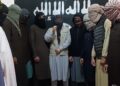
For years, Balochistan has been home to two very different armed movements. On one side are Baloch nationalist groups such as the Baloch Liberation Army (BLA). On the other is Daesh Khorasan (IS-K), which, according to various reports and claims, has also been trying to expand its influence in the region.
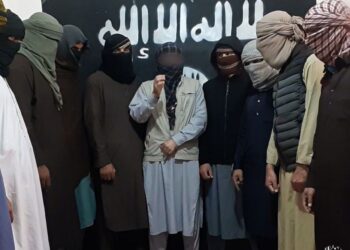
The BLA claimed in March 2025 that it had attacked a secret Daesh training camp in the Mastung area, killing more than thirty Daesh fighters. Three months later, in June 2025, Daesh referred to that attack in a video and formally declared war on the BLA. According to the BLA, Daesh members in Mastung were gathering intelligence on Baloch fighters at the direction of Pakistan’s intelligence agencies so the Pakistani military could carry out targeted operations against them.
One thing is worth noting. When the BLA inflicted such heavy losses on Daesh in Mastung, Pakistan’s media barely covered the incident. The reason was clear enough. The state did not want the BLA to get credit for defeating an international terrorist organization. Yet not long afterward, when Daesh launched retaliatory attacks against the BLA, pro-government social media accounts, YouTubers, and a number of commentators openly welcomed those attacks. They portrayed Daesh’s operations as proof of the BLA’s weakness and as a major success for the state.
This is where the first major and startling contradiction appears, exposing the inconsistencies in the narrative promoted by Pakistan’s military and its supporters. Driven by their hostility toward the BLA, pro-government circles forgot that Pakistan’s official position has always been that Daesh has neither an organized presence nor safe havens inside the country. Yet the moment pro-military social media accounts began celebrating Daesh’s attacks, they were indirectly suggesting that Daesh has a sufficiently organized and capable presence in Pakistan to strike the networks of a large armed group like the BLA.
By the logic that “the enemy of my enemy is my friend,” celebrating the battlefield successes of an internationally recognized extremist group contradicts the official narrative that Pakistan’s security establishment has promoted for years.
It also calls into question another long-standing claim repeatedly made by ISPR: that every armed group fighting against Pakistan, whether Baloch nationalist or religious extremist, is somehow linked through hidden coordination or mutual understanding.
The bloody fighting between the BLA and Daesh proves otherwise. There is neither a formal nor an informal alliance between them. They are bitter enemies, both ideologically and militarily. The state’s effort to lump all armed groups together under a single label was a propaganda strategy designed to win international sympathy by tying the Baloch movement to Daesh, discrediting it abroad, and weakening criticism of human rights abuses. Yet those contradictions become even more striking when Judge Abdul Hakeem Kakar is killed in Mastung and Daesh immediately claims responsibility.
According to Daesh’s own declared ideology, it considers governments, individuals, and courts that operate under democracy, man-made laws, and constitutional systems to be its enemies. Judge Abdul Hakeem Kakar served under that same constitutional order, so by that logic he could be regarded as one of Daesh’s potential targets. But here lies the contradiction: at the very same time, this judge had consistently opposed actions by Pakistan’s security agencies that he considered outside the law, and he refused to issue rulings that suited their wishes.
His judicial stance indirectly benefited those who saw themselves as victims of state oppression, and before this incident there had been no publicly known personal dispute or previous conflict between the judge and Daesh. So why would Daesh single out a judge whose legal position had become a problem for the security establishment?
That question forms the basis of the argument advanced by Baloch political circles, independent analysts, and media outlets that Daesh operates in Balochistan as a proxy for the security agencies. Judge Abdul Hakeem Kakar’s murder dealt the greatest blow to the rule of law and the justice system. Yet those who benefited the most were the very security agencies whose officials the judge had ordered to face criminal proceedings, despite the fact that Daesh, according to its own ideology, regards them as outside the fold of Islam.
Had public suspicion and anger focused entirely on the security agencies after Judge Abdul Hakeem Kakar’s killing, Daesh’s immediate claim of responsibility had the effect of easing that pressure. By taking credit for the attack, it indirectly reduced suspicion surrounding institutions such as the CTD and the Pakistani military. That is another striking contradiction: a group that claims to be democracy’s greatest enemy carries out an act that ends up serving the interests of the democratic state’s own security apparatus.
The bitter reality is that the conflict unfolding in Balochistan has reached a stage where the state’s official narrative is facing serious questions, particularly as Daesh and Pakistan’s military and security agencies increasingly appear to be advancing the same side of the struggle.
If Pakistan’s security agencies are indeed using Daesh as a proxy to pursue their strategic objectives and suppress their immediate opponents, the Baloch nationalists, then Daesh will never truly disappear from Pakistan.
“Terrorism is like a snake that cannot be kept merely to bite the neighbor, because one day that same snake will bite the one who feeds it.”
The killing of Judge Abdul Hakeem Kakar is another example of that policy. In the end, the same proxy force turned its violence against one of the state’s own pillars, the judiciary. Until Pakistan’s military and security agencies fully carry out their legal responsibilities, regard the people as their greatest asset, and abandon the pursuit of corrupt objectives through propaganda wars, defenders of the law and the public such as Judge Abdul Hakeem Kakar will continue to be sacrificed, while criminal institutions like the CTD will continue their futile attempts to hide behind Daesh’s claims of responsibility.