














Akbar Jamal
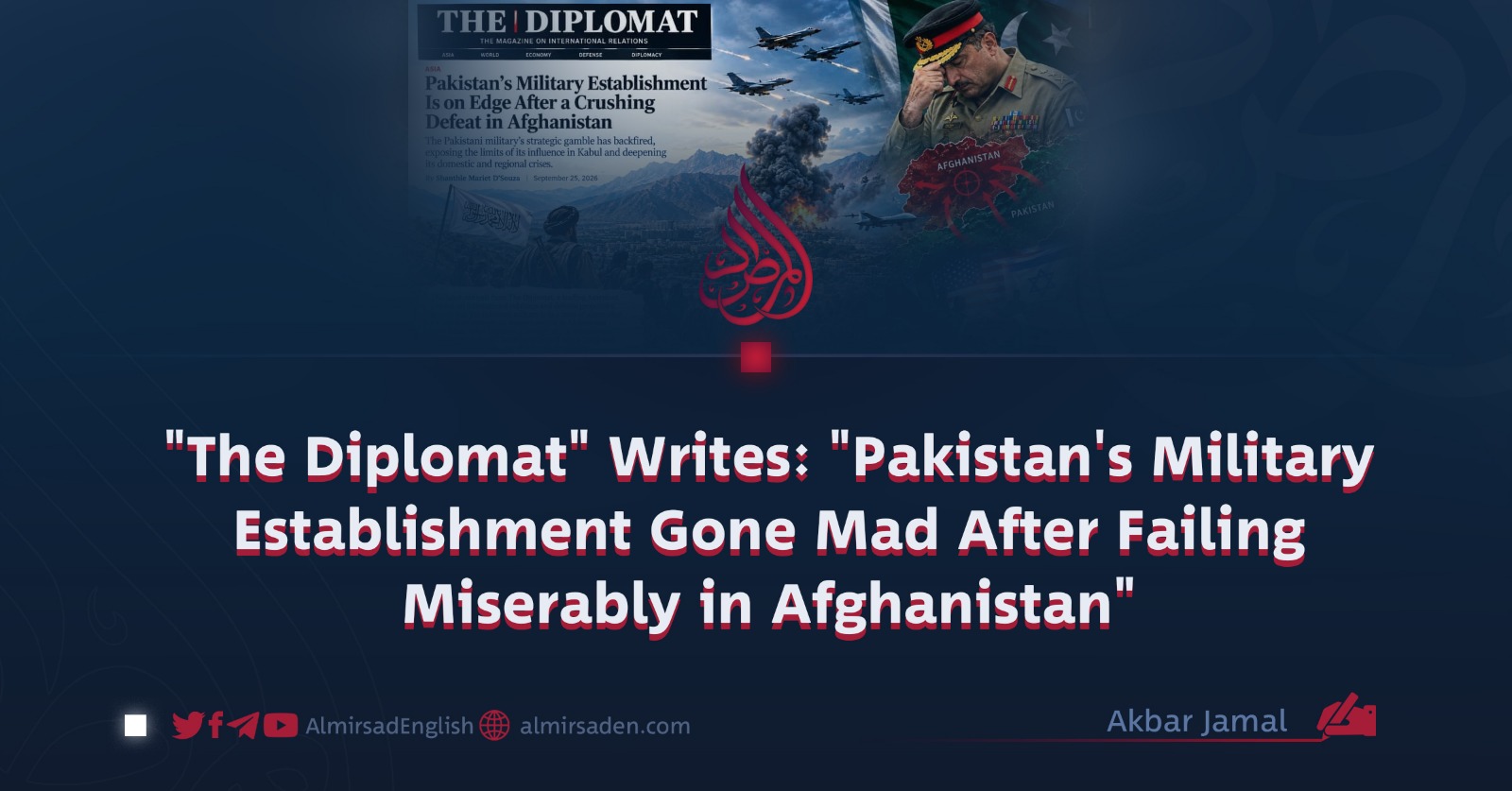
The recent analysis from The Diplomat, the respected American magazine on international relations and defense geopolitics, isn’t just an article, it’s a mirror held up to the policy-making corridors of Rawalpindi’s military center. This report makes clear that Pakistan’s army is trapped in a strategic miscalculation, a failed fantasy of pride, one that hasn’t just wrapped the whole region in the smoke and smell of gunpowder, but has pushed Islamabad itself into a swamp it seems to find harder to climb out of with every passing day.
If we look closely at the current situation through the lens of the Islamic Emirate of Afghanistan’s (IEA) principled, defensive, and sharia-based position, this truth becomes as clear as broad daylight: the dangerous game Pakistan’s military establishment started to dump the blame for its own internal political and security crises onto Kabul is now swallowing it whole in return.
The real reason behind the Pakistani army’s current strategic panic is the shattering of the dream Pakistan held about Kabul, the dream under which it had, for decades, viewed Afghanistan as its own “strategic depth,” meaning nothing more than a client state. When, in 2021, the Afghan people, under the IEA’s leadership, brought twenty years of American occupation and foreign domination to an end and established their own free and sovereign government, Rawalpindi assumed Kabul’s new leadership would move according to its signals.
When the IEA adopted a neutral, sovereign, independent foreign policy based on Afghan interests, Pakistan’s military generals’ stomachs started turning. The influence they’d spent years building through manipulation collapsed into thin air within moments. Pakistan’s army started using the name Tehreek-i-Taliban Pakistan (TTP) as a cover, to hide this same self-inflicted political and diplomatic humiliation and restore its own arbitrary, so-called influence over Kabul.
The alarming defense statistics unveiled in The Diplomat’s report are a practical demonstration of this very same panic in Rawalpindi. According to the report, in less than a year, Pakistan’s army has carried out at least 15 or more air and drone strikes in open violation of Afghan border limits. The recent indiscriminate bombing of the peaceful areas of Kunar and Paktika with American-made “GBU-12” bombs is a direct product of this same military insubordination. The oppressed, unarmed Afghans, women, and children on whom these bombs were dropped are themselves loud proof that Pakistan’s military leadership, using security as an excuse, is in reality carrying out unjustified aggression against the Afghan people.
But according to this magazine’s own analysis, far from achieving its intended strategic outcome, these 15 strikes and horrific bombings have proven a complete and miserable failure for Rawalpindi.
An even more shameful aspect is the Pakistani army’s behind-the-scenes role, in which it is sponsoring and funding the Afghan government’s armed opponents, so-called death squads, and disruptive elements. On one hand Islamabad stages a drama before the international community of being a victim of terrorism, and on the other it pats the backs of these same disruptive groups to stop Kabul’s peaceful Islamic government from stabilizing. Yet history is full of evidence that forces which seek the solution to their internal problems in cross-border bombing and funding guerrilla groups end up trapped in their own net in the end.
“The Diplomat” has rightly warned Rawalpindi’s policymakers that the dream of bringing Kabul to its knees through economic blockade, closed borders, and airstrikes is an extremely “short-sighted” and foolish approach. Those generals who perhaps haven’t studied history should remember this: the country and the nation that the so-called world’s sole superpower, America, along with 48 allied countries including the Pakistani army, could not bend, by Allah’s grace, despite two decades of the most horrific bullying and lethal tactics, how could the bombing of a Pakistani army foolish to the point of madness ever defeat it?
By Allah’s will, it was never written into the nature of Islam-loving Afghans to accept decisions imposed on them by foreign pressure or at gunpoint. The only result of Rawalpindi’s biased, hate-filled approach has been stirring up a new, harsh storm of public rage and hatred toward Pakistan across every corner of Afghanistan, particularly in the border regions.
The depth of this strategic decline becomes even clearer when the facts surface about the Pakistani army’s ties with the Trump family and its secret drone deals with pro-Israel companies. Obtaining military technology through secret deals with those who kill Palestinians and Israeli-influence lobbyists, using the tax money of its own people, reveals the bloody face of Pakistan’s military establishment, one that becomes harder to hide with each passing day.
All of this shows that neither Islamic brotherhood nor regional peace has any place in the Pakistani army’s priorities, it’s a war to secure its own power and survival and to pursue those American interests. The truth is that the center of this security crisis isn’t Kabul, it’s Islamabad’s and Rawalpindi’s own wrong policies. The current internal situation in Khyber Pakhtunkhwa and Balochistan, and the demands from provincial officials there for direct talks with Kabul, are open proof that the Pakistani army’s manufactured “blame-the-neighbor card” and “fake security narrative” have now rusted even inside its own country.
The people and provincial governments have now reached this conclusion: the cause of the army’s failure isn’t Afghanistan’s lack of cooperation, it’s Rawalpindi’s own incompetence and its two-faced, hypocritical approach. That’s why the IEA has always countered all these schemes with wisdom, patience, and its full right to defend itself and its own land. All these military efforts to pressure the Afghan government and people have collapsed like a wall of sand and proven fruitless.
If Pakistan’s military establishment still won’t learn a lesson from reality, won’t stop violating Afghan airspace, and won’t set aside its arrogant, force-based stance, then the final political and defense cost of this short-sighted, poorly calculated approach will fall on Pakistan’s own political and defense standing. History is witness that when the smoke of cannons and bombs darkens the sky alongside oppression and injustice, victory in the end belongs to those who stand firm for their own rights.