













By Dr. Farhan Kakar
When the quiet and dignified atmosphere of Mecca’s historic Qasr Al-Safa was transformed into a scene of diplomatic activity, it seemed as though the moment had arrived to write a new chapter in history.
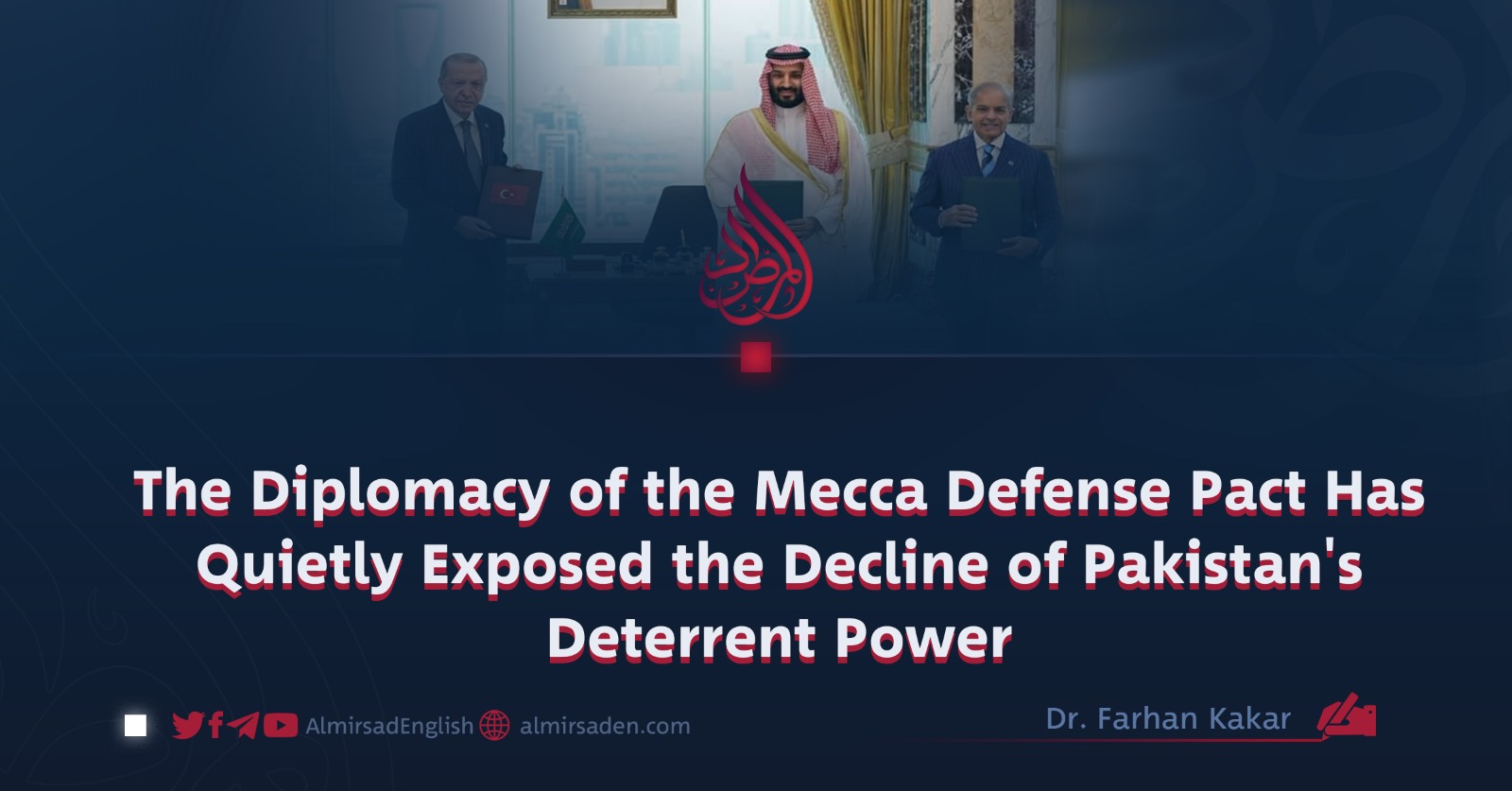
News that Saudi Crown Prince Mohammed bin Salman, Turkish President Recep Tayyip Erdoğan, and Pakistan’s so-called Prime Minister Shehbaz Sharif had gathered around the same table became an attention-grabbing headline for news agencies. But for those who closely follow the deeper politics of the Middle East and South Asia, it was a sign of a quiet but profound political earthquake.
When the three leaders signed the documents of the “Mecca Joint Defense Agreement,” private discussions and speculation began in diplomatic circles around the world. The spirit of the agreement clearly carries an echo of NATO’s famous Article 5, whose basic meaning is, “An attack on one is an attack on all.” To understand this interesting situation, one needs to look at it through the kind of conversations heard in Kabul’s traditional tea houses, where politics is not judged through textbook terminology, but through the bitter realities of life and examples drawn from everyday experience.
On the surface, the pact appears to be a major trilateral Islamic alliance, one that brings together Turkey’s modern drones and digital technology, Pakistan’s supposedly battle-tested military capabilities, and Saudi Arabia’s enormous oil wealth to build an unbreakable defensive wall. Diplomats, meanwhile, smile and say: “This agreement is fully consistent with the UN Charter, and its purpose is to reduce dependence on Western powers.”
But when this political game is examined more closely in Kabul’s cold air, and when one looks beyond the smoke and noise of the wars of the past 45 years, a much darker reality emerges behind this shining agreement. In diplomatic language, it is called a strategic partnership. In reality, it is the story of Pakistan quietly admitting the failure of its Single Nation Deterrence.
Think of it like this. A wealthy village landowner, a man rich in oil money and riyals, wants to protect himself and his property. So he hires the village’s apparently strongest, most experienced, and honorable wrestler as his guard. To keep him as his protector, he gives him oil for massage and riyals for food.
But when the moment of need arrives, and the landowner senses a threat from the neighboring village, he also realizes that the wrestler himself is caught in a web of hidden illnesses, heavy debts, and family disputes. He can only stare at the neighboring village without being able to stand up to it. In the end, the landowner is forced to bring in another man from the city, one equipped with modern weapons, and make him part of his security.
The history of defense relations between Pakistan and Saudi Arabia goes back several decades. But what happened that finally forced Riyadh to knock on Ankara’s door as well?
The first and biggest reason is Pakistan’s severe economic crisis. No matter how strong a military may be, if its economy is empty and weak, its threats no longer carry the deterrent power needed to stop an adversary from attacking. Imagine a man holding the most advanced gun in the world, but who is so short of money that he cannot afford a single meal and, once his ammunition and gunpowder run out, has no means to replace them. His rival will never be afraid of him. Pakistan’s economic weakness has stripped its military threat of much of its effect. Other powers in the region, particularly Iran, have understood very well that Islamabad is not in a position to carry the financial burden of a prolonged conflict.
The second major problem is Pakistan’s own internal situation. At present, much of the Pakistani military’s attention and a large part of its forces are being used inside the country to deal with growing armed violence, attacks by the Tehrik-e-Taliban Pakistan (TTP), and insecurity in Balochistan. When a man’s own house is burning from within, he cannot devote all his attention to protecting the neighbor’s house from the threat of fire.
Internal disorder has pushed Pakistan to the point where it cannot stand as a solid steel shield against emerging unconventional or proxy threats facing Saudi Arabia.
The third issue is tied to diplomatic and geographic realities. Pakistan and Iran share a long border, and the two countries are bound by long-term energy needs and mutual necessities. In addition, the presence of a large religious minority in Pakistan with ties to Iran, along with the sensitivities surrounding it, prevents Islamabad from openly entering a war against Tehran simply for Riyadh’s sake.
Pakistan’s approach toward Iran has largely remained limited to cautious statements and restrained responses. When Saudi Arabia reached the conclusion that Pakistan alone was not enough to serve as a complete deterrent force for its security, it also turned its attention toward Turkey to fill this gap. Turkey’s participation in this alliance is, in reality, a result of these very economic and geographic limitations facing Pakistan.
Turkey is economically more stable, is an experienced NATO member, and has demonstrated the capabilities of its drone technology on the international stage. Although the Mecca Agreement is being presented on the surface as a celebration of a historic victory, a closer look beneath the surface reveals something else: when a country loses economic strength and internal stability, even a country with a distinguished history and a powerful military cannot, on its own, guarantee the security and protection of others.
Behind the bright lights of Mecca lies this bitter reality about Pakistan. Through this agreement, that reality has been exposed to the world, even without the Pakistani military’s consent…