












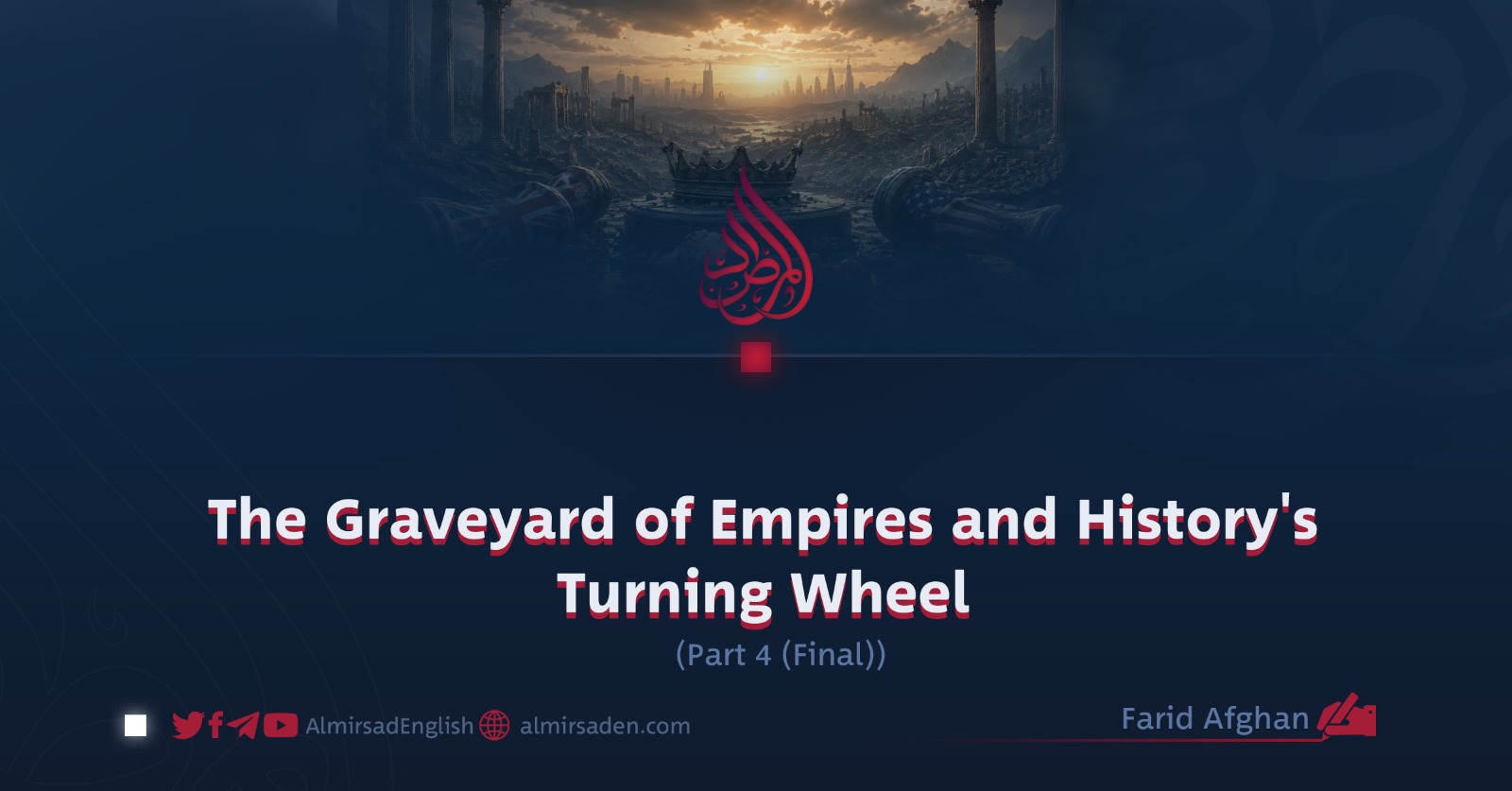
Part 4 (Final)
By Farid Afghan
The Third Anglo-Afghan War and the Changing World Order
When Amanullah Khan declared Afghanistan’s complete political and diplomatic independence from Kabul’s royal court in April 1919, a wave of serious alarm spread through the halls of the British Empire. For the British, it was unthinkable that a mountain kingdom would reject their forty-year dominance in a single stroke.
The government of British India gave no positive response at all to King Amanullah Khan’s letter. Instead, it increased the movement of military forces along the borders. In May 1919, Amanullah Khan formally declared the “War of Independence” against the British, known in history as the Third Anglo-Afghan War.
This time the wheel of history had turned fully in the other direction. Powerful Britain, forty years earlier, was now hollowed out from within. The devastation of the First World War had weakened Britain’s economy, and its own troops were no longer ready for another war. Even more important, the very heart of the British Raj, India itself, stood on the threshold of independence from within.
Because of the horrific massacre at Jallianwala Bagh in April 1919, a fire of hatred against the British had been lit across India, and because of the Khilafat Movement, Muslims and Hindus alike had taken to the streets together to bring an end to British rule. Muslim and Hindu soldiers serving in the British Indian Army were also refusing to fight against their neighboring country, Afghanistan. In this way, the very internal discord that had once been Afghanistan’s weakness had now turned into the British Empire’s own undoing.
Historic Victory on the Battlefield and the Thal Front
The War of Independence opened on three major fronts: Khyber, Kandahar, and Chitral-Waziristan. The British still held the military advantage, and to break Afghan morale they carried out the first aerial bombing in history against Kabul and Jalalabad. Bombs struck parts of the royal palace itself, and for a short time this spread fear among the people, but the freedom-seeking spirit of the Afghan ghazis could not be broken by technology. Afghan forces and border tribes cut British supply lines on the ground and, using traditional guerrilla tactics, paralyzed the British army.
The most decisive and historic battle of this war was fought on the Waziristan and Thal front, in what is today Pakistan’s border region, led at the time by General Nadir Khan, who would later become king of Afghanistan. General Nadir Khan brought Afghan forces together with local Pashtun tribes and launched such a forceful assault on British military positions that it broke the momentum of the British army entirely. The Afghans besieged the fort at Thal, seized control of British artillery positions, and forced them into retreat.
The heavy British defeat on this front forced military strategists in London to consider that if the war dragged on any longer, it could ignite a massive revolt on the other side of the border, across India’s tribal areas and the whole subcontinent, one the British Empire would no longer have the power to control.
The Treaty of Rawalpindi and the 28th of Asad
Facing war exhaustion and the fierce resistance of the Afghan ghazis, the British Empire finally bowed its head. A ceasefire was announced in June 1919, and delegations from both countries sat down at the negotiating table in Rawalpindi, in what is today Pakistan.
After lengthy discussions, a historic peace treaty was signed between the British government and the Afghan delegation on August 8, 1919, known as the Treaty of Rawalpindi. Under this treaty, Britain formally acknowledged that Afghanistan was a sovereign, independent, and free country, and that British India retained no right over its foreign policy.
Although the peace treaty itself was signed on August 8, it was on August 19, 1919, corresponding to the 28th of Asad 1298 in the Solar Hijri calendar, that King Amanullah Khan, at a great celebration in Kabul, formally declared Afghanistan’s complete political, diplomatic, and territorial independence before the world. In honor of this historic day, the 28th of Asad is celebrated every year in Afghanistan as Independence Day.
This was Afghan history’s own miracle, proof that a nation, even lacking resources, can force even the greatest colonial power on earth into retreat if it stands united. After this victory, Britain never again dared to invade Afghanistan.
After 9/11 and History Repeating Itself
It’s one of history’s strange tragedies that arrogant empires never learn from the past. The very lesson Afghans taught the British Empire in 1919 had to be relearned in the twenty-first century by the United States, the world’s sole great power, and its roughly fifty NATO allies.
After the events of September 11, when the American-led coalition attacked Afghanistan with trillions of dollars’ worth of the most advanced weapons, drones, satellite technology, and hundreds of thousands of soldiers, it seemed, on the surface, that in this modern age Afghan traditional resistance would finally come to an end.
But the laws of nature never change. The governments America built in Kabul were riddled with severe financial corruption, and the morale of their army rested not on patriotism or Islam but on foreign dollars. The Afghan people, meanwhile, true to their traditional psychology, firmly refused to accept any foreign occupier and made use of this same harsh mountain geography to launch a long, exhausting guerrilla war.
After twenty years of prolonged struggle, thousands of deaths, and nearly two trillion dollars wasted, in 2021 the American people and politicians reached the same war exhaustion that had once been the fate of the British after the First World War, and later of the Soviets. In the end, the American-led coalition too was forced to withdraw from Kabul in despair, just as Britain and the Soviet Union had withdrawn before them. History proved once again that Afghanistan truly is the graveyard of empires.
The Lesson of Mutual Unity and Material Progress
The greatest intellectual and philosophical lesson to be drawn from this whole history is that true survival and success for any nation rests on two fundamental pillars: first, the nation’s mutual unity and agreement, and second, self-sufficiency in the material and scientific fields.
Afghanistan’s history is witness to this: whenever this nation has shown unity against a foreign enemy, it has astonished the world. But whenever, after military victory, this nation fell prey to internal ethnic, linguistic, or religious divisions, both its geography was torn apart and its independence stripped away.
At this current stage, as Afghanistan enters a new phase under the leadership of the Islamic Emirate of Afghanistan (IEA), the greatest challenge facing the Afghan nation is not military at all, but internal unity, the economy, and knowledge. Pride in past victories alone can never give any nation permanent greatness unless it prepares itself for the needs of the present age.
Today’s world no longer accepts the power of the rifle alone. It understands the language of economic stability, modern sciences, technology, and industrial self-sufficiency. As long as a country remains dependent on foreign aid, loans, and strategic needs, its independence will always remain under threat.
This same principle applies broadly to the entire Islamic world too, a world that, despite its rich resources, has lost its true weight on the global stage because of a lack of internal unity, intellectual coordination, and modern knowledge.
The Path Forward: Scientific and Economic Jihad
The wheel of history has now reached a point where the Afghan nation and the Islamic world need a new path for their own survival. Jihad on the military front has completed its role. Now is the time for this same discipline, resolve, and spirit of unmatched sacrifice to be transformed into “mutual unity, scientific and economic jihad.”
Afghanistan must open the doors of modern education and technical training to its youth, develop its vast natural and mineral resources on modern foundations, and build a stable domestic economy that can stand like a wall of steel against foreign sanctions.
Likewise, until the countries of the Islamic world set aside their political disputes and form a shared economic and scientific bloc, they will keep failing to get their own decisions accepted on the world stage. If unity is the first condition of survival, material and scientific progress is the only path to giving that survival a lasting rise.
History has once again given Afghans the chance to stand on their own feet, and now it is in their hands how they use this chance to build their own lasting and bright future.