















Part 3
Akbar Jamal
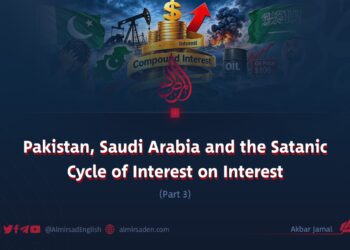
The most frightening, horrifying and destructive feature of the interest-based system is what’s called, in economic terminology, “compound interest,” or the “interest-on-interest cycle” (Compound Interest Trap). It’s a mathematical trap that, once it closes around a debtor country’s neck, can last for generations, yet the debt still shows no sign of coming to an end. If we apply and unpack this complex global mechanism using the same six-billion-dollar oil loan agreement between Pakistan and Saudi Arabia that we described in Part Two, its reality becomes as clear as a mirror.
As we saw, under this agreement Pakistan is charged interest at 1.5 percent a year, which comes to $90 million. Under the conventional interest-based system, the transaction becomes particularly dangerous when the debtor country, because of economic problems or a shortage of dollars, can’t pay a loan installment or the interest at the end of the year or within the set period.
Suppose Pakistan fails to pay this $90 million in interest at the end of the first year. Here the magic of the interest-based system begins its work. The lending institution doesn’t waive this $90 million in interest, nor does it keep it separate from the original debt. Instead, it adds it to Pakistan’s original debt of $6 billion, a process known as capitalization. Now, at the start of the second year, Pakistan’s outstanding debt in the financial records is no longer recorded as $6 billion; it rises to $6.09 billion.
From here the second frightening stage of this satanic cycle begins. When the second year’s 1.5 percent interest is calculated, it’s no longer charged on Pakistan’s original $6 billion; it’s calculated on the increased total of $6.09 billion. As a result, the second year’s interest rises from $90 million to $91.35 million. If Pakistan can’t pay this at the end of the second year either, this new interest is also added to the original debt, and Pakistan’s total debt reaches $6,181,350,000.
The third year’s interest is then calculated on this new, increased amount, coming to nearly $92.72 million, and at the end of the year the total debt exceeds $6.274 billion. The economic and practical result of this whole global mathematical complexity is that the interest from the previous period becomes part of the debtor country’s “principal amount,” or “original capital,” for the coming period. The debtor country gets caught in an endless cycle of paying interest on interest, in which the original debt stays where it is, but the mountain of interest rises higher with time, day by day, and takes on a more frightening form.
This is the very injustice against which the Holy Quran issues a stern warning in verse 130 of Surah Al-Imran:
﴿يَا أَيُّهَا الَّذِينَ آمَنُوا لَا تَأْكُلُوا الرِّبَا أَضْعَافًا مُّضَاعَفَةً وَاتَّقُوا اللَّهَ لَعَلَّكُمْ تُفْلِحُونَ﴾
“O you who have believed, do not consume usury, doubled and multiplied, but fear Allah that you may be successful.”
For this very reason, international interest-based institutions don’t set the price of credit for a commodity the way an ordinary shopkeeper does, and they don’t keep it fixed. If the price were fixed, their profit would be limited to a set level, and they could no longer keep multiplying their wealth continuously.
So they keep the “time meter” running, so that the longer the debtor country delays repayment, the more their income grows. Now the question is how developments in the international market are exploited to keep this interest meter running. Here the “futures market” and the role of speculation, or betting on price movements for profit, come into play.
When war clouds spread over a region, especially an oil-producing region like the Middle East, and conditions grow tense, oil prices rise from $90 to $95 or $100 even before the war starts, simply because of the threat of conflict. These prices don’t rise on their own; international interest-based investment banks and major investors profit from this environment of fear.
They spread rumors and fear in the market, claiming that “because of the war, oil supplies will be cut off in the future.” As a result of this fear, traders seeking to make unjust profits buy futures contracts for millions of barrels of oil at low prices and hold on to them, so they can sell them later at a high price.
In this way, when oil supplies are gathered up from one part of the market and concentrated in a few hands, the number of buyers suddenly increases on the other side. As a result, under the law of supply and demand, prices artificially shoot up. When war begins, shipping companies raise the “war risk insurance” premiums for their ships many times over. Behind these insurance companies stand the same international interest-based financiers.
Organizations of oil-producing countries, such as OPEC, also bring their production under control in such circumstances. As costs rise and oil supplies shrink, oil prices keep rising, and the budgets of developing countries like Pakistan come under severe pressure. As these countries spend dollars importing expensive oil for their domestic needs, their dollar reserves run out. For this reason, they’re forced to take out new interest-based loans from the International Monetary Fund (IMF) and similar institutions to pay their old debts and interest. In this way, this satanic cycle of global interest uses every crisis and every war as fuel for its own continuation and expansion.