














By Asif Tarin
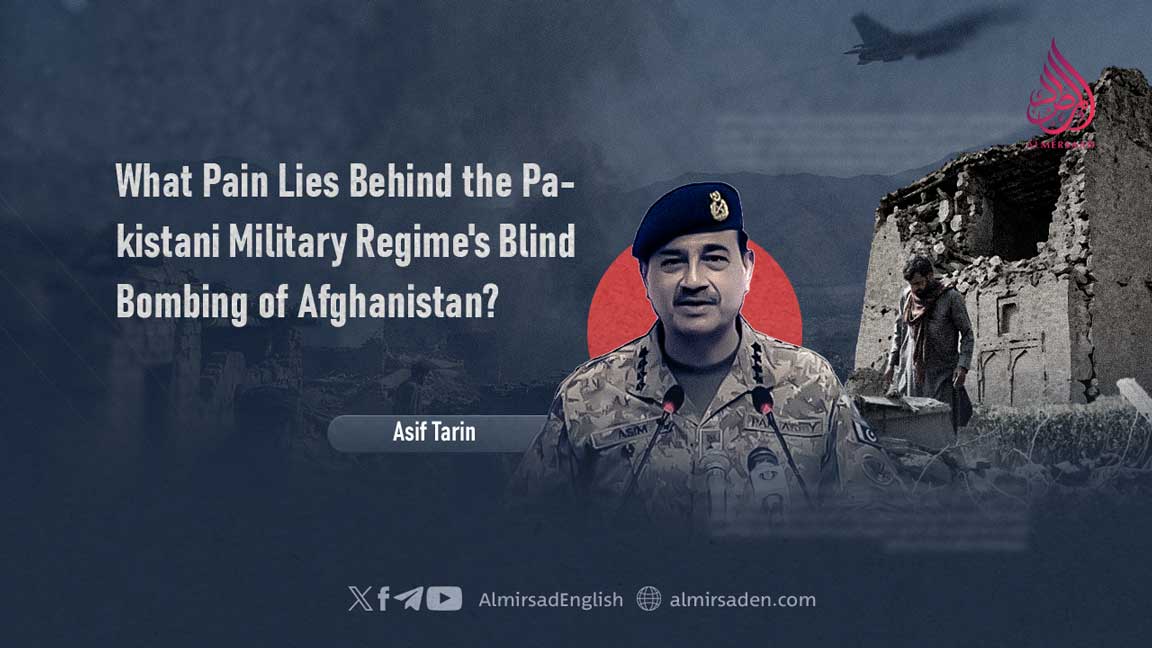
The skies over eastern Afghanistan’s peaceful provinces, Kunar and Paktika, have once again grown heavy with the smoke of gunpowder. On the night of September 20th, 2026, the ruthlessness with which Pakistani air force jets targeted ordinary civilians’ homes and property, without cause and without provocation, has once again drawn the world’s attention to the smoldering geopolitical fire in this region.
The Afghan government has called this action an open violation of international law and national sovereignty, and has announced that it reserves the right to respond. On the surface this bombing carries the name of a so-called intelligence-based operation against militancy, but in reality it’s a classic example of something going on behind the curtain of standard security excuses, hiding international geopolitics, diplomatic defeat, and strategic humiliation. To make sense of this whole picture, we need to take a hard, objective look at the diplomatic chess pieces laid out between Kabul, Islamabad, New Delhi, and Riyadh.
The root of this story starts with that same old narrative of “strategic depth,” the one under which Pakistan has always wanted to keep Afghanistan under its own influence. From interfering in Afghanistan’s internal civil war in the nineties right up to recent years, Islamabad, under Rawalpindi’s control, has held onto this mindset, that Kabul should keep its internal, and especially its foreign, policies subordinate to the Pakistani army’s interests.
That’s exactly why, whenever the Islamic Emirate of Afghanistan (IEA) has started shaping its own foreign policy as a free and sovereign state, the Pakistani army has been seen making an “unclean attempt” to widen the gap of tension between the two neighbors.
This diplomatic war reached its peak in October 2025, when Afghan foreign minister Amir Khan Muttaqi made a historic diplomatic and trade visit to India.
What’s interesting is that before this visit to India, a visit to Pakistan had also been scheduled for August 2025, but Islamabad, under pressure from the army, backed out of hosting the Afghan foreign minister’s visit, using the technical excuse of UN travel restrictions. What’s striking about this is that Pakistan itself held the presidency of the UN Security Council at the time. By contrast, India obtained a proper travel exemption from the very same UN under that same Pakistani presidency and gave the Afghan delegation a warm welcome.
This whole episode proved that Pakistan, which appeared to have been bypassed during the Afghan foreign minister’s India visit, was actually the one bypassed, because of its own diplomatic weakness.
Kabul’s message throughout has remained clear: it doesn’t need Islamabad to carve out its own trade and diplomatic paths.
To cool the anger of this same humiliation and strategic defeat, the Pakistani army bombed Afghanistan on the night of October 9th, 2025, claiming it had targeted Tehrik-i-Taliban Pakistan chief Mufti Noor Wali Mehsud, even though Mufti Noor Wali Mehsud was present in Pakistan itself.
The chain of mutual conflict that began with Pakistani military aggression on the night of October 9th, 2025, was temporarily halted through the mediation of regional powers like China, Qatar, Saudi Arabia, and Turkey, and throughout the war, the IEA kept repeating its position that the solution to these problems could only come through the negotiating table, not through bombing.
Consistent with this same stance, the IEA released three Pakistani soldiers captured during the war as a goodwill gesture, through Saudi mediation.
In the middle of all this, the biggest contradiction appeared once a long and serious round of negotiations began under regional mediation. The IEA took a clear and consistent position that existing issues and security concerns could only be resolved through peaceful dialogue, and Kabul kept the doors of diplomacy open continuously, even during the war.
Pakistan’s army, by contrast, took an extremely rigid and aggressive stance. The Pakistani army repeatedly insisted publicly that it would hold no negotiations with “terrorists and their facilitators” and remained fixed on using military force alone. This same unreasonable stubbornness and rigidity from Pakistan fanned small disputes into the shape of a larger war, one that left Islamabad condemned before the international community and mediating countries as a peace-hostile, war-loving party.
But historically, the Pakistani army has consistently turned to cross-border adventurism to divert its own people’s attention from severe internal problems like political instability, record-breaking inflation, and public protests. Whenever Pakistan faced pressure at the international level to come to the negotiating table, it would dump the blame for attacks happening inside Pakistan onto Afghanistan to hide its own embarrassment.
Linking the attacks on Rangers in Karachi a few months ago to Afghanistan was part of this same propaganda and narrative war, meant to give the world the impression that Pakistan’s army isn’t the aggressor but the poor, wronged, helpless, alone, and defenseless party.
This chain of condemnation against Pakistan’s army on the economic and diplomatic front grew even more severe when Pakistan asked America for $10 billion in funds in exchange for its past cooperation against the IEA, over which Pakistan’s own people harshly criticized their own army, saying that after becoming a frontline ally in the twenty-year war, the country gained nothing but economic ruin and the need to beg.
This same weakness in economic decision-making became clear again when Pakistan, for the first time in history, requested Saudi Arabia provide oil on credit for a long fifteen-year term and invest in the country’s economy. But Saudi Arabia, because of Pakistan’s poor economic condition, unstable environment, and the army’s interference in the country’s political institutions, chose not to act on that request, and instead turned toward Afghan soil in September 2026.
Saudi Arabia’s major energy company, Delta International Energy, signed a historic $200 million oil and gas exploration agreement with Afghanistan and began oil and gas exploration in Herat, an event that ground the Pakistani army’s geopolitical pride into the dust.
Around the same time, another major turn in geopolitics came when Saudi Arabia, Pakistan, and Turkey signed the “Mecca Joint Defense Agreement” for the protection of the two holy mosques and the Kingdom. Although its target wasn’t openly named on paper, in substance this agreement was meant as a strong defensive shield against Iran and the Houthis.
Because the Houthis had, in recent months, intensified their attacks on Saudi refineries, Saudi Arabia demanded immediate military assistance and intervention from Pakistan under the Mecca Agreement. Here the Pakistani army trapped the country in a horrifying geopolitical quagmire. On one hand, it didn’t want to anger its neighbor Iran and stir up domestic sectarian sensitivities; on the other, flatly refusing Saudi Arabia’s demand would have meant violating the Mecca Agreement and facing severe international humiliation and disgrace.
Out of this diplomatic deadlock, economic humiliation, and the anger over growing Saudi-Afghan trade and diplomatic ties, the Pakistani army once again set its old pieces in motion. On September 18th, 2026, a horrific car bomb was set off at the Old Police Lines complex in Kohat, and security agencies immediately built a media narrative claiming “an Afghan citizen was involved in this attack.”
Under cover of this same false propaganda, Kunar and Paktika were bombed on the night of September 20th.
Behind this recent bombing, Pakistan killed two birds with one stone. First, it gave itself an excuse to offer Saudi Arabia: “Pakistan can’t send its forces against the Houthis under the Mecca Agreement because its own western border with Afghanistan is unsafe, and it’s already caught up in a war there.”
Second, by bombing Afghanistan, it vented its anger over why Saudi Arabia bypassed Islamabad to invest in Kabul.
So this latest aggression isn’t really about ending militancy inside Pakistan at all, it’s a final, failed attempt to hide Pakistan’s own internal failures, the humiliation of its economic begging bowl, and its geopolitical isolation on the international stage, the cost of which, sadly, is being borne right now by innocent civilians on both sides, though in the times ahead, the heavy, real cost of it will have to be carried by Pakistan itself, under its incompetent and unreasonable military.