










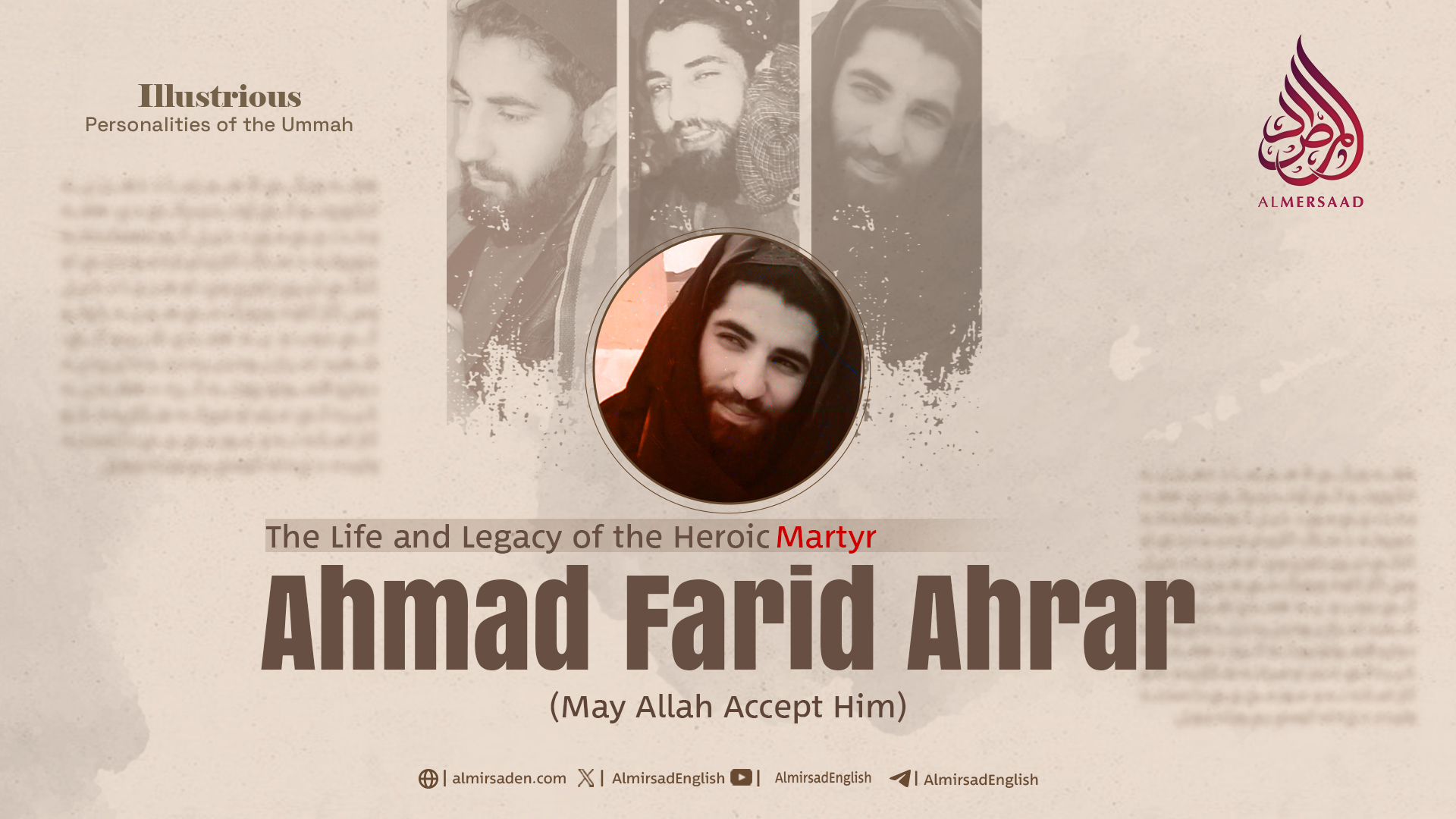
A shining star of courage, honor, and steadfastness. A man of strong faith, firm resolve, and high ambition. A sincere mujahid on the path of truth and a man of quiet character. The blessed martyr Ahmad Farid Ahrar, may Allah accept him, son of Martyr Muhammad Naib, was a resident of Bamba’i village in Band Chak district of Maidan Wardak province. He was born on 15 Hamal 1377 (Solar Hijri) into a religious and honorable family.
Education
From an early age, Ahmad Farid Ahrar had a special love for learning. He began his education at the village school and successfully completed his formal studies through twelfth grade. Alongside his education, he carried a deep passion for serving his religion, homeland, and people. He was committed to the path of truth and was always concerned with preserving Islamic values.
Martyr Ahrar in the Field of Jihad
When the dark shadow of occupation had spread across the country, Ahmad Farid Ahrar was just entering his youth. Driven by faith, honor, and Islamic conviction, he joined the sacred path of jihad in 1392. He was a humble, well-mannered, brave, and compassionate mujahid who held a special place among his companions. He endured the hardships of the battlefield, the cold of the night, and the heat of the day with patience and a clear brow.
In the Words of His Brother
We were building the guesthouse of our home. We had brought heavy stones for the masonry work, and everyone was doing what they could. My brother was deep in the work alongside us. At one point Ahrar lifted a very heavy stone with both hands. Determination and courage showed on his face, but the work was not easy.
My mother saw the scene and said from the depth of her heart:
“My son, be careful. You will hurt yourself.”
Ahrar, whose eyes were fixed on a greater dream, calmly replied:
“Mother, I no longer worry about myself. But I will be careful for the sake of jihad. God forbid that I should be left behind from it.”
Those were not just words. They were the true voice of his heart. Such love, such sincerity, that a man forgets himself but fears missing his purpose. This is the trait of the great men of the Ummah.
His brother recalls another incident from the days when they lived in Kabul:
One morning, just before dawn, while the call to prayer was still echoing through the air, Ahrar left the house. The streets were silent and the sun had not yet risen.
Not even ten minutes had passed when a massive explosion shook the area.
The atmosphere inside the house changed instantly. Everyone became worried. Hearts raced. Everyone began asking:
“Where is Ahrar?”
A short while later, Ahrar came running back home. He had a smile on his face and was laughing loudly as though nothing had happened.
I said to him:
“There has been an explosion and you’re laughing? What’s going on?”
With confidence and a playful tone he replied:
“I blew them into pieces.”
I asked again:
“What happened? Tell me.”
He laughed and said:
“You’ll find out soon enough.”
The sun had not yet risen when I went outside. I could hear the horns of Rangers vehicles from a distance. As I got closer, people were being kept away from the area.
The Ranger vehicle in which the regime’s servants used to move around proudly was lying in pieces across the street.
Ahrar was the kind of man who never lost his smile in the face of danger and never abandoned courage even under the shadow of death.
Ahrar always spoke to his companions about patience, sincerity, and steadfastness. His love for the path of truth was so strong that every hardship of this world seemed small to him.
He left behind countless stories of courage on the battlefield. He was always present on the front lines and never knew how to retreat in times of danger.
One of his companions relates:
One night, the Americans raided the area where Ahrar and another companion named Shahid were staying. Both had already moved away from the raid zone and taken positions nearby.
American soldiers and local forces had occupied the house that was being raided. Ahrar and Shahid knew the area well.
Ahrar called his commander on the radio and said:
“Shahid and I are going to fight them.”
The commander refused permission. The situation was difficult, and he did not want them to put themselves in danger.
But Ahrar was not a man who could walk away while the enemy remained before him. He kept insisting until the commander finally gave permission.
Ahrar and Shahid launched a deadly attack on the raid force. Several American soldiers were killed.
Soon aircraft began bombing the area. The sky filled with fire, dust, and smoke. The battle continued fiercely for nearly three hours.
In the end, Shahid was martyred.
Ahrar called for help, but the skies were completely occupied by jets and drones. No one could reach him.
So Ahrar lifted the body of his martyred companion onto his own shoulders and carried him out of the battlefield by himself.
This was not simply a story of combat. It was a story of loyalty, honor, and brotherhood written in blood.
Another companion recalls:
In 1398, two checkpoints in Bamba’i village of Chak district were spending their days and nights under a severe siege. Supply routes had been cut, food and provisions were not reaching them, and the circle of the siege was tightening day by day. The surrounding areas were under mujahideen control at the time, so military vehicles from the district center did not dare move. There was no choice but to stop private vehicles, load them with food supplies, and tell the drivers firmly to take them to the posts.
When Ahrar learned of this, he gathered several loyal companions and moved toward the road.
Stepping onto that road was like putting one’s life on the line.
Ahrar stopped one of the vehicles and unloaded the supplies that were destined for the checkpoints.
Before they could leave, they were caught in a fierce ambush.
Ahrar and his companions fought back with determination and high morale. After a prolonged clash, through courage and good judgment, they came out of the combat zone unharmed and wrote their bravery into the pages of that time.
In 1395, Ahrar bought a new motorcycle.
Out of love and sincerity, he sent it to his companions in Nangarhar so it could be used in the path of jihad.
Three months later I found him sitting at home, his head bowed and his eyes full of tears.
I called out to him:
“What is wrong? Why are you crying?”
He said in a broken voice:
“The companion to whom I sent that motorcycle was riding it when a drone strike hit him and martyred him.”
His tears were not for the motorcycle. They were for the loyal friend who had begun his journey toward martyrdom on the very gift Ahrar had sent him.
Ahrar was a man of loyalty and brotherhood. He treated the grief of his companions as his own grief.
Ahrar was still very young when his father was martyred in Shirazi village of Sayedabad district in 1395.
This cast a heavy shadow over his life, for he had not yet seen the easy days of his age when life put its greatest tests before him.
On one side the responsibilities of the family fell on his shoulders: looking after the household, meeting the family’s needs, filling the place his father had left. On the other side the responsibility of jihad was with him, for he was in charge of guerrilla operations in Kabul and carried that heavy burden as well.
The tests from Allah Almighty grew heavier day by day, but Ahrar never lost patience.
Neither grief nor hardship broke him.
He carried the burden of his family like a mountain and carried the burden of jihad with sincerity and determination. Hardship did not break Ahrar. It only made him stronger.
Gradually days came when living in Kabul became difficult. The former puppet administration had its eyes on him, raids were being launched against him, and every day efforts were made to capture him. Even his home was no longer safe.
Eventually the time came for military training.
His companions sent messages urging him to come.
He sat thinking:
“If I leave, who will take care of the family? If I stay, how will I fulfill my purpose?”
In the end, he entrusted his affairs to Allah and in 1396 began his training under Ustad Ali Anas.
One companion recalls:
“When we were in training, a call came for deployment to Ghazni. Ahrar came with us. He was brave, steadfast, and never tired of hardship. During those days he was seriously wounded. The roads were difficult and the journey was hard, but despite his injuries we eventually managed to return to the training camp.”
The Fight Against Daesh Khawarij
In 1398, when forces from Wardak province were moving toward Nangarhar, Martyr Ahrar, who was also a trained and skilled mujahid in the laser section, made the decision to go.
This was not simply a journey. It was the journey of a man who already knew where his final destination lay.
Before leaving home, he walked around as if bidding farewell to every wall and every memory.
He entered the unfinished guesthouse and said:
“Don’t stop the work. Complete the guesthouse.”
Then in a low but steady voice he said:
“Don’t tell anyone at home, especially Mother, that I am going to Nangarhar. My heart tells me that I will be martyred there.”
These were not ordinary words. They were the words of a man who felt the signs of his destiny.
He set out toward Nangarhar. A week and a half later he called his dear mother. After the greetings he asked after the family, the friends, the relatives. He asked about the unfinished guesthouse. He spoke to her words of comfort and patience, the way a person does when the time for departure has come and they want to be a balm for hearts before the farewell.
That was his last conversation with his family. His last greeting. His last asking after them.
One of his companions tells the story:
Ahrar held a special place in every companion’s heart. He was a wonderful person, gentle in character, always in service of those around him. His manners, his warmth, and his sincerity were such that everyone felt he was their own.
One day we received information that Daesh militants had established a base in the Zawa area of Khogyani.
We moved there immediately and spent the night in a mosque.
The next morning, Ahrar appeared unusually happy.
He smiled and told everyone:
“Today I will be martyred.”
He wrote the names of all the companions on a wall in his beautiful handwriting and said:
“One of these names will disappear forever. That person will be martyred.”
Then he added:
“I will be the one, Insha’Allah.”
Later, the clearing of houses began.
We split into two groups.
After clearing one house and while work on the second was still underway, Ahrar said:
“I’m going into the next house.”
I called out:
“Don’t go alone. It’s dangerous. We’ll go together.”
But Ahrar had always been a man who moved toward danger rather than away from it. He did not take his companion’s words and headed toward the third house.
I was watching him when voices rose from inside. Ahrar kicked the door open with great force, broke it down, and the moment it gave way he opened fire on the enemy. Together with the bullets he cried out Takbir, his voice filling the air with cries of Allahu Akbar.
I ran toward him, but before I could reach him, he was struck.
As he fell, he shouted once more:
“Allahu Akbar!”
And then he drank from the cup of martyrdom.
The dream he had pursued for years was finally fulfilled.
Thirteen days later, his blessed body was brought back to his homeland.
He looked as fresh and beautiful as though he were merely asleep.
Villagers, friends, and relatives received him with tears in their eyes and buried him in the cemetery of his ancestors.
The earth was silent, but the heavens knew that a traveler had finally reached his destination.
May Allah accept his martyrdom and raise his rank.
Date of Martyrdom
At last, this brave mujahid and devoted traveler on the path of truth achieved his lifelong dream and attained the rank of martyrdom on 1 Mizan 1398.
Ahmad Farid Ahrar left this temporary world and returned to his Lord, but his name, sacrifice, and memory remain alive in the hearts of the people.