








By Walid Wyar
The 24th of Asad is not an ordinary day in Afghanistan’s contemporary history. It is not a day connected only to Afghanistan. The fate of the wider world, particularly that of NATO and America, is also tied to it.
Nearly twenty-five years ago, America and its military allies formed a coalition to occupy Afghanistan, even though our country was neither a threat to any other country nor connected to the 9/11 attacks. The real truth was that the Islamic Emirate of Afghanistan (IEA), which had brought an end to the spread of civil war in Afghanistan, was unacceptable to the West and the American alliance. This pure Islamic system, built on its own values, had no equal among the Islamic countries of the region or the wider world.
On the other hand, biased intelligence agencies and anti-Islam elements understood that the IEA’s commitment to Islamic values could turn it into a powerful force in Afghanistan and the region, making it much harder to contain in the future. George Bush, the U.S. president at the time and a founder of the modern-day Crusader wars, declared that you were either with us or against us; there was no third way.
Eventually, the invasion began. By bringing forward a number of Afghans living in the West and others who had been involved in the civil wars, they once again established the foundations of a republic in Afghanistan under the slogans of democracy. This republic was an exact copy of Western republican systems, built on a constitution, man-made laws and other Western values that even the West and America themselves did not fully practice.
The reality was that, following the occupation, the IEA withdrew from the cities only for a short period. After reorganizing itself, it challenged the Western-backed idea of the republic through its struggle and limited resources, and once again lit the torch of jihad and resistance in the hearts of a new generation of Afghans.
The years that followed were a critical period marked by the brutality and oppression of the Western coalition in Afghanistan. Western-based and pro-American rulers had willingly taken a position against the people and Islamic values. But there was still a hope. That hope was the armed and ideological struggle of the IEA, which was bringing the Mujahideen and ordinary people the good news of an approaching victory.
That promise was fulfilled in 2021. Throughout this struggle of material means and spiritual resolve, the White Banner of Muhammad (PBUH) continued to fly, and eventually it was raised by the hands of the Mujahideen over the towering Arg Palace.
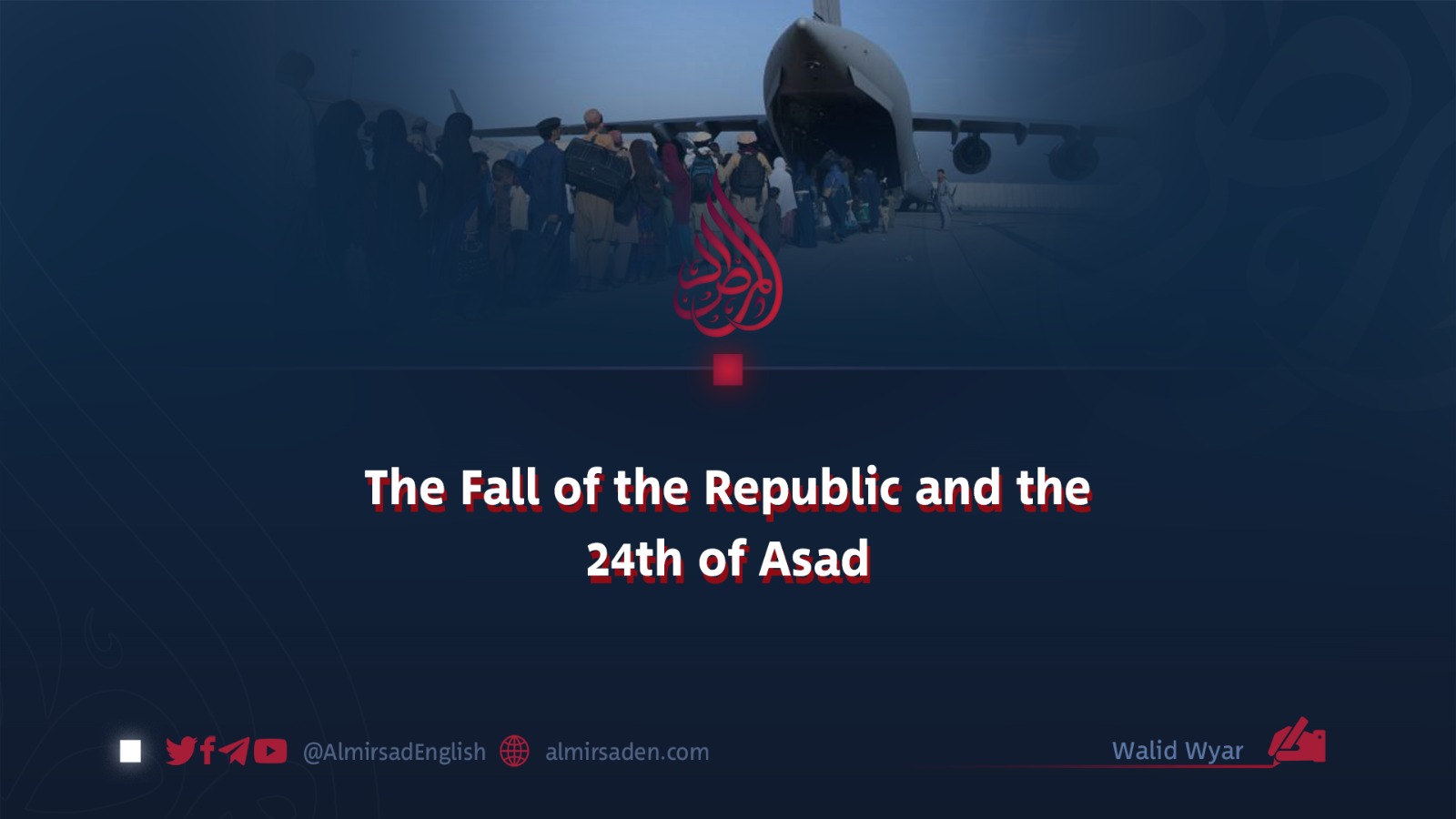
Yes, it was the 24th of Asad, that historic day when Kabul was filled with cries of Islamic victory and conquest. Freedom-loving people poured into the streets and alleys in celebration, as though it were Eid. But those who had tied their fate to their Western and American masters were heading toward the airport, running after planes and, fearing the disgrace that their past actions would bring, forgetting their Lord, their country and their people.
The republic on which billions of dollars had been spent by the West and the United States over two decades, campaigning extensively for it and imposing it on the people through a constitution and other man-made principles, and presenting it as the source of all kinds of brutality and wrongdoing, collapsed like a drawing on water. Very soon, even members of that imposed system began speaking out against it and asking the people for forgiveness.
There is no doubt that the IEA’s struggle played a fundamental role in the fall of the republic. But the pillars of that struggle rested on popular support for the IEA and its commitment to Islamic Sharia, something that had always been the lasting and historic demand of our Muslim people. In the end, that demand became a reality.
The 24th of Asad was, on the one hand, a day of historic victory and the bright destination of the caravan of thousands of sincere martyrs. On the other hand, it was also a day of safety for hardened criminals, killers and those who had betrayed the country under the cover of the republic. The IEA supreme leader and conqueror of Afghanistan, Amir al-Mu’minin, may Allah Almighty preserve him, issued a historic and unprecedented decree of general amnesty and forgiveness, the like of which the world had never seen and which no one had expected.
That decree opened the door, after the 24th of Asad, to national reconciliation among Afghans, to remaining united and to seeing themselves once again as one nation. The IEA Mujahideen, with full respect for the decree of their leader, even welcomed many people with open arms as brothers who, for two decades, had known nothing but oppression and brutality.