






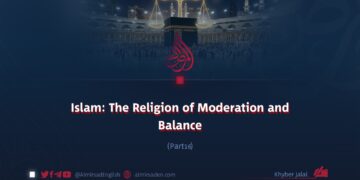












Part 16
Khyber Jalal
16. Moderation in Dealing With Opponents
One of the clearest expressions of moderation in Islam is how it deals with its opponents. From its very beginning, Islam has stood on justice, wisdom, mercy and fairness, and it asks its followers to observe these same values even when facing intellectual, religious or social opponents. For this reason, Islam accepts neither excessive violence and extremist conduct nor surrender to falsehood or turning a blind eye to the truth. Instead, it shows Muslims a balanced, wise path.
Difference of opinion and the existence of opponents are part of the divine pattern running through human life, just as Allah (SWT) says:
﴿وَلَوْ شَاءَ رَبُّكَ لَجَعَلَ النَّاسَ أُمَّةً وَاحِدَةً وَلَا يَزَالُونَ مُخْتَلِفِينَ﴾ (Hud 118)
“And if your Lord had so willed, He could surely have made mankind one Ummah [nation or community (following one religion only i.e. Islam)], but they will not cease to disagree.”
For this reason, the existence of disagreement isn’t a problem in itself. What matters is how these disagreements get handled. Islam asks Muslims to observe religious, moral and human principles when dealing with opponents, and to stay away from oppression, humiliation, insults and injustice.
The Holy Quran says this about engaging with opponents:
﴿ادْعُ إِلَىٰ سَبِيلِ رَبِّكَ بِالْحِكْمَةِ وَالْمَوْعِظَةِ الْحَسَنَةِ وَجَادِلْهُم بِالَّتِي هِيَ أَحْسَنُ﴾ (An-Nahl 125)
“Invite to the way of your Lord with wisdom and good instruction, and argue with them in a way that is best.”
This verse states one of the key principles of moderation in dealing with opponents. Islam wants preaching, dialogue and the defense of truth to rest on logic, reasoning, courtesy and wisdom, not on anger, mockery or harshness.
The Seerah of the Messenger of Allah (PBUH) is the finest example of this principle. Throughout his mission, he faced various forms of opposition, mockery, persecution and hostility, but on many occasions, he dealt with his opponents with gentleness, patience and good character. It was this same noble character that led many people to embrace Islam.
Islam has commanded Muslims to maintain justice even toward their enemies. Allah (SWT) says:
﴿وَلَا يَجْرِمَنَّكُمْ شَنَآنُ قَوْمٍ عَلَىٰ أَلَّا تَعْدِلُوا ۚ اعْدِلُوا هُوَ أَقْرَبُ لِلتَّقْوَى﴾ (Al-Ma’idah 8)
“And do not let the hatred of a people prevent you from being just. Be just; that is nearer to righteousness.”
This verse captures another core principle of Islamic ethics: many people, when they come face to face with their opponents, lose their sense of fairness. But Islam asks Muslims never to distort the truth or abandon justice, even in a state of disagreement or hostility.
However, moderation does not mean a Muslim gives up on the truth or stays silent in the face of falsehood. Islam calls Muslims to stand firm for the truth and to defend it, but this defense must be carried out through legitimate, wise and moral means.
Across different periods, one of the great harms suffered by Muslim societies has been going to extremes in dealing with opponents: scholarly and legal disagreements sometimes turned into hostility, slander, accusations, and even Takfir. This kind of conduct matches neither the spirit of Islam nor the path of the Salaf-e-Saliheen
(Pious Predecessors). The scholars and leaders of this Ummah, despite their disagreements on scholarly matters, kept their mutual respect and never let a difference of opinion turn into personal enmity.
Negligence is just as dangerous. It means treating truth and falsehood as the same thing in the name of tolerance, or staying indifferent in the face of clear deviations and mistakes. Islam accepts neither excess nor negligence. Instead, it calls the Muslim to a stance where speaking the truth goes hand in hand with good character, where standing firm on the truth goes hand in hand with wisdom, and where a clear position goes hand in hand with justice.
In an age of constant connection, where differences of opinion have become more visible than ever, observing this Islamic principle is needed more than ever. A great deal of conflict, hostility and division arises because people turn to insults, mockery and prejudice instead of dialogue and reasoning.
For this reason, moderation in dealing with opponents requires that a Muslim, while standing firm on the truth, never abandon justice, good character, wisdom and fairness. A Muslim should state the truth, but in a good way; should defend their beliefs and values without resorting to cruelty or transgression; and should deal with opponents according to the principles set out in the Holy Quran and the Prophetic Sunnah. This is exactly the approach that can lay the ground for reform, mutual understanding and the spread of truth in society.