












Haroon Tipu
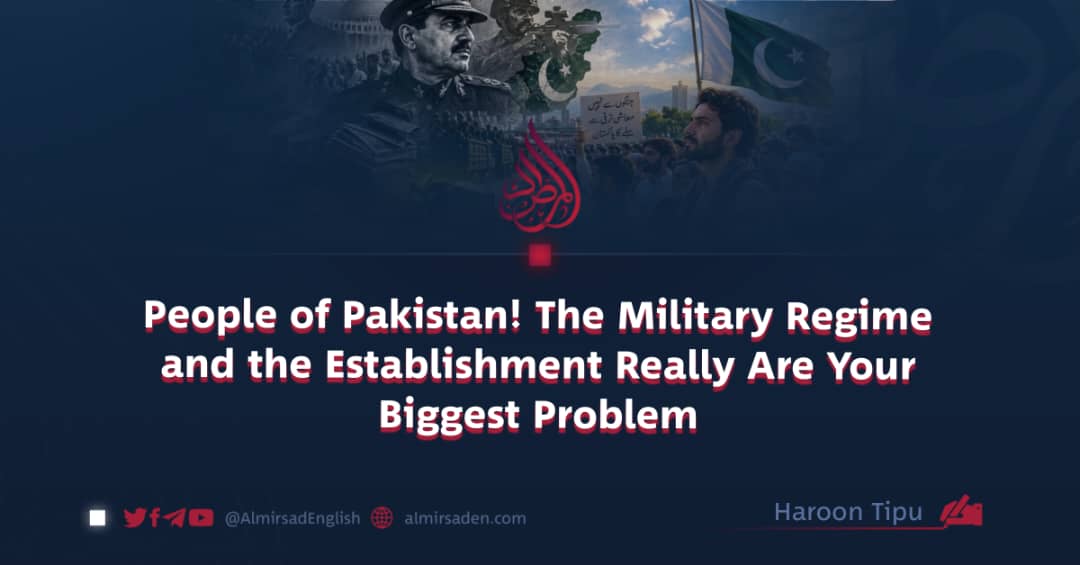
A society’s survival and its continuity depend, to a large degree, on the trust of its people and on their collective intellectual resolve. The world’s geographic map takes shape from the existence of human beings, and institutions are built to serve those same human beings. Unfortunately, in Pakistan’s history, this natural principle got deliberately turned on its head. Right after Pakistan’s founding, work began on building a narrative that, like black magic, planted an idea in people’s minds: “The state’s survival doesn’t rest on the existence of its people; it rests on the existence of the military institution.” It was a kind of intellectual hypnosis, a mental conquest, under which defending the borders was declared the sole condition for the country’s survival. But when we turn the pages of history, reality looks nothing like what the Pakistani army claims. When Pakistan appeared on the world map in August 1947, it wasn’t the result of any military victory, and no organized military force even existed at the time that could have guaranteed this newborn country’s survival.
Pakistan actually came into being through the political struggle, an unbreakable popular movement, of millions of Muslims across the subcontinent, along with the sacrifices of religious scholars. The military gradually became more organized and stronger after the partition of India. The logical and historical reality has always been this: “A country exists, so an army exists for it, not the other way around: the country doesn’t exist because of the army.”
General Zia-ul-Haq’s seizure of power in July 1977 is the biggest and clearest example of this. In his first address to the nation, under the name “Operation Fair Play,” he promised fair elections within just 90 days, after which the army would return to its barracks. That promise turned into a long mirage. Those 90 days never came. Instead, the entire following decade was spent on various tricks and tactics to drag out his rule. Whether it was the slogan of enforcing Islam or propaganda about politicians’ incompetence, it all served one purpose: protecting military rule. This rule rested not on the people’s vote, but on the power of the gun. It didn’t end through any political process either. It ended in 1988 with a plane exploding in the skies over Bahawalpur, loaded with crates of mangoes packed with explosives.
Every dictator, while seizing power, made the same claim: that he’d come to save the country and reform the system. But the reality is that every era of military dictatorship left the country weaker, politically, economically and socially. Out of this pattern grew a particular mindset inside the country, one we can call “viewing the world through the scope of a gun.”
When a military institution steps outside its defined constitutional limits and takes control of a country’s politics, economy and society, it starts viewing every single issue through the lens of security and enmity. Looked at through this “military scope,” its own citizens who demand their rights, its journalists, and its political workers stop looking like its own people and start looking like “enemies.” As a result, instead of political dialogue and mutual understanding to resolve internal problems, attempts were made to use force, which only deepened the divide already inside the country.
The most horrifying result of this policy showed up in 1971, in the fall of Dhaka. The people of East Pakistan, today’s Bangladesh, were denied their economic and political rights. When an attempt was made to crush them by force instead, even one of the world’s powerful armies couldn’t hold the country together, because it had lost the people’s trust and pushed them into deepening alienation. History proved that when people lose trust in their state and army, military force alone cannot preserve a country’s territorial integrity.
Even so, the media was put to use to silence public voices and protect the military regime. Whenever serious voices in the media, or fearless figures like Asma Jahangir, openly criticized the military leadership’s wrong policies, new narratives were cleverly crafted to shift the direction of the debate. Instead of TV debates asking “Is it right for the army to interfere in politics?” the question got reframed as “Is criticizing the army really the solution to our problems?”
The point of this sleight of hand was to present an army guilty of real mistakes as a victim and as the country’s savior. That way, the blame for every failed decision could be dumped onto political pawns and onto the people voicing legitimate criticism, while the real center of power stayed shielded from any kind of accountability.
But every narrative has a lifespan, and the magic of propaganda eventually dies in the face of reality. Over the past few years, especially with the rapid spread of information and social media, Pakistani public awareness has entered a new stage. People are no longer willing to accept the army’s old, emotional slogans, the ones used for decades to hide economic ruin and political instability.
One striking, symbolic example of this awakening public awareness showed up in the border areas of Sindh province, where people blocked the path of military trucks returning from the border after a clash with India and voiced their protest. A driver in military uniform, falling back on the old narrative, tried to remind people: “We’re coming back from fighting at the border to protect you.” The people’s answer wasn’t part of any magical narrative. It was a bitter truth spoken plainly: “The real reason behind this constant tension and these wars with neighboring countries is your own military policies!”
This scene bears witness to a real shift: the people have started telling the difference between an ordinary soldier’s personal sincerity and sense of duty on the battlefield on one hand, and the military policies crafted behind closed doors on the other. This public anger isn’t directed at any one individual; it’s directed at a mindset that always wants to keep the country a security state, instead of a state built around the welfare of its people.
Today’s Pakistani citizen has come to understand this reality: you can’t find a lasting solution to internal and external problems by looking through the scope of a gun. Countries don’t stay safe just because an army stands at their borders. They become safe and stable through the rule of the constitution, strong institutions, economic self-reliance, and giving their citizens their rights.
The old system of military mind-control, imposed through propaganda, is now close to breaking apart. It’s become clear that until every institution returns to its constitutional limits and the people are given their rights, the dream of real stability and progress will stay unfinished.