





Ehsan
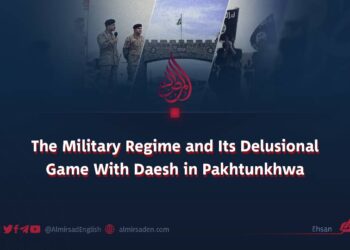
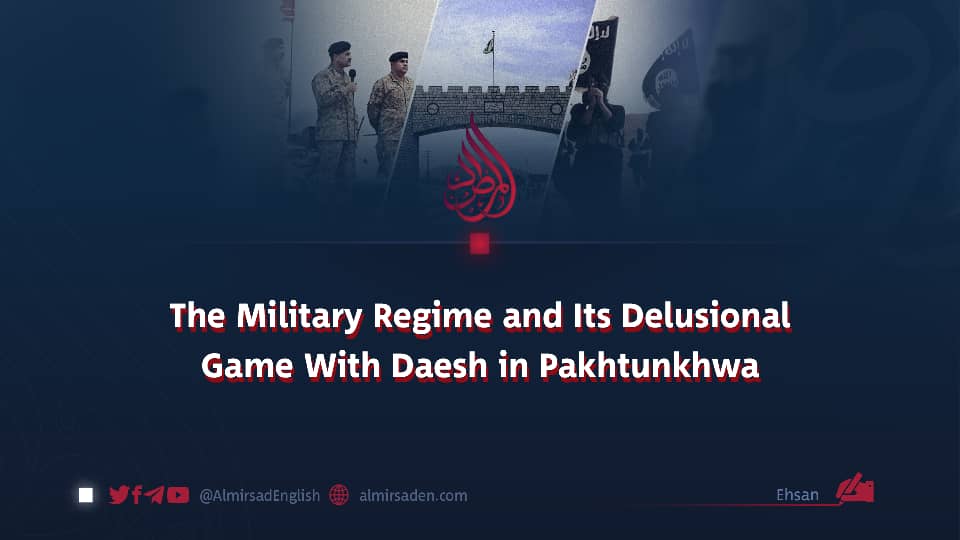
The security situation in Pakhtunkhwa has been designed in such a way that centers of Daesh are built there and its members trained, so that insecurity spreads to Afghanistan, the region and Central Asia. After suffering successive defeats at the hands of the Islamic Emirate of Afghanistan (IEA) on the political and diplomatic fronts, Pakistan’s military regime has this time opened the last chapter of its game, that is, creating and backing centers of the terrorist group Daesh in Pakistan’s Pashtun-populated areas, especially in Pakhtunkhwa and Balochistan.
This policy isn’t an ordinary miscalculation. It’s a deliberate and criminal act that is leading the military regime toward moral, human and strategic decline. The question that arises here is this: why has a regime that presents itself as a defender of regional security and makes false agreements with other countries turned to training and nurturing terrorism instead of fighting it? The answer lies hidden in this regime’s successive failures.
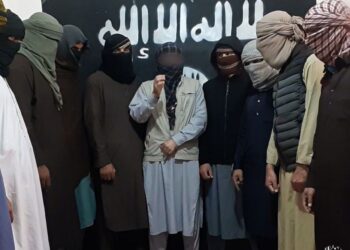
After its relations with the IEA deteriorated and it failed to impose its will on Kabul, Pakistan’s military regime has gone back to its old policy of training and nurturing terrorist proxy groups. Reports indicate that elements tied to the Pakistani army have established centers for ISIS-K in the Mastung and Khuzdar districts of Balochistan. These centers serve two purposes at once: crushing the Baloch people’s resistance and establishing a base for attacks on Afghanistan.
This is, in truth, the same policy Pakistan has used for decades against India and Afghanistan. But this time, playing with fire is more dangerous than ever, because Daesh, unlike regional groups, is a cross-border network that recognizes no borders.
In this game the military regime’s aim is clear. In recent years Pakistan has seen more than a thousand attacks on its own soil and has proved unable to prevent them. At the same time, it’s under pressure from Baloch groups that demand justice. The military regime is looking for a tool that will both increase pressure on the IEA and crush the Baloch resistance. ISIS-K, which lost its room to operate in Afghanistan after the IEA’s tough operations, seems a suitable tool for this purpose.
But this is a great mistake, because Daesh has never been a controllable tool and never will be. Daesh has claimed responsibility for bloody attacks in various countries and has taken an active part in cross-border operations. By its nature, the group acts against any system that tries to limit its activities.
An even more bitter truth is that the military regime uses Daesh to threaten Afghanistan and also to suppress the people who have been under the Pakistani regime’s oppression for years. For decades the Baloch have been victims of enforced disappearances, extrajudicial executions and torture. In recent months they’ve dealt heavy blows to the Pakistani army. The military regime, which has failed to suppress this resistance, has now deployed Daesh to fight in its place.
But this calculation, like all this regime’s earlier calculations, is headed for defeat, because Daesh is loyal neither to Pakistan nor to any other country. This takfiri group, which is backed to serve the intelligence aims of wicked countries, will in the end turn its poison on the very hand that fed it.
Pakistan’s military regime thinks it can train and nurture Daesh in Pakhtunkhwa and Balochistan and then steer it toward Afghanistan and Central Asia, without itself becoming prey to this venomous snake. This is the bear’s winter sleep, which ends in its own ruin. The Daesh members being trained in Pakhtunkhwa today will carry out bloody attacks in Peshawar and Islamabad tomorrow.
The IEA has proved several times that it stands firm against the wicked policies of Pakistan’s regime and does everything it can to protect the security of the people of Afghanistan and the region. But Pakistan’s military regime should know that this dangerous game doesn’t threaten Afghanistan alone, and its fire will sooner or later engulf Pakistan itself. A regime that turns to such wicked and loathsome means to hide its own internal crises stands condemned before Afghanistan, and before history and the conscience of humanity as well.