


















Ahmad Shafaq
Pakistan’s political and defense history has always been filled with contradictions that seem impossible to weigh on the scale of simple, ordinary logic. On one hand, such a strict standard is set for patriotism and national security that even talking about peace, trade, or shared cultural heritage with India, considered the enemy under state policy, is treated as a grave crime. But on the other hand, decisions emerge from within this same state system that openly confirm the very position of that neighboring country. This is exactly the intellectual and practical gap and contradiction that leaves informed Pakistanis facing confusion and despair time and again.
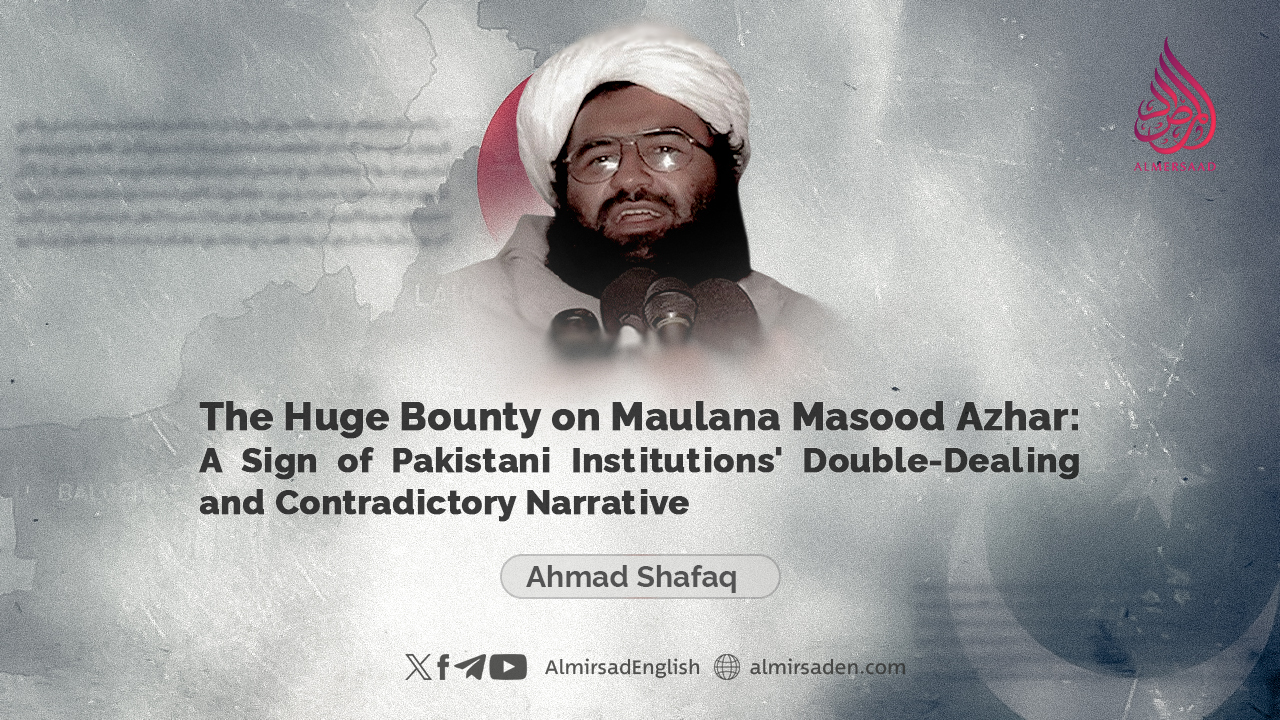
The freshest and clearest example of this contradiction is the increase in the bounty on Jaish-e-Mohammed’s chief, Maulana Masood Azhar, in the Federal Investigation Agency’s (FIA) Red Book, from five million to seven million rupees. This move isn’t just a matter of one legal document, behind it lies a whole story spanning decades, the ups and downs of state policies, and a long war of narratives.
To understand this contradiction, we need a brief, unbiased look at this organization’s past. Jaish-e-Mohammed (JeM) wasn’t some ordinary or unknown outfit to Pakistan’s security establishment. At a particular stage in history, when the state needed unconventional methods, meaning proxy groups, to protect its strategic interests, this organization played its role, in its own eyes, as a patriotic actor or a useful tool of the state.
On the Kashmir front, where India’s state oppression had reached its peak and still continues, the group fought a long and difficult armed struggle. Its members sacrificed their own heads under the narrative of protecting Pakistan’s survival and interests. Most importantly, throughout this long military campaign, Jaish-e-Mohammed never once raised arms against Pakistan’s own domestic assets, national institutions, or security forces, nor did it stage any violent protest inside the country for its demands. They always waited for the state’s signal, and their activities remained limited to objectives beyond the border.
But geopolitics, or world politics, has one bitter and merciless principle: states have no permanent friends and no permanent enemies, only permanent interests.
When international pressure from the Financial Action Task Force (FATF), the International Monetary Fund (IMF), and the United Nations increased and Pakistan’s economic survival came under threat, those very groups that had once been an important part of the security narrative suddenly became a burden. The same patriotic group was then declared illegal, its leader was officially described as a wanted fugitive, and a bounty was placed on his head.
This is exactly where the great contradiction arises that turns into a spectacle and a laughingstock for the people of Pakistan. On one hand, out of expediency, the government calls Maulana Masood Azhar, from a legal standpoint, a “highly wanted and dangerous” fugitive. But on the other hand, the objective reality is that this whole network has been active for years right in the heart of a developed, populous, well-known city like Bahawalpur.
Last year, in May 2025, when India, in the course of “Operation Sindoor,” carried out airstrikes on Jaish-e-Mohammed’s center in Bahawalpur, killing a number of people including Maulana Masood Azhar’s close relatives, the world saw that this network wasn’t hiding anywhere, it was operating from a known, specific address, and reconstruction work began there again right after.
Now the question is: if the state truly considered them highly wanted fugitives, then under whose protection were they living in Bahawalpur? This isn’t incompetence on the part of the security agencies, it’s a conscious, deliberate contradiction, one created by the state itself, a contradiction in which the state shows one face on paper to deceive the world and its own people, while in practice it follows a different policy to preserve its old tools, so it can use them again whenever the need arises in the future.
To understand this contradiction better, we can offer a logical example. Imagine that a large factory produces special chemical materials under the cover of darkness at night in order to maintain its control over the market. But when signs appear that government inspectors, the IMF, FATF, and UN, are about to raid the factory, its owner, meaning the Pakistani army, comes out himself and announces: “These chemical materials are extremely dangerous. I’m banning their production, and I’ll offer a reward to anyone who gives information about their manufacturers.”
Meanwhile, that very factory and its workers keep operating right under the owner’s own watch, on his own land. This is exactly the same double standard visible between the Red Book of Pakistan’s double-dealing security narrative and the centers in Bahawalpur.
On another note, the most painful side of this whole affair is the war of narratives in which the ordinary Pakistani citizen always ends up crushed.
In Pakistan, if any ordinary citizen, journalist, or scholar talks about regional peace, the welfare of the poor people of both countries, or improving relations with India on the basis of historical and civilizational ties, the security narrative’s propaganda machine immediately brands them “pro-India” or “an Indian spy.” They’re told, if you’re so eager to normalize relations with India, then leave Pakistan and go live in India.
But on the other hand, when Pakistan itself raises the bounty on Maulana Masood Azhar, Indian media broadcasts it widely and presents it to the whole world as its own great victory. Indian media wins this war of narratives with this very line: “Look! Pakistan itself has finally admitted that the man we’ve been calling a terrorist for years really is a terrorist, because now Pakistan has admitted it too.”
There’s no doubt that the cause of Kashmir’s Muslims, insofar as it concerns their practice of Islam, is entirely religious and jihadi in nature, and it is hoped that whichever young men have been killed in this cause will be martyrs in Allah’s sight. But what’s worth reflecting on here is that the biggest obstacle standing against the freedom of Kashmir’s Muslims appears to be Pakistan’s own army. That’s why, even though Kashmir’s jihadi activities are, in themselves, right and legitimate, they should never be carried out under the command and direction of a two-faced institution like Pakistan’s army.
Here, a fundamental, principled, and moral question arises: if even a slight resemblance to India’s position is a sign of treason for an ordinary citizen, then by what standard should the action of a state institution be judged when it places an international stamp of confirmation on India’s narrative? Is the standard for deciding whether a narrative is right or wrong only for ordinary citizens, while state institutions are exempt from it?
Because here, by promoting India’s narrative, the Pakistani army itself proves to be “pro-India,” an “Indian spy,” and “Fitna al Hindustan.” So there is neither a need for such a pro-India army in Pakistan nor any place for it to remain. Therefore, let this army go to India.
This situation leaves a major, deep lesson for the people of Pakistan, especially the younger generation. Human life is such a priceless gift of power that it’s given only once. When states, according to shifting economic and diplomatic conditions, bury their own old narratives, and sacrifice their obedient followers once the need for them has run out, the people need to understand clearly that they shouldn’t turn themselves into fuel for emotional or strategic slogans built on foundations of short-term political interest.
Especially the slogans of a state whose double-dealing in policy, interests, emotions, and relations, and whose behind-the-curtain friendship and closeness with America and India, have been exposed, clear, and proven since the very first day of the country’s founding. The true measure of patriotism isn’t found in empty slogans of traditional enmity; it’s found in the rule of law within one’s own country, economic prosperity, applying principles equally to everyone, and holding onto the idea of peaceful coexistence in the region. Until Pakistan builds this kind of principled consistency in its own domestic narrative, these contradictions will keep shaking the public’s consciousness, and Pakistan will always stand on the defensive in this war of narratives.