






















By Nauman Saeed
The survival of the Islamic Kingdom of Granada in Al-Andalus for two centuries was one of the miracles of Islam. This Islamic island, swimming in the stormy ocean of the hatred, hostility, and historical intrigues of the Crusader world, could never have sustained such a long and renowned resistance had its spirit of perseverance not sprung from Islamic faith and principles.
Without Islamic faith, this island could never have stood alone against its enemies in Al-Andalus, especially when all the other Islamic cities and fortresses had already fallen nearly two centuries earlier. The answer to this challenge lay in the very secret that enabled Granada to remain filled with Islamic thought and a magnificent civilization for almost two centuries. The people of Granada understood that they were surrounded by an enemy waiting for every opportunity to deceive and overcome them, and that assistance and victory from the wider Islamic world were unlikely to arrive. Therefore, they believed they had to rely upon their own strength and determination.
This awareness became their greatest motivation, compelling them to remain permanently prepared for every circumstance, to keep the banner of jihad raised, and to remain steadfast in their adherence to Islam. In this way, Granada remained the queen of Islamic Al-Andalus until 1492 CE (897 AH), a beacon of knowledge and the last shining torch of Islamic civilization in Europe.
However, in the years preceding the fall of Granada, a major transformation took place in the life of Al-Andalus. A powerful Christian alliance emerged in which the two largest Christian kingdoms that stood in opposition to Islam—the Kingdom of Aragon and the Kingdom of Castile—were united.
This alliance was completed through the marriage of Queen Isabella of Castile and King Ferdinand of Aragon. The dream of these two Catholic monarchs on the night of their marriage was to conquer Granada, spend their honeymoon in the Alhambra Palace, and raise the Cross upon the highest tower overlooking Granada.
On the Islamic side, however, serious divisions had emerged within the Sultanate of Granada, particularly among the ruling family itself. The remaining territory of Granada had effectively been divided into two parts. One part, centered in the capital city of Granada, was governed by Abu Abdallah Muhammad ibn Abu al-Hasan al-Nasri, the last ruler of Granada, while the other part, consisting of Wadi Ash and the surrounding regions, was ruled by his uncle, Abu Abdallah Muhammad.
In 894 AH, the Catholic monarchs launched an offensive against Wadi Ash and its surrounding territories. They succeeded in capturing Wadi Ash, Almeria, Baza, and other regions, advancing until they reached the gates of Granada itself. They then sent envoys to Abu Abdallah al-Nasri, demanding that he surrender the magnificent Alhambra Palace to them, while offering that he would be allowed to remain alive in Granada under their protection.
Like many weak rulers in the recurring cycles of history, this king too proved incapable of meeting the challenge before him, for he had made no preparations for such a day. Yet he understood that accepting this demand would mean the surrender of the last Islamic kingdom in Al-Andalus, and so he rejected it. War broke out between the Muslims and the Christians and continued for two years.
Among the Muslim defenders was a heroic warrior who kept the flames of honor, courage, and steadfastness burning in the hearts of the Mujahideen: Musa ibn Abi al-Ghassan. He was a hero who appeared like the final brilliance of the sun before its setting. Through the efforts of this warrior and his companions, Granada was able to resist the Catholic monarchs for two years and endure a harsh siege that lasted seven months.
Yet even so, the outcome of the war was ultimately apparent. Abu Abdallah was not a man who preserved the kingdom entrusted to him with the resolve and determination of a true leader. Internal disputes and divisions within Granada, set against the complete unity of the Christian front, effectively provided the enemy with an opportunity. Likewise, the long-standing historical deviations, ethnic rivalries, and the unprincipled and illegitimate conflicts and disputes inherited from previously fallen Islamic kingdoms all contributed to the extinguishing of the last candle of Islam in Al-Andalus.
When Abu Abdallah, the last king of Granada, boarded a vessel and departed from Islamic Granada, bidding farewell to a land that had breathed under the banner of Islam in Europe for eight centuries, he wept over the kingdom he had lost. In that painful and tragic moment, he heard the historic words of his mother:
“Now weep like a woman for a kingdom that you failed to defend like a man.”
The truth is that, through this single statement, his mother was not merely rebuking her son; she was also condemning many rulers of the Islamic world who wept like women over kingdoms that they had failed to defend like men.
The story of the fall of beautiful Islamic Granada is not merely a dark page in history; rather, it is a living lesson for the Muslim Ummah, a painful warning, and an alarm bell for future generations. Granada did not fall when the enemy became strong; it fell when the Muslims became weak, when they were divided by internal disputes, when personal interests replaced the interests of the Ummah, and when every faction became preoccupied solely with preserving its own power, influence, and position.
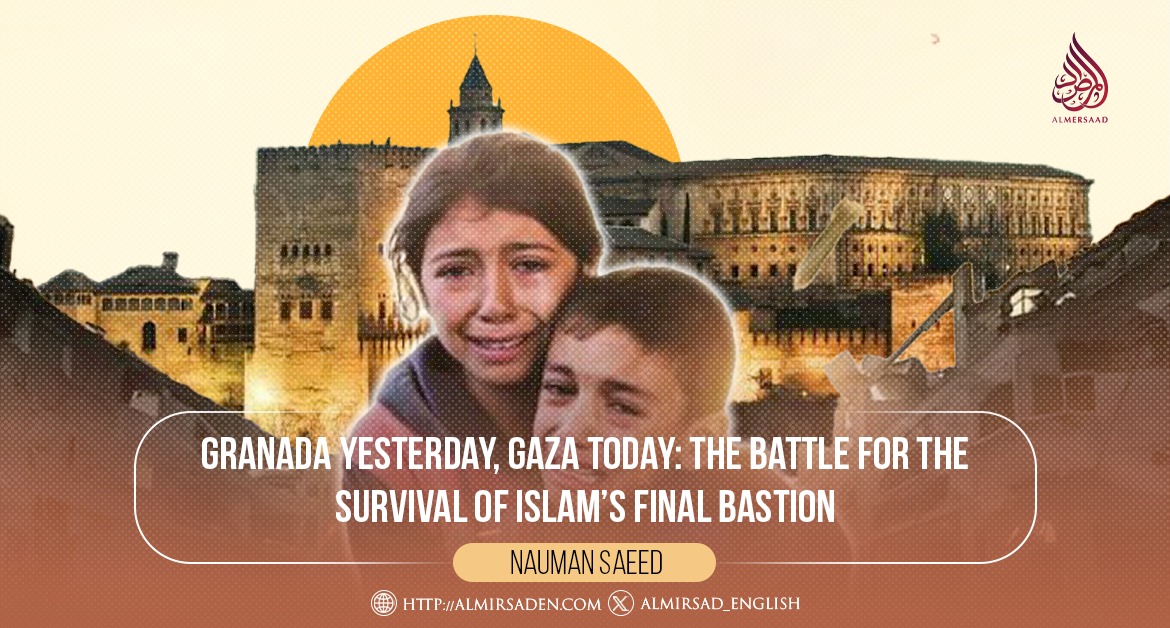
Today, when one looks at Gaza and sees the siege, the hunger, the bombardment, the cries of children, the tears of mothers, and the silence of the Ummah, the final days of Granada come vividly to mind. The same condition, the same pain, and the same repetition of history. There too, Muslims were abandoned, and today Gaza stands between the oppression of the world, the unity of its enemies, and the powerlessness of the Ummah.
The people of Granada understood that there was no powerful force standing behind them; therefore, they relied upon their faith, jihad, sacrifice, and steadfastness. Gaza today stands with the same spirit. The children who memorize the Qur’an beneath the shadow of bombs, the mothers who proudly bid farewell to their martyred sons, and the Mujahideen who continue to resist despite facing some of the world’s most advanced weapons are all signs that this Islamic faith remains alive.
Yet history also teaches that the sacrifices of a few heroes alone cannot save an Ummah unless the Ummah as a whole awakens. Granada fell because of internal divisions, ethnic rivalries, struggles for power, and weak leadership. Likewise, if the Ummah today remains divided by language, ethnicity, politics, and factional loyalties, then the suffering of Gaza will not remain confined within Gaza’s walls alone; rather, that fire will eventually reach the doorstep of the entire Ummah.
Today, Gaza is a mirror for the Ummah. Everyone should look into it and see their own condition. Those who do not stand with the oppressed, those who regard the suffering of the Ummah as nothing more than news headlines, and those who have become accustomed to the shedding of Muslim blood should remember the final scene of Granada: the day when the last king wept over his lost kingdom, yet his tears no longer held any value.
The Ummah must understand that history is not meant merely to be read; it is meant to be learned from. If we fail to draw lessons from the fall of Granada, if we are not awakened by the resilience of Gaza, and if we do not set aside our divisions in the face of the unity of our enemies, then future generations may repeat the very same words about us:
“Now weep for the Ummah as women weep for that which you failed to defend as men.”