










By Salamat Ali Khan
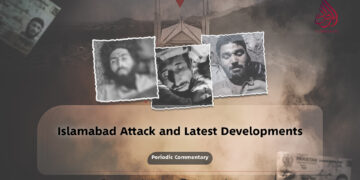
Last Friday, in the middle of Friday congregational prayers, a horrifying attack unfolded inside a Shia imambargah in Islamabad’s suburban Tarlai Kalan area, leaving many worshippers dead or wounded. The violence erupted just after the first rakʿah had ended and as the second was beginning.
In the days since, no eyewitness testimony has been released. Instead, only official statements have been presented. Unofficial accounts, however, tell a different story. Residents and prominent social media figures report that several armed men stormed the prayer hall, opening fire on defenseless worshippers, killing dozens and wounding scores more.
Others describe hearing gunshots followed by a powerful blast, though even they concede they cannot say with certainty what caused the explosion. From the start, government officials insisted the incident was the work of a suicide bomber who detonated himself among the congregation. Soon afterward, the Daeshi Khawarij echoed that claim, naming one of their members as the attacker.
The attack drew condemnation from across the region and beyond. Among the strongest responses came from the Islamic Emirate of Afghanistan (IEA), which denounced the violence in blunt terms and publicly expressed sympathy for the victims and their families.
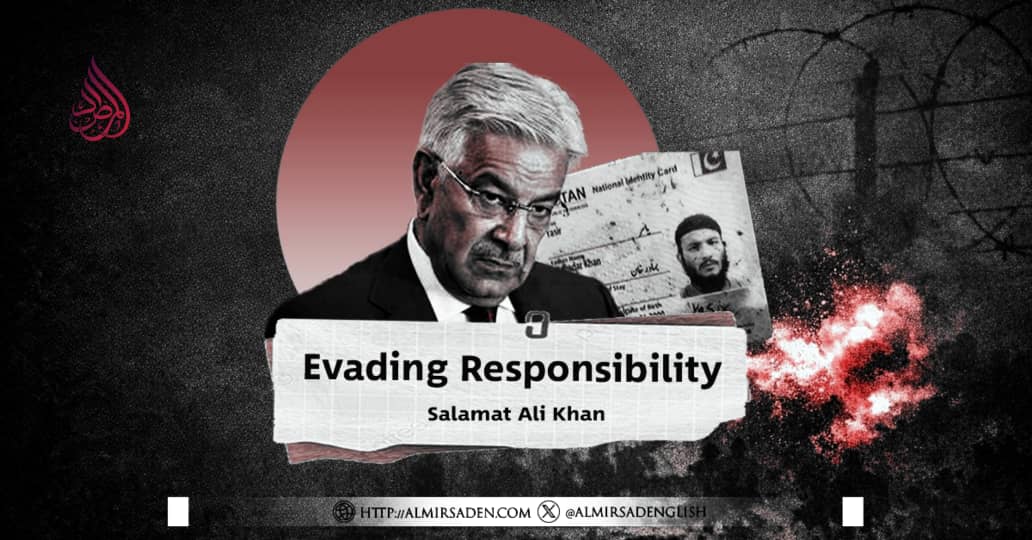
Yet Pakistan’s ruling circles did not respond by welcoming those expressions of solidarity. Instead, they reverted to familiar habits, assigning blame before presenting evidence. Senior officials, including the defense minister, spoke in strikingly blunt language, claiming that the attack was linked to Afghanistan and had been planned there. He even suggested the bomber himself was Afghan. That allegation soon ran into trouble. Pakistan’s own interior ministry later said the attacker was not Afghan at all, but Pakistani. Even so, other officials and so-called clerics aligned with the authorities continued to press the Afghanistan narrative.
Fueling the controversy was a national identity card said to belong to the attacker, which began circulating widely across television screens and social media feeds. What immediately caught public attention was its condition. The card appeared largely intact, except for one badly damaged section. In precisely that spot, observers noted what looked like a small metallic component resembling a SIM card, the part that would normally contain stored data.
Now the questions are: Why would someone preparing to carry out such an operation bring an identity card to the scene in the first place? And even if he did, how could the card survive an explosion powerful enough to kill and maim so many people, while the portion holding sensitive information was the only part destroyed?
Does this not raise the possibility that the card did not belong to the attacker at all and was displayed merely to mislead the nation? Or, alternatively, that it did belong to him but that he had been prepared for the operation by ruling circles, with the data-bearing component damaged so that all secrets between the attacker and the real networks behind the attack remain safely hidden?
Political commentators say the government’s conflicting statements, questionable decisions, and rush to assign blame without even a preliminary investigation point to something deeper than confusion.They see it as an attempt to evade responsibility. That, they argue, is why the defense minister offers one narrative while the interior minister offers another. Most officials, including the Defence Minister, point the finger at Afghanistan, while respected and well-informed politicians in Pakistan openly ask: If terrorists truly cross over from Afghanistan, to what extent have you, as the Defence Minister, fulfilled your responsibilities?
Between Islamabad and the Durand Line lie hundreds of kilometers lined with checkpoints, intelligence agencies, and security posts of every kind. How, then, does an attacker pass through this maze with weapons and equipment intact, reach his target, and carry out his assault? Some politicians have even sarcastically remarked that even the chief minister of a major province such as Khyber Pakhtunkhwa struggles to secure a simple meeting with his own party leader, Imran Khan, yet a bomber is said to move with ease, strike his target and succeed in his mission. How can authorities cast blame elsewhere while claiming innocence themselves?
Analysts extend the argument beyond this single incident. They contend that years of failed and oppressive policies toward Pakistan’s own citizens have eroded public trust and exposed weaknesses in both governance and intelligence. Only days before the Islamabad attack, Baloch separatists carried out coordinated assaults in a dozen cities across Balochistan and briefly seized control of the provincial capital, Quetta. In response, authorities then seized on the mosque attack as a convenient way to redirect scrutiny toward Afghanistan and other countries, while drawing attention away from their failure in Balochistan.
Critics also point to political upheavals from two years earlier, when, they say, the public’s electoral mandate was overturned. People had voted overwhelmingly for Imran Khan and his party, but they imprisoned him and installed the current failed administration in his place. Imran Khan was the people’s representative and worked for their rights, something that conflicted with the interests of the powerful circle in the military.
Now, with large numbers of Pakistanis rallying in his name and February 8 declared a day of strikes and demonstrations, many anticipated that protests could grow into a sustained movement challenging the present regime. Against that backdrop, the ruling circle implemented this plan, among others, to divert the people’s attention and shift focus away from the core issue.
Some analysts go even further, asserting that the Daeshi Khawarij are being actively manipulated by Pakistani authorities, that their hideouts are facilitated by elements within the military regime, that targets are pointed out to them, and that they are used to pursue shadowy political objectives. Similar patterns have surfaced repeatedly in recent months, which is why such suspicions have gained traction in political and media circles alike.