









By Ahmad Shafaq
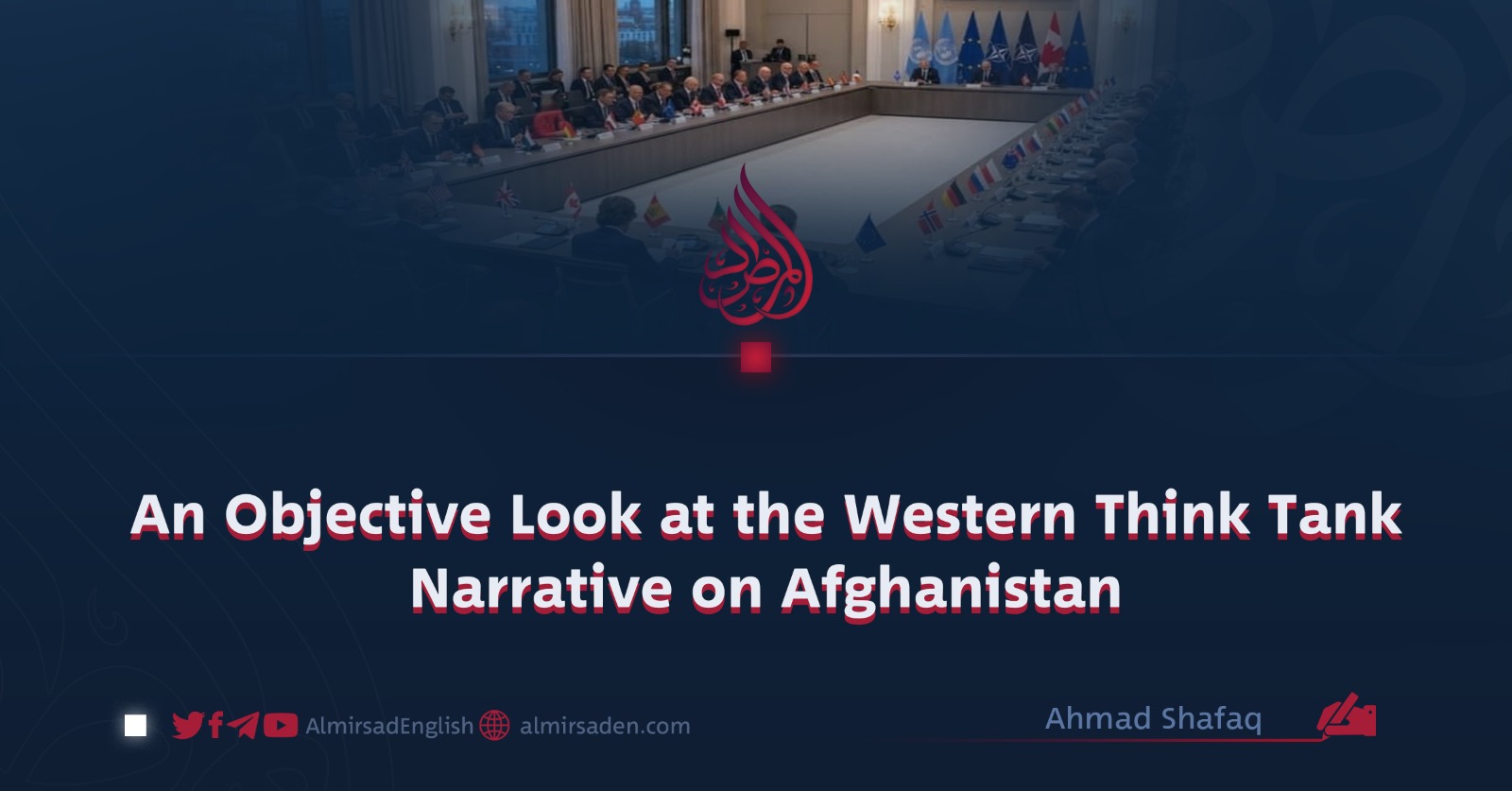
Think tanks play a central role in shaping every country’s foreign policy and international outlook. When it comes to Afghanistan, the narrative produced by Western think tanks does more than influence global opinion. It also shapes major decisions, from sanctions and diplomatic isolation to the flow of international aid. In recent years, however, serious doubts have emerged not only about the way these institutions approach security issues and terrorism, but also about their methods of analysis, their reluctance to acknowledge realities on the ground, and the damaging consequences of the policies they recommend.
A close reading of their reports reveals that the first, and perhaps the biggest, contradiction lies in the way they conduct research and the sources they rely on. Since the political change in Kabul and the withdrawal of Western diplomats from Afghanistan, these institutions have lost most of their ability to gather information directly from inside the country. To fill this “information black hole,” many of them have adopted an approach that appears one-sided and driven by bias.
Most of their reports rely on the statements of Afghan politicians living abroad, former officials of the previous republic, or refugees whose political interests are tied to the collapse of the current system. Alongside this, they rely heavily on satellite imagery and social media monitoring.
Such tools can provide useful information to a point. But they cannot capture the deeper realities of a society, the public mood, or the flexibility of day-to-day governance. Any credible research requires hearing all sides. Yet in the Western narrative, both the current authorities in Kabul and the voices of ordinary Afghans are largely absent. As a result, these reports become less about objective analysis and more about advancing a particular political agenda, one aimed at giving moral and legal cover to Western policies that remain detached from realities inside Afghanistan. Another major contradiction is that Western analysts continue to judge Afghanistan through the standards of liberal Western governance and modern democracy. They fail to understand that Afghanistan is a country whose internal structure has long rested on tribal systems, traditional councils, and deeply rooted religious principles.
Even after the failure of a twenty-year effort to impose the Western model, the same thinking still dominates the work of these institutions. They continue to view the present government in Kabul only as an “authoritarian” or “conservative” system, while refusing to acknowledge that it has social roots of its own. The result is that positive developments taking place on the ground rarely find their way into their reports.
After decades of civil war, the country now has a strong central government. As a result, domestic security has improved considerably, and travel and trade are far safer than they were in the past. The widespread corruption that drained international aid under the previous government has also come to an end.
The ban on poppy cultivation and narcotics, something the international community had demanded for years, was enforced by the current government within a remarkably short period. Even the UN has acknowledged this in its own reports. Yet Western think tanks continue to focus almost entirely on issues that reinforce their negative narrative. The result is a serious gap in their analysis. The influence of these institutions does not stop with academic debate. Their reports shape policy in Washington, London, and Brussels.
When they repeatedly portray Afghanistan as a place consumed by human rights abuses and governed by a “failed state,” they provide Western policymakers with the political justification to keep billions of dollars belonging to Afghanistan’s central bank frozen and to maintain sweeping economic sanctions.
Their recommendations rarely revolve around constructive engagement or finding diplomatic solutions. Instead, they almost always call for deeper isolation and greater pressure.
The tragedy is that the burden of sanctions and economic isolation is carried not by those in power, but by ordinary Afghans, the very people in whose name these institutions claim to oppose the Afghan government. Western think tanks speak constantly about human rights, yet the policies they advocate have deprived millions of Afghans of their most basic economic and humanitarian rights. This contradiction makes it clear that the real goal of these institutions is not the welfare of the Afghan people, but the protection of their own political interests. For these reasons, the current Western think tank narrative on Afghanistan remains detached from realities on the ground, shaped by ideological bias, and harmful to ordinary people.
At a time when countries across the region, including China, Russia, and Afghanistan’s neighbors, are building practical ties with the Afghan authorities in trade, security, and economic cooperation, the West continues to cling to the same old one-sided narrative. If the international community is truly interested in lasting peace, stability, and the well-being of the Afghan people, it must move beyond this narrow, one-sided view. It must acknowledge the realities inside Afghanistan with an open mind and choose constructive dialogue over continued confrontation.