













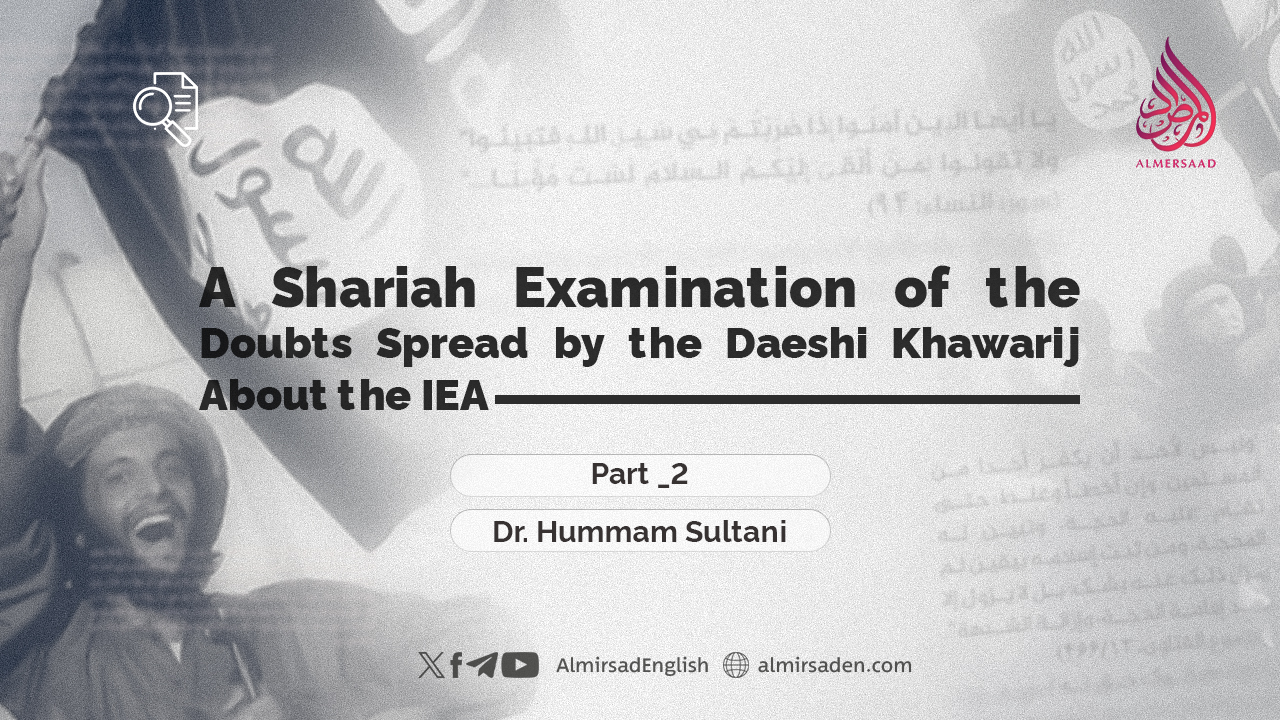
Part 2
Dr. Hummam Sultani
When it’s established from the Sunnah of the Messenger of Allah (PBUH) that a non-Muslim’s kindness can be acknowledged and his positive conduct can be praised, then on what grounds could a Muslim praising or thanking a disbeliever for some help, good treatment, or praiseworthy stance be called disbelief?
The truth is, those who make this claim don’t just declare Muslims disbelievers over sins, the way the Khawarij do, they go even further than that, treating things whose legitimacy is established by the Messenger of Allah’s (PBUH) own blessed Sunnah as causes of disbelief too. This kind of thinking is a clear sign of extremism, intellectual imbalance, and departure from the sharia texts.
In fact, if a Muslim describes a disbeliever’s good habit, fine character, or praiseworthy trait, even if that disbeliever has never done him any kindness at all, there’s still no problem in this from a sharia standpoint. Likewise, if a Muslim treats a disbeliever’s family well because of that person’s good name, fine character, or nobility, that too is permitted. A clear example of this is the good treatment shown by the Messenger of Allah (PBUH) toward Safana Bint e Hatim al-Ta’i.
For this reason, acknowledging some good quality in a disbeliever, thanking him for some kindness, or praising some positive conduct of his cannot be a cause of disbelief. Treating such matters as causes of disbelief is, in truth, the mindset of extremists who know neither the reality of the religion nor its principles and standards.
Of course, if a Muslim praises a disbeliever out of flattery, worldly gain, or some improper aim, in a way the disbeliever doesn’t actually deserve, that’s certainly a forbidden and invalid act, but that alone doesn’t make that person a disbeliever either. But if he praises the disbeliever’s disbelief itself, calls his shirk correct and acceptable, praises his aggression against Muslims, or helps him against Muslims through word, deed, or practical cooperation, these are matters that, by their very nature, can be a cause of disbelief.
For this reason, whoever seeks the truth needs to guard against mixing up these matters in such sensitive questions, and avoid falling prey to the false understandings and doubts spread by the Daeshi Khawarij and other extremist groups.
As for relations, mutual economic cooperation, trade ties, political dealings, diplomatic visits, and in some cases alliances with disbelieving countries and individuals, if the purpose behind them is protecting the Islamic state’s interests, safeguarding Muslims’ welfare, or lifting sanctions and blockades imposed on them, and all of this is carried out within the limits and principles set by sharia, then this falls among the permitted parts of Islamic siyasah shar’iyyah.
The blessed Seerah of the Messenger of Allah (PBUH) offers the best guidance on this point. The Messenger of Allah (PBUH) engaged with non-Muslims in various ways. He welcomed their delegations, whether they later became Muslim or not, made treaties with many tribes and groups, formed temporary alliances with some, bought and sold with them, and he passed away while his (iron) armor was mortgaged to a Jew.
All these facts undercut the very foundation the extremist groups’ doubts stand on, and expose the truth behind their baseless claims. That’s why Muslims need to study the blessed life of the Messenger of Allah (PBUH) deeply, and turn to reliable scholarly books that lay out, in detail, the sharia rulings on relations and dealings with disbelieving states and individuals. This same path can clear the darkness of doubt from the hearts of those who’ve fallen under the influence of extremist propaganda.
Keep this in mind!
The greatest ignorance is trying to put out a burning lamp in the middle of darkness like this, when it’s well known that if this lamp goes out, darkness will spread in every direction, to the point that a person won’t even be able to see his own hand in front of his eyes.
Now think about it for a moment. If that light isn’t just an ordinary lamp, but a great light, one that, even if a few signs of weakness and imperfection still remain in it, still stands right at the threshold of the true dawn breaking, and the very people who hold that light are working, with complete honesty and sincerity, to remove those remaining imperfections, then trying to put out such a light isn’t just against reason and wisdom, it’s a grave mistake whose damage the whole of society bears together.
The truth is, only those who love darkness are enemies of light, who hate the appearance of any good and virtue, oppose every reform effort, and go so far into extremism that they use the light’s very few imperfections as an excuse to want to put the whole lamp out. Whereas what reason, fairness, and wisdom actually call for is keeping the light alive, fixing its imperfections, and making it even stronger and brighter, not imposing the rule of darkness back over society once again.
Second Doubt: The Accusation of Permitting and Protecting Shirk-Based Practices
Before issuing a sharia ruling about a Muslim individual or government, it’s necessary to investigate the matters connected to them and examine their conduct within the correct framework. Issuing a ruling of takfir based only on accusations, incomplete information, or assigning one meaning to different matters doesn’t fit with scholarly honesty or sharia caution. Visiting graves and asking help from the dead, visiting historical sites, and worshipping idols are different things, just as protecting a person’s rights and endorsing his beliefs are different things. If these distinctions are ignored, instead of clarifying the truth of matters, even more wrong assumptions get created.
In our country, the Daeshi Khawarij mix up these different matters when criticizing the Islamic Emirate’s conduct, and then draw takfir conclusions from that same mixture. That’s why it’s necessary to examine the different sides of this doubt separately, so the difference between a claim and the truth, and between an action and the sharia ruling drawn from it, becomes clear.
The Daeshi Khawarij, who make takfir of the Islamic Emirate, make this accusation: “The IEA permits shirk-based practices tied to graves, asking help from the dead, and visiting the statues of Buddha. It also protects the Shia’s shirk-based beliefs and practices, and doesn’t stop them from insulting the Sahabah and the Mothers of the Believers, may Allah be pleased with them all.”
Several different matters have been mixed together in this accusation. Ruling on each matter without understanding its reality and nature isn’t correct.
Visiting Graves and Praying for the Dead:
Regarding shirk-based practices tied to graves and asking help from the dead, it should be said that permitting such practices isn’t the IEA’s policy in our country. Of course, there are graves and shrines of famous historical military commanders in the country, like Mahmud Ghaznavi (rh). There are also graves of certain martyrs and movement leaders that some IEA officials visit, praying for those buried there. Here it’s necessary to understand a fundamental distinction: visiting a grave and praying to Allah (SWT) for the Muslim buried there is one thing, but asking the dead person for one’s needs and calling on him for help is another. Treating these two as the same is not correct.
The Messenger of Allah (PBUH) himself would visit Jannatul Baqi and pray there for the Muslims buried there. The Messenger of Allah (PBUH) said:
«قَدْ كُنْتُ نَهَيْتُكُمْ عَنْ زِيَارَةِ الْقُبُورِ، فَقَدْ أُذِنَ لِمُحَمَّدٍ فِي زِيَارَةِ قَبْرِ أُمِّهِ، فَزُورُوهَا فَإِنَّهَا تُذَكِّرُ الْآخِرَةَ.»
“I had prohibited you from visiting the graves. But Muhammad was permitted to visit the grave of his mother: so visit them, for they will remind you of the Hereafter.” (Sunan al-Tirmidhi: 1054)
Likewise, the Messenger of Allah (PBUH) conveyed this message from Jibrīl:
«إِنَّ رَبَّكَ يَأْمُرُكَ أَنْ تَأْتِيَ أَهْلَ الْبَقِيعِ فَتَسْتَغْفِرَ لَهُم».
“Indeed your Lord commands you to go to the people of al-Baqi and seek forgiveness for them.” (Sahih Muslim, Hadith: 974)
For this reason, simply visiting a grave and praying for the person buried there cannot be called shirk. If a specific sharia violation is claimed to be happening in some particular place, that claim needs to be discussed with proof and detail; the mere act of visiting can’t be treated as evidence of it on its own.