



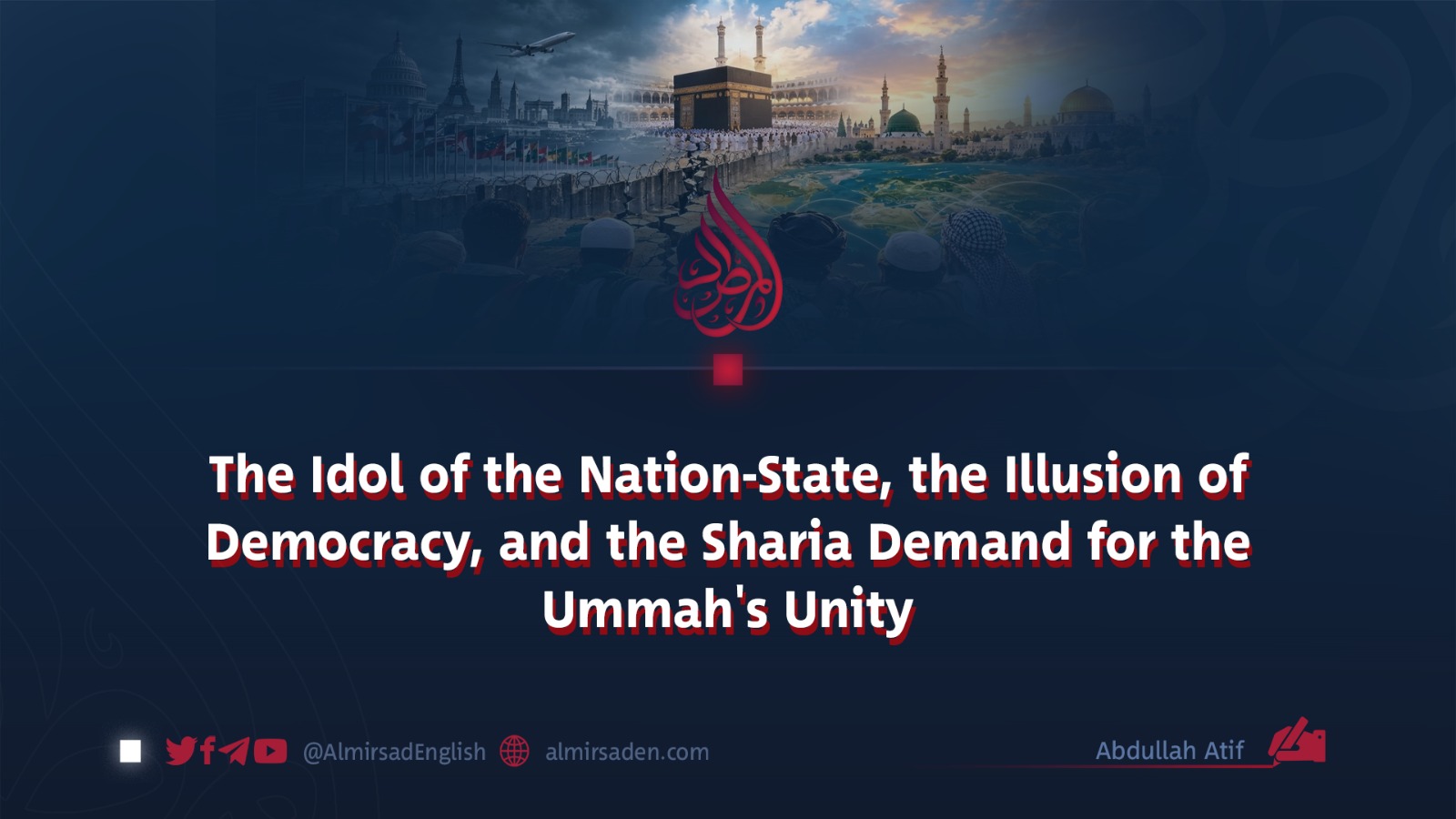
Abdullah Atif
Islam has declared Muslims to be one ummah, one single body. The Quran says:
﴿إِنَّمَا الْمُؤْمِنُونَ إِخْوَةٌ﴾
“Indeed, the believers are brothers.”
And in hadith it’s said:
المسلمون كرجل واحد
“Muslims are like one man.”
On this very foundation, the scholars of Islam established this principle: if Muslims anywhere on the face of the earth are being oppressed and stand alone against an enemy, then helping them first becomes an individual obligation on the Muslims nearest to them. If that isn’t enough, this obligation keeps spreading outward from the nearest to the farthest, until it becomes an obligation on every capable Muslim from east to west.
This very chain of jurisprudence is itself proof that, in Islam’s view, there’s no concept of permanent, sacred borders between Muslims that would stop one Muslim from helping another. If a border becomes an obstacle to help and support, it isn’t a sharia border but a political one. The borders we see today are the result of colonial-era divisions. Lines were drawn between people who shared one nation, one language and one religion, and a flag, a national anthem and a passport were imposed on each resulting piece.
Look at Europe: they fought wars among themselves for centuries, but once they realized these borders and passports were holding them back, they signed the Schengen Agreement and removed border controls between them. Today, a German citizen can travel to France, and a French citizen can travel to Italy, without a passport or visa. They can work there and run businesses.
Now look at America: its fifty states, each one equal to one of our own countries, have no border between them. Nobody asks for a visa to go from California to Texas. Even the disbelievers themselves have come to understand this: if you want to move a nation forward, if you want to build mutual compassion, sacrifice and brotherhood among people, you have to tear these walls down. They tore down their borders for their own worldly progress. So why don’t we Muslims understand, for the sake of our own religion, the very thing the disbelievers already understood for the sake of their own world?
We’re witnessing all these harms because of democracy, since democracy itself is built on the concept of the nation-state, which means the Muslims of each state are bound only to the interests of their own state. This mindset hasn’t just influenced ordinary people; it’s influenced the scholars too, and the result is that many fatwas now get issued on the assumption that “Pakistan’s Muslims should help Pakistan, Turkey’s Muslims should help Turkey,” and so on.
Looking at today’s official fatwas, it seems as though each country’s Muslims have their own separate set of sharia rulings, one for Afghanistan’s Muslims, another for Pakistan’s Muslims, and so on, even though it’s as clear as broad daylight that the real source of Islamic fiqh is the caliphate, not democracy. What’s strange is that today there are scholars, even senior ones, who’ve devoted themselves to this very democracy, and who can be heard saying things like “we’re fighting the war to preserve democracy.”
Look: under the caliphate, sovereignty belongs to Allah, the law is sharia, and a Muslim, wherever they are, answers to that same law. The caliph isn’t the representative of one single piece of land; he’s the representative of the whole ummah. That’s why, under the caliphate, Palestine or Kashmir isn’t a matter of “foreign policy,” it’s an internal matter, the same way a fire in one room of a house stirs the whole house into action.
As long as the caliphate existed, Muslims didn’t need a visa to move around. A Muslim could travel from Andalusia to Baghdad without a single piece of paper. But this democracy broke that unity and taught us that every country is responsible only for its own visas and its own interests. The result is that today the ummah isn’t one body anymore, it’s like scattered limbs.
If there’s no caliphate today, that doesn’t mean every sharia ruling now has to hinge on democracy. No, not at all. So what’s needed is to view these sharia rulings not through the lens of democracy, but through the true principle of the caliphate.
In short:
Think about it! If the disbelievers can erase their borders and come together as one for their own worldly interests, why can’t we come together as one for our own religion? These lines exist on maps, not in our hearts. As long as we keep worshipping these artificial idols, the ummah will keep on suffering just the same. The choice is ours to make: do we want the nationalism that emerged under the Sykes-Picot Agreement, or the Islamic brotherhood that Muhammad (PBUH) introduced to us?
وَمَا عَلَيْنَا إِلَّا الْبَلَاغُ