














By Ajmal
In the fiercest days of war and occupation, when the Zionist enemy believed it had every movement in Gaza under constant surveillance, monitored by spies and warplanes, a fearless mujahid was moving at the heart of the battlefield.
The occupiers could not see him, but they felt the impact of his operations with every painful blow.
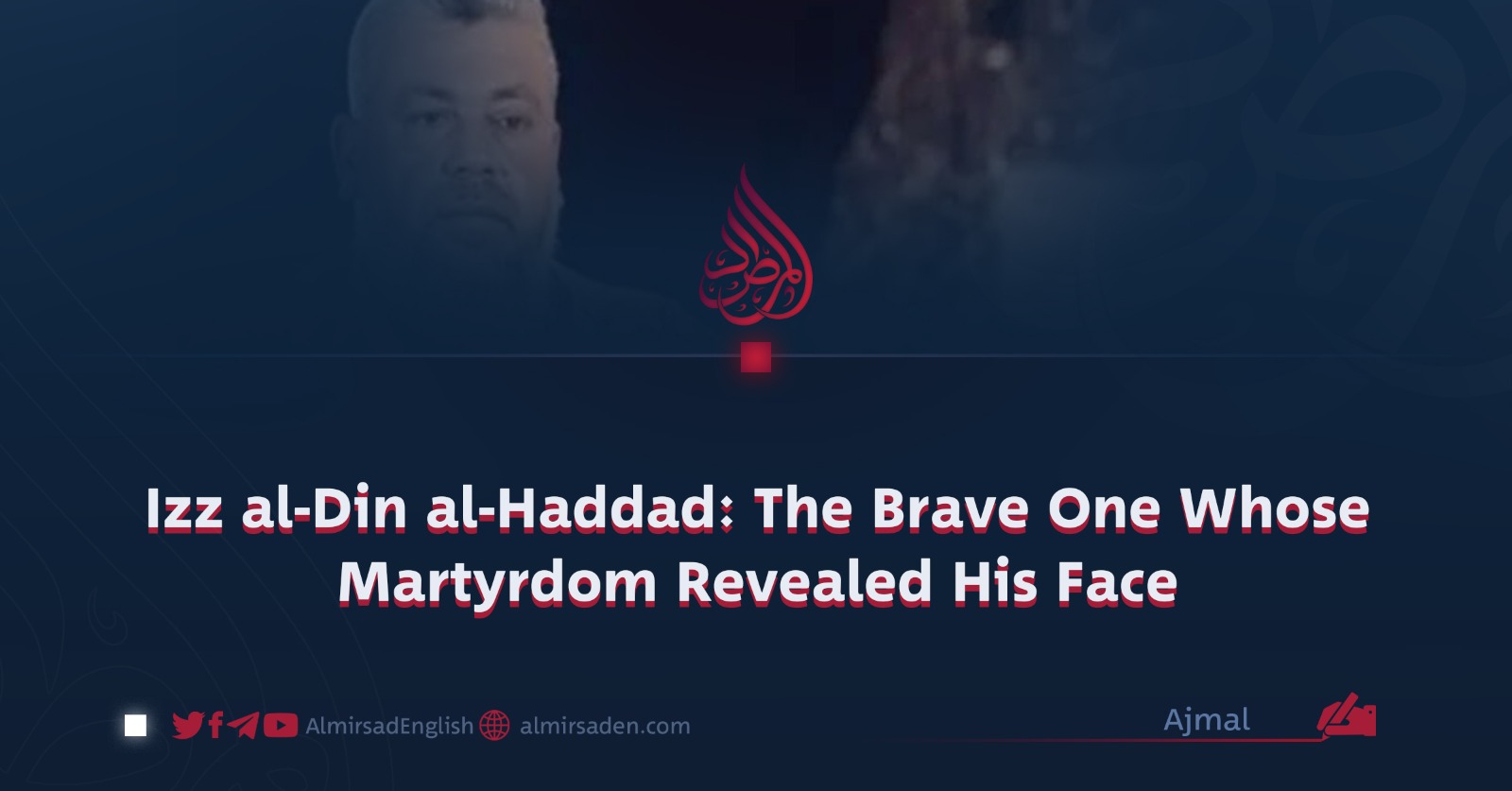
That man was Izz al-Din al-Haddad, better known as Abu Suhaib.
The enemy itself gave him the name “The Shadow of al-Qassam,” not as a mockery, but as a reluctant admission of the fear and frustration they felt before a commander who seemed impossible to track and even harder to defeat.
But on the night of Friday, May 15, that shadow rose to the heavens and returned his soul to his Creator, joining the ranks of those martyrs who never bowed to humiliation.
Born in Gaza in 1970, in one of its impoverished neighborhoods, Izz al-Din al-Haddad spent his life in quiet dedication and deliberate obscurity.
He was not a man of interviews, public appearances, or self-promotion.
His world was the battlefield.
He served as commander of the Gaza Brigade within the Izz ad-Din al-Qassam Brigades, one of the resistance’s most sensitive and strategically important military formations.
His mastery of urban warfare, underground tunnels, and complex security operations made him a persistent nightmare for the Zionist regime.
In the heart of Gaza City, his presence alone was enough to unsettle one of the most technologically advanced armies in the world.
The occupation, whose repeated violations of ceasefire agreements have become a familiar pattern, once again broke its word by launching an airstrike on Gaza City.
This was more than a tactical operation.
It was an admission of failure.
For years, the enemy had tried to kill him.
Time and again, he survived assassination attempts. Even Israeli media acknowledged that he had repeatedly slipped through their grasp.
This time, however, the bombs struck his home while he sat with his wife and daughter.
It is the habit of an enemy that cannot prevail in direct confrontation to target homes and families instead.
The name Izz al-Din al-Haddad became widely known after the launch of the “Al-Aqsa Flood” operation on October 7, 2023.
Not because he sought recognition, but because he played a decisive role in coordinating the resistance and rebuilding its command structure after the martyrdom of senior leaders.
The enemy regarded him as one of Hamas’s most capable military strategists, a man who preserved a sophisticated command network even under relentless bombardment.
Before attaining martyrdom, he had already sacrificed his two sons, Suhaib and Mu’min, on the same sacred path.
What kind of father offers the dearest parts of his own heart, one after another, for the liberation of Jerusalem?
And in the end, he followed them, attaining martyrdom alongside his wife and daughter.
To honor Hamas and the Palestinian resistance is, in truth, to honor those men and women who stand with limited means against one of the most formidable military machines on earth.
Izz al-Din al-Haddad was one of those commanders whose name may not always have dominated headlines, but whose courage is written across every front line of the resistance.
He was not a shadow.
He was a reality the enemy wished it could erase.
And with his martyrdom, no chapter has closed.
A new one has begun.
For the blood of the martyrs illuminates the road, and that road does not end until the liberation of Quds.
Tonight, the sky over Gaza holds a new star.
Its name is Izz al-Din al-Haddad.
His martyrdom, alongside his wife and daughter, once again exposed the true face of a regime that has shown neither fidelity to agreements nor respect for ceasefires.
The history of the Zionist occupation is marked by broken promises, and this latest strike was no exception.
Unable to prevail against Palestinian mujahideen on the battlefield, it continues to direct its fire toward homes, public spaces, and densely populated neighborhoods.
The killing of Izz al-Din al-Haddad and his family was not a brilliant military achievement.
It was a clear war crime and the final expression of an enemy’s helplessness before a man it could never capture alive.
What the occupiers consistently fail to understand is that the martyrdom of leaders does not weaken the resistance.
It renews it.
Izz al-Din al-Haddad has departed, but the path he paved with the blood of his two sons, and ultimately with the sacrifice of his own life and family, is today brighter and more firmly established than ever.
A new generation of Hamas mujahideen has been raised in the school of men like him, men who fought in the shadows and embraced martyrdom with honor.
Gaza mourns tonight.
But Gaza has not bowed.
The Shadow of al-Qassam has ascended to the heavens, yet his name lives on in every tunnel, every pathway, and every defensive position where the spirit of resistance still breathes.