


By Farid Afghan
Sometimes history writes its lessons so clearly and in such blood that, no matter how much a person may want to, he cannot look away. When we look at the changing political and military situation in Afghanistan on the occasion of the 24th of Asad (August 15), the mind naturally returns to a fundamental question: Why is freedom so important for a nation? And why is the political, economic and governmental rule of foreigners no less than deadly poison for any living society?
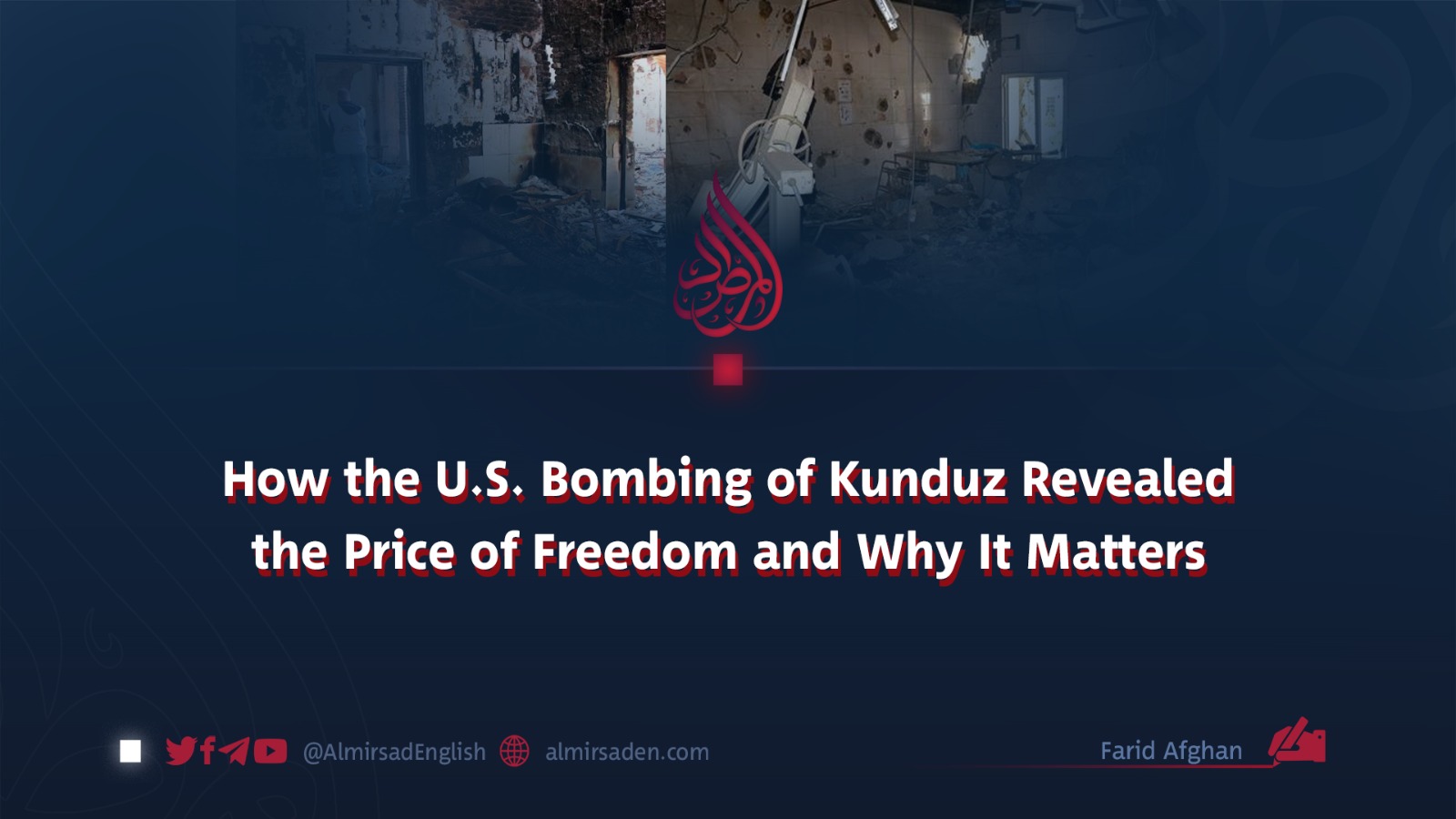
There is no need for a theoretical discussion to answer this question. It is enough to recall the bloody incident that took place in Kunduz on October 3, 2015.
On that dark night, when the whole city was gripped by fear of war, the Médecins Sans Frontières (MSF) hospital was the only refuge for innocent people. But when an American AC-130 gunship began bombing the hospital, neither the international markings on the hospital building nor all the documents and information clearly identifying every part of the building could protect it.
The bombing continued for a full hour. Patients lying unconscious in the operating rooms were burned alive and reduced to ashes, while a rain of fire fell from the sky on doctors trying to escape. Later, the killing of 47 people was simply described as a “technical error,” and the case was closed.
This painful incident was not merely an accident or a military failure. It was a clear picture of the reality that when the reins of power are in the hands of foreigners, the blood of a subjugated nation becomes cheap in their eyes. Whenever a foreign power gains economic, political or military dominance over a country, it hides its own interests behind attractive slogans of development and democracy. The greatest harm caused by such domination is that the dignity, honor and human rights of the oppressed and subjugated nation lose their value.
The Islamic view firmly rejects the idea that Muslim societies should depend on the assistance and support of non-Islamic or foreign powers in matters of their decisions, economy and system of government. The fundamental aim of the Quran and Sunnah is to free human beings from servitude and psychological slavery to others and provide them with the means to live with dignity and self-reliance. Foreign political rule takes away a Muslim nation’s right to set its own priorities, while economic domination can trap it in international markets and debt to the point where escaping that trap becomes almost impossible.
As long as a country does not have complete independence in its economic and political decisions, its religion, culture and future generations can never be fully protected. The 24th of Asad is not merely the day of America’s defeat and military withdrawal. It is also the day of victory for the idea that freedom has no substitute. It teaches us that the apparent calm achieved under the shadow of foreign forces is only a temporary mirage, one that ultimately ends in tragedies like Kunduz.
The goal of true freedom is not merely to drive out foreign forces. It is to stand on one’s own feet and build a strong, just and self-reliant system that leaves no foreign power with the courage to interfere again. Nations can never progress by living at the mercy of others. Their survival and dignity lie only in their freedom, independence, self-respect and commitment to their own principles.