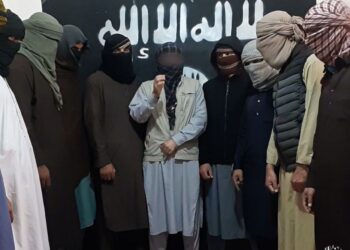


















Abu-Bilal al-Minuki was killed in an American airstrike in Nigeria in May of this year. He was in charge of the IS’s General Directorate of Provinces (GDP) and was in direct contact with the Al-Siddiq Office, whose areas of activity include East, South and Central Asia. After his death, some important documents fell into the hands of intelligence services and prominent media outlets. These documents mention some sensitive subjects.
The letter was written by the head of the Al-Siddiq Office, Qari Tamim al-Kurdi (Engineer Obaidullah), to the ISIS Khawarij’s leadership council (the Delegated Committee, al-Lajna al-Mufawwada).
Given the sensitivity of the subjects mentioned in the letter, some ISIS activists tried to play the matter down and call the letter a forgery. But Al-Mirsaad has received confirmation of the letter, and of the subjects it mentions, from its sources, who have precise knowledge of ISIS-K’s internal affairs. These sources have also given Al-Mirsaad some significant information that exposes the true face of ISIS Khawarij.
First, we present the translation of the letter to readers with no additions or omissions. To help readers understand, Al-Mirsaad has written additional information in square brackets.
الحمدلله القوي المتعال، والصلاة والسلام علی الضحوک القتال، نبینا محمد وعلی آله وصحبه أسد البلاغ وفرسان النزال. أما بعد:
لجنة المفوضه
To the Delegated Committee [the equivalent body of the ISIS Khawarij’s leadership council].
How are you, and how is your health? Praise be to Allah, all the mujahideen on our side are well. Praise be to Allah, how are you? We hope you are in Allah’s care and protection. Two messages from you reached us, and in reply we say:
Convey the greetings of us and all the mujahideen of the Al-Siddiq Office to the caliph of the Muslims [the caliph of the ISIS Khawarij], may Allah (SWT) protect and look after him. Assure him on our behalf that all the mujahideen, small and great, are obedient soldiers of the Islamic State, ready for any sacrifice in the way of Allah (SWT) and for the exaltation of the kalima.
We haven’t made any progress toward a ceasefire in Pakistan and Iran, and we’re waiting to see whether they will answer our demands about the release of some brothers [ISIS prisoners]. We are now preparing to strike certain targets in Iran and Pakistan, so that they get ready for a ceasefire. With Allah’s help, we’re trying to shed their soldiers’ blood, as in the Kerman operation.
We’ve spoken with the brothers [ISIS members] in the Philippines and Indonesia, and the messages exchanged with them are in the attached video, so please watch it. If you think it suitable to send them any message, opinion or advice on our behalf, we’ll send it to them. We sent five thousand dollars to the Philippines and will send some to Indonesia too. We’ve strongly encouraged them to engage in economic work [financial support] and will see what they do, but they’ve agreed with us on economic work. In terms of advice, planning and money, whatever is within our means, God willing we’ll send it to them so they take up economic work.
As for the prisoner who is in the mujahideen’s hands, he is an adult. We’ll see what comes of his case, and God willing we’ll share every new matter about him with you.
We received $45,000 from you; may Allah reward you with good.
As for the brothers [ISIS supporters] we have in Bangladesh, we want to test them with jihadi operations, to kill enemies and spill blood, so we can be sure whether they’re our brothers or from the enemies’ side. If they’re brothers, they kill the enemies and show them no mercy, even if at first they’re weak in courage, initiative and means. Enemies don’t kill each other; they only stage a dramatic scene with no media coverage, though every sensible person, God willing, understands this.
We’re in contact with them, and although going from Bangladesh to other countries is no problem, not one person has made hijra to our side so far, and they’ve done no military work so far. We’re giving them time to do what the Islamic State wants from them.
Al-Siddiq Office
Qari Tamim al-Kurdi
In the letter above, the ISIS Khawarij admit to carrying out certain acts that they themselves cite as grounds for declaring other jihadi groups disbelievers. Their deep distrust of the people who come to their ranks is also visible from afar. We’ll discuss this later, but first we’ll give the details of the prisoner whom Qari Tamim al-Kurdi, in writing to his leadership council, stressed was an “adult.”
Al-Mirsaad’s sources have said that the “adult” prisoner mentioned in this letter is in fact a child, around 14 years old. His name is Jafar Khan. He is originally from Spin Boldak district of Kandahar but currently lives in the Sheikh Manda area of Quetta, the main city in Pakistan’s Balochistan province.
The sources say the ISIS Khawarij kidnapped him from his area about ten months ago and, using pseudonymous Telegram accounts, demanded seventy crore (700 million) Pakistani rupees from his family. According to Al-Mirsaad’s sources, his family cannot afford the seventy crore rupees demanded by the ISIS Khawarij. To put pressure on the family, ISIS martyred the child’s father, Haji Salahuddin, after he left a sports club near their home.
According to Al-Mirsaad’s sources, a member of the ISIS group has admitted that Jafar Khan was kidnapped by ISIS, and he has asked his leaders to release the child because of his innocence and his family’s inability to pay.
Al-Mirsaad will also publish, in due course, images of the messages and other necessary documents from the user of a pseudonymous Telegram account associated with ISIS, in which he describes the kidnapping of Jafar Khan as the work of “the mujahid brothers of the caliphate.”
Apparently this kidnapping and the killing of the child’s father caused an uproar among ISIS members, to the point that the leadership council has asked for an explanation about it.
The sources say Jafar Khan is still a prisoner, and the ISIS Khawarij are still calling his family from virtual numbers on WhatsApp and Telegram and demanding money.
Al-Mirsaad’s sources add that the Sheikh Manda area of Quetta is a former ISIS center, and many ISIS corrupters from that area were killed in Nangarhar during ISIS’s period of rule. The sources add that in the last two years, the ISIS group has kidnapped five more people from that area, including Jafar Khan, and martyred Dr. Musawar’s 13-year-old son after kidnapping him.
Kidnapping is the easiest way for ISIS-K to get money. The ISIS Khawarij call it part of their economic policy, and the Al-Siddiq Office letter’s encouragement for ISIS members in other countries to engage in economic work shows that the Khorasani Khawarij pass their practical experience on to them too.
Kidnapping traders and their relatives and then releasing them in exchange for money is the work of the ISIS Khawarij’s economic department. In 1443 AH, the governor of the ISIS Khawarij’s Sham province told all officials to revive economic affairs, manage them themselves and continue them in complete secrecy. The ISIS Khawarij try as hard as they can to keep the unlawful acts of their economic department hidden, such as kidnapping, threatening traders and attacking them for money, and they never accept responsibility for them.
Three years ago, on July 23, 2023, Al-Mirsaad obtained and published the ISIS Khawarij’s official guideline for extorting money from traders.
Ceasefire Efforts with Pakistan and Iran
The letter says explicitly that the ISIS Khawarij want to reach a ceasefire with the governments of Iran and Pakistan, which they regard as apostate, in return for the release of prisoners. These efforts by the ISIS Khawarij show the wavering and hypocrisy of their manhaj (methodology). They pass off everything they do as a matter of expediency, but if another jihadi group does the same, they accuse it of disbelief and apostasy.
This is also worth reflecting on: through whom did the ISIS Khawarij convey the ceasefire and their demands to Iranian and Pakistani officials? There must certainly be an intelligence channel through which they conveyed their demands.
Whether ISIS reaches a ceasefire agreement with Iran and Pakistan through intelligence channels, publicly announced or not, it’s now clear that the manhaj of these people with their crude thinking always shifts with their own whims and desires.
Distrust of Their Own Supporters and Members
The Al-Siddiq Office letter expresses doubt about the ISIS members or supporters in Bangladesh, saying it isn’t known whether they’re really sincere or enemy operatives. The ISIS Khawarij’s suspicion that their own people are spies is not limited to this letter. Every new person the Khawarij recruit is kept under severe psychological pressure and regarded as a spy. On top of this, it can’t be denied that foreign intelligence organizations have extensively infiltrated ISIS through its current recruitment methods and use its activities to their own advantage.
This Al-Siddiq Office letter shows Muslims the true face of the ISIS Khawarij very well. Their manhaj follows their own whims; what they call apostasy in others they call lawful expediency for themselves; they fund their group with the money from kidnapping innocent Muslims; and their leadership, apart from a few key figures, does not even trust its closest associates and officials.