




















Jafari
Part 1
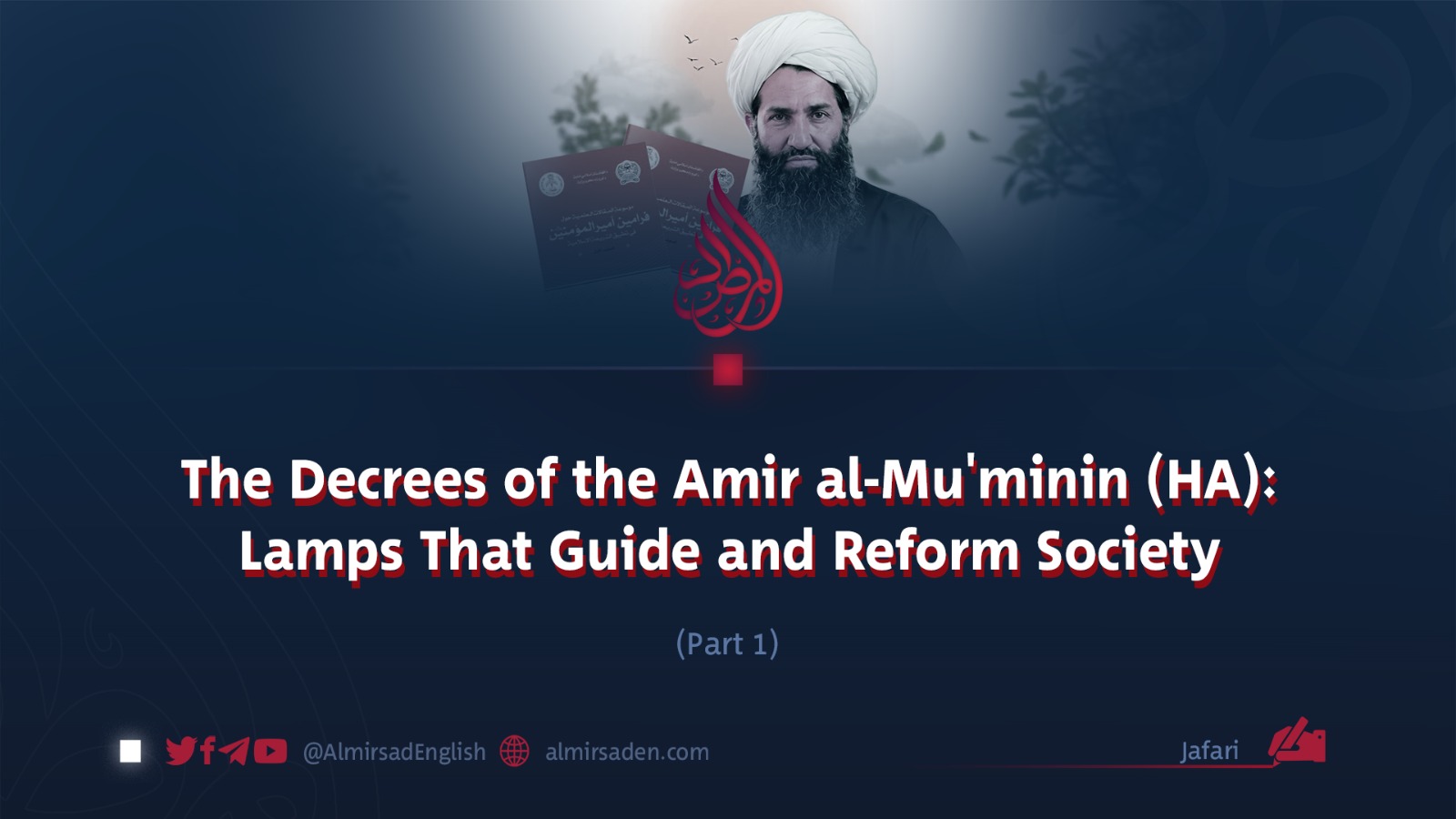
In the world today, many countries are ruled by people whose aim in power is mostly personal, partisan or material gain. But the Amir al-Mu’minin (HA) is one of the leaders whose main aim and greatest concern is guiding society and reforming it according to Sharia rulings. He has devoted all his time and strength to this aim, and he prepares the recommendations, decrees and instructions his people need to be guided and reformed.
He has also presented written works to introduce the sacred truth of Islam; the best example is the book “The Creed of Ahl al-Sunnah wa al-Jama’ah.” Beyond this, he has issued many other decrees and instructions, each of which serves as a lamp to guide society. In today’s materialistic world, it is hard to find a leader who truly cares about reforming society and saving it from vices, and who keeps in view his people’s well-being in both this world and the next.
One point should be made clear at the start: the Amir al-Mu’minin’s (HA) decrees shouldn’t be treated as dry administrative and government orders. From the Sharia point of view, a decree issued on the basis of the Noble Quran and the Sunnah has its roots in the principles the religion has set for human well-being. When a Muslim ruler issues a decree, it is in truth a continuation of the path that the Messenger of Allah (PBUH) and the Rightly Guided Caliphs (RA) took in guiding people. For this reason, the Amir al-Mu’minin’s (HA) decrees have a Sharia side and a social side: on one hand they make clear people’s religious duties, and on the other they pave the way for reforming their lives in society.
The Sharia side of a decree lies in bringing people out of uncertainty and confusion. In matters where opinions differ, or where people don’t know what their Sharia duty is, the Amir al-Mu’minin’s (HA) decree lights their way like a lamp. These decrees are prepared in consultation with religious scholars and on the basis of Sharia evidence, so that people can carry out their Sharia duties with confidence. The Holy Quran also stresses obeying those in authority, on the condition that the obedience doesn’t lead to disobeying Allah (SWT). For this reason, obeying a decree issued on the basis of Sharia is an act of worship, and it brings the conscience peace and ease.
The effects of a decree don’t stay within the individual conscience; they show up in social life too. Many decrees are issued to remove vices, administrative corruption, oppression, bribery and injustice. When such decrees are carried out in society, people’s trust in the system grows, social relations become healthier and the way is opened for spiritual and material progress. Experience has shown that wherever the Amir al-Mu’minin’s (HA) decrees were seriously implemented, order, security and justice improved there.
This is the link between a Sharia ruling and its social effect that needs to be understood: Sharia came for human well-being, and human well-being is achieved in society.
Responsibility for carrying out the Amir al-Mu’minin’s (HA) decrees doesn’t rest on the government alone; the people share it. Obeying with full understanding and awareness, asking questions politely and respectfully in order to understand a decree well, and cooperating in carrying it out are three duties every Muslim should fulfill. If people take the decrees seriously and treat them as Sharia duties, not mere administrative orders, their effects will plainly be seen at home, in the market, at school and in the mosque.
This is the aim the Amir al-Mu’minin (HA) pursues by issuing these decrees: a reformed, well-informed society, committed to Sharia rulings, that will flourish in this world and the Hereafter.