



In the name of Allah, the Most Gracious, the Most Merciful.
Introduction:
الْحَمْدُ لِلّٰهِ خَالِقِ الْكَوْنِ وَالْخَلِيقَةِ، وَجَاعِلِ آدَمَ فِي الْأَرْضِ خَلِيفَةً، وَعَلَّمَهُ أَسْمَاءَ الْأَشْيَاءِ لِحَيَاةٍ شَرِيفَةٍ، وَالصَّلَاةُ وَالسَّلَامُ عَلَى صَاحِبِ الشَّفَاعَةِ وَالدَّرَجَةِ الرَّفِيعَةِ، بَذَلَ قُصَارَى جُهْدِهِ فِي حِمَايَةِ النِّظَامِ الْإِسْلَامِيِّ وَمَعْقِلِهِ الْمَدِينَةِ، وَعَلَى آلِهِ وَأَصْحَابِهِ ذَوِي الْهِمَمِ الْعَالِيَةِ وَالْعَزِيمَةِ، وَبَعْد:
Allah (SWT) said:
﴿وَعَدَ اللَّهُ الَّذِينَ آمَنُوا مِنكُمْ وَعَمِلُوا الصَّالِحَاتِ لَيَسْتَخْلِفَنَّهُمْ فِي الْأَرْضِ كَمَا اسْتَخْلَفَ الَّذِينَ مِنْ قَبْلِهِمْ﴾
“Allah has promised those among you who believe and do righteous deeds that He will surely make them successors in the land, just as He made those before them successors.”
And the Messenger of Allah (PBUH) said:
“مَنْ مَاتَ وَلَيْسَ فِي عُنُقِهِ بَيْعَةٌ مَاتَ مِيتَةً جَاهِلِيَّةً”
“Whoever dies without a pledge of allegiance upon his neck dies a death of Jahiliyyah.”
صدق الله العظيم و صدق رسوله النبی الکريم.
A ruling authority’s decree carries distinct importance and value from several perspectives. One perspective is the decree’s doctrinal, intellectual and moral foundation: its knowledge, understanding and priorities. Another perspective is the effect that implementing the decrees has on society and the system.
Sharia-based imamate and emirate constitute a lost yet sacred reality, and every Muslim must understand it deeply. The Islamic Emirate, which after centuries is a genuinely revived example of Sharia-based imamate and emirate in a historical part of the Islamic world, has a weighty and worthy leadership whose decrees carry particular importance and value.
Knowing the background, foundations, content and effects of these decrees builds a deep practical understanding of Sharia-based imamate and emirate. However, we cannot reach this goal simply by reading the texts of the decrees. We have to grasp the original meaning, implication and message of every word, sentence and clause, and recognize the thought, belief and moral standards behind them, and the understanding and insight by whose blessing these decrees were prepared and compiled. We also need accurate, precise information about the effects that implementing the decrees has had on society and the system.
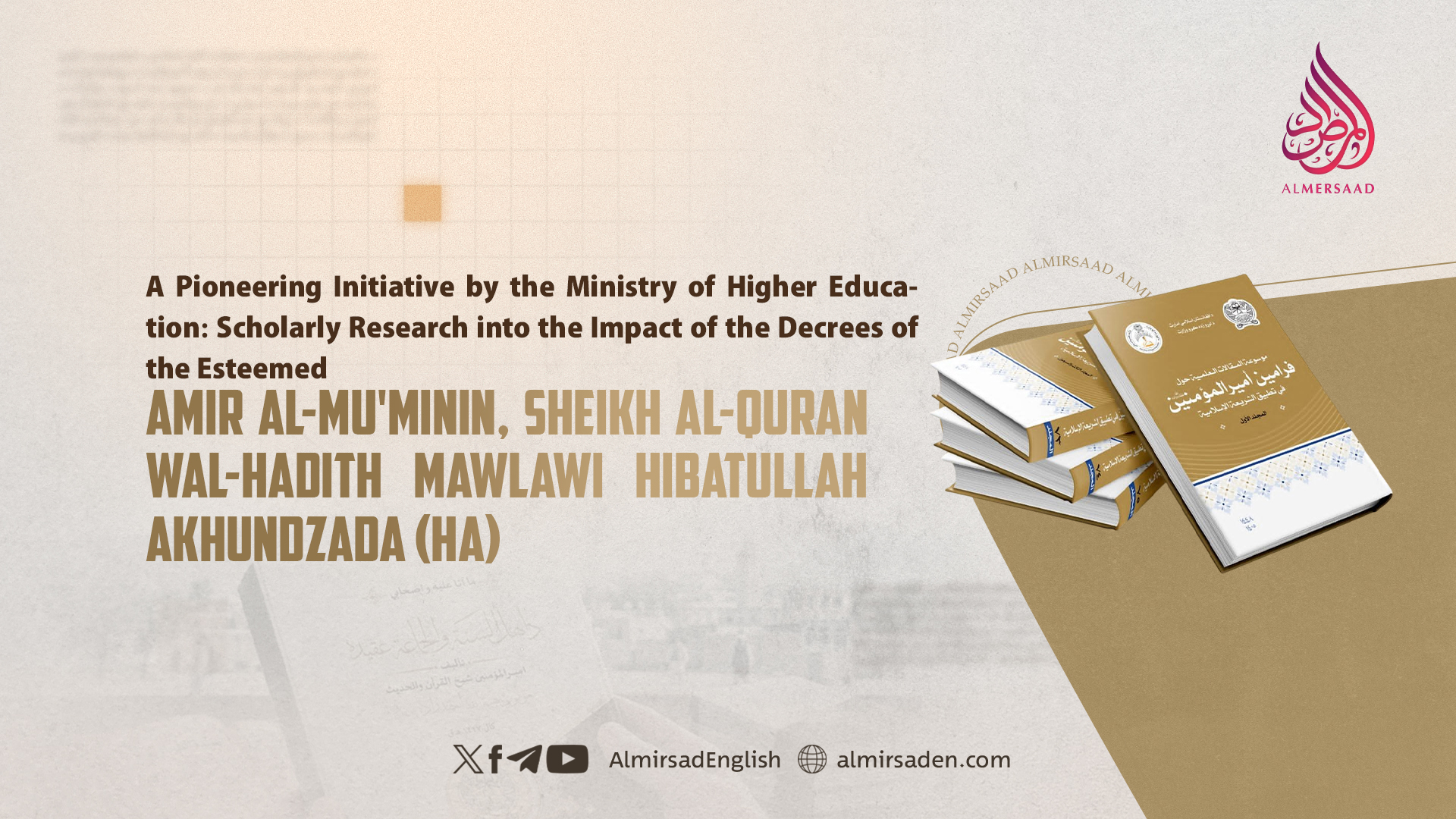
The initiative taken by Maidan Wardak University to carry out scholarly research on the effects of the decrees of the Esteemed Amir al-Mu’minin (HA), and the holding of this glorious scholarly conference by the respected leadership of the Ministry of Higher Education, are truly praiseworthy steps. Jazakum Allahu khayr al-jaza’. Through such initiatives we can convey a genuine Sharia understanding of the foundations of Sharia-based emirate and imamate to present and future generations, and rescue these realities from the coercion that history and intellectual colonialism have always used to distort them. Those forces have always distorted the facts about sacred struggles, jihad and Sharia-based imamate and emirate.
However, my academic level is not such that I can write a research paper on the decrees and their effects using scholarly research methods, as a researcher would. But when I learned of this great initiative, I was glad from the bottom of my heart. To honor it, I resolved to write a short informational overview, in the form of an article, about the Sharia imamate and emirate, the Islamic Movement of the Taliban of Afghanistan as a distinguished movement, the personality of the Esteemed Amir al-Mu’minin (HA), his decrees and their effects. May Allah reward me for this writing, and make all participants of this conference pleased and happy.
Sharia-Based Imamate and Emirate: A Lost Yet Sacred Reality
Establishing and consolidating Sharia-based imamate and emirate on earth is a divine command, a religious duty and a demand of sound reason. Without it, religion isn’t put into practice, justice doesn’t come, security doesn’t come, worldly well-being isn’t reached, and a person doesn’t remain in his human nature. This divine command was also addressed to earlier nations and to some prophets (AS). Allah (SWT) says:
﴿وَإِذِ ابْتَلَىٰ إِبْرَاهِيمَ رَبُّهُ بِكَلِمَاتٍ فَأَتَمَّهُنَّ ۖ قَالَ إِنِّي جَاعِلُكَ لِلنَّاسِ إِمَامًا﴾ (Al-Baqarah 124)
And [mention, O Muhammad], when Ibrahim was tried by his Lord with commands and he fulfilled them. [Allah] said, “Indeed, I will make you an imam for the people.”
And in another place He says:
﴿يَا دَاوُودُ إِنَّا جَعَلْنَاكَ خَلِيفَةً فِي الْأَرْضِ فَاحْكُم بَيْنَ النَّاسِ بِالْحَقِّ وَلَا تَتَّبِعِ الْهَوَىٰ﴾ (Sad 26)
[We said], “O Dawud, indeed We have made you a khalifah upon the earth, so judge between the people in truth and do not follow [your own] desire.”
Since humanity lost Sharia-based imamate and emirate, it has been deprived, individually and socially, of many values:
– It lost the strong source of divine guidance and the power of justice and moral leadership.
– Material progress took the place of moral progress.
– Material gains became the center of life instead of a person’s true happiness.
– Colonialism, despotism and the rule of the powerful grew stronger.
– Knowledge and industry advanced, or material progress arrived, but humanity fell behind morally.
– Humanity turned to certain theories and practices that have no connection with human nature.
And many other things of this kind…
If this situation continues, humanity will be pushed toward the pit of complete ruin by the conditions and opportunities created by the false Eastern and Western ideologies under attractive names. Even now, we’re witnessing signs of this reality around the world. The sharia texts hold clear guidance on the imamate and emirate, and their theoretical, intellectual and juristic foundations exist, yet for a long time humanity hasn’t seen a single example of it in complete and lasting practice.
After the fall of the lofty tower of the Islamic caliphate, many da’wah, reform, political and jihadi movements struggled, and still struggle, to revive this lost yet sacred reality. Regrettably, some of these movements fell into excess and negligence, and others didn’t reach the goal for other reasons. Among all these movements, the only one that twice established itself on earth and found the opportunity to revive Sharia-based imamate and emirate, through the blessing of its methodology, was the Islamic Movement of the Taliban of Afghanistan. It established the Islamic Emirate. This methodology was truly a successful one. Among its fundamental principles were tawhid, following the Sharia of the righteous predecessors, da’wah, promoting the religious sciences, developing a true understanding of religion, benefiting from scientific advances without imitating foreign cultures, conducting politics and jihad according to the Prophetic method, and reviving Sharia-based imamate and emirate according to that method.
Another distinguishing trait of the Islamic Movement of the Taliban of Afghanistan was the leadership of firmly grounded religious scholars and the formation of an army from religiously knowledgeable, righteous young men. Through this movement, and later through its efforts, the Islamic Emirate was protected from deviation, aberration, corruption and fitnas. Allah (SWT) says:
﴿وَعَدَ اللَّهُ الَّذِينَ آمَنُوا مِنكُمْ وَعَمِلُوا الصَّالِحَاتِ لَيَسْتَخْلِفَنَّهُمْ فِي الْأَرْضِ﴾
“Allah has promised those who have believed among you and done righteous deeds that He will surely grant them succession [to authority] upon the earth…”
In truth, this movement was the final organized form of the decades- and centuries-long struggles of Afghanistan’s religious, scholarly and righteous stratum to revive Sharia-based imamate and emirate. Much negligence has occurred in recording the golden lines of those struggles in history, and the existing historical record has, under considerable coercion, either concealed or distorted them. Even so, from the little scattered historical information that remains, we know who the late Mullah Mushk-e-Alam, the martyred Mullah Abdul Karim, the martyred Mullah Muhammad Sarwar, the martyred Mullah Amir Muhammad Khan, the martyred Mullah Abdul Rahim Khan, the martyred Mullah Abdul Ahad Khan Popalzai, Mullah Abdul Ghafoor Khan, the Mullah Sahib of Chaknur, the Mullah Sahib of Kajori, the martyred Mullah Abdullah and the martyred Mullah Abdul Rashid were.
What was their role in the sacred struggles and jihads against British colonialism and the taghuts? We also take pride in the achievements of all the other ghazis who took part in those battles and struggles alongside them or under their guidance.
We also know at whose call and fatwa the people rose against the communists and the Red Army, waged jihad, and defeated them. We know who the following were, and what their role in the sacred jihad against the Red Army was, and how they remained firm in their path: the late Mawlawi Yunus Khalis, the late Mawlawi Mohammad Nabi Mohammadi, the late Mawlawi Jalaluddin Haqqani, the martyred Mawlawi Nasrullah Mansur, the late Mawlawi Rafiullah Muazzin; of Kandahar, Hafiz Abdul Karim, the martyred Lala Malang and Mullah Naik Muhammad; of Helmand, Mullah Muhammad Nasim Akhundzada and Mawlawi Baz Muhammad; of Uruzgan, the martyred Mullah Shafiq and Mullah Mashar; of Paktika, Mawlawi Abdul Rahim Sahibzada; of Paktia and Khost, the martyred Mullah Buzurg and Qazi Abdullah Gul; of Logar, Mullah Khushal; of Maidan Wardak, Akhundzada Sahib of Yusuf Khel and Akhundzada Sahib of Jalrez; of Ghazni, the martyred Mawlawi Naik Muhammad and the martyred Qari Abdullah; of Kabul, the martyred Mawlawi Shafiullah and the martyred Mawlawi Terakhel; of Parwan, the martyred Mawlawi Abdul Saboor Akhundzada; of Tagab, Mawlawi Abdul Zahir; of Zabul, the martyred Mullah Musa Kalim; of Farah, Mawlawi Saifullah Danishmand; of Ghor, the martyred Allamah Muhammad Sahib; of Obe district in Herat, Mawlawi Agha Sahib and Mawlawi Jalilullah Mawlawizadeh; of Badghis, Mawlawi Abdul Hakim; of Faryab, Mawlawi Abdul Salam Mughal; of Sar-e Pul, Mawlawi Abdul Jalil; of Jawzjan, Mawlawi Muradi; of Balkh, Mawlawi Abdul Jabbar; of Samangan, Mawlawi Abdul Wasi and Sheikh al-Hadith Qari Habibullah; of Baghlan, Mawlawi Muhammad Qul and Mawlawi Abdul Hai Mughal; of Kunduz, Mullah Mulham Halimi and Mawlawi Baridad; of Takhar, Mawlawi Abdul Wahab; of Badakhshan, Mawlawi Abdul Hakim and Mawlawi Abdul Rehman; of Kunar, the martyred Mawlawi Habibullah; of Narang, Mullah Abdullah, known as Mullah Abdal; of Ghaziabad, Mawlawi Bilal; of Nuristan, Mawlawi Faqirullah; of Nangarhar, the martyred Mullah Kandahari and Mawlawi Sultan Aziz; of Laghman, the martyred Mawlawi Abdul Rahim Hanafi. May Allah have mercy on them and accept them.
We also take pride in all those other great mujahideen and ghazis who waged the sacred jihad against the Red Army, who, like these noble scholars, remained steadfast in their jihad and stayed on the truth to the end. We also know who kept Islamic brotherhood in the jihad against the Red Army and who turned to division and infighting. Who ground into the dust the aspirations of that sacred jihad, which the whole ummah was waiting to see fulfilled? And who then struggled and waged jihad to revive it?
In truth, this movement was the blessing of the services carried out in religion and scholarship through our scholarly centers in Kabul, Balkh, Bust, Faryab, Herat, Sijistan (present-day Zaranj) and Ghazni.
It was also the blessing of the services of those great exegetes, hadith scholars, mujtahids and masters of the sciences whose efforts the whole ummah acknowledges in their greatness: Imam Abu Hanifa (rh); Imam Qutaybah ibn Sa’id al-Baghlani (rh), the direct and indirect teacher of the six imams of hadith; Imam Nafi’ Kabuli; Imam Makhul; Mulla Ali Qari; Allamah al-Khattabi al-Busti; Yusuf Faryabi; Khwaja Abdullah Ansari; Maulana Jalaluddin Balkhi; Maulana Abdul Rahman Jami; and Sanai Ghaznavi (rh), may Allah have mercy on them all. This movement was also the blessing of the Sharia perspectives of the schools of thought grounded in moderation (Mawarannahr and Deoband), which have always carried the message of moderation to the ummah.
By establishing the Islamic Emirate, the Islamic Movement of the Taliban of Afghanistan carried out its great Sharia responsibility and took a great historic step in reviving the lost yet sacred reality of Sharia-based imamate and emirate. In this area the views, policies, efforts and achievements of all the Islamic Emirate’s leaderships deserve great praise, and much should be written about them and recorded in golden lines on the pages of history.
However, considering the time and the subject of this glorious conference, I would like to offer a brief overview of the visions, policies, efforts and achievements of the Esteemed Amir al-Mu’minin, Sheikh al-Quran wal-Hadith Mawlawi Hibatullah Akhundzada (HA).
The Personality and Achievements of the Esteemed Amir al-Mu’minin (HA)
The Esteemed Amir al-Mu’minin (HA) is a great religious scholar. He actively participated in three historic periods of struggle and jihad against the Red Army, against corruption and against the Crusader occupiers, and he has held various responsibilities. After the passing of the late Amir al-Mu’minin Mullah Muhammad Omar Mujahid (rh), he came to hold the position of deputy to the Imamate. After the martyrdom of Amir al-Mu’minin Mullah Akhtar Muhammad Mansur (rh), the great responsibility of the Imamate was entrusted to him unanimously by the Council of Ahl al-Hall wal-Aqd.
The following are clear examples and great achievements of his deep religious understanding, decisiveness, political insight and strong management: eliminating fitnas; speeding up political activity by strengthening the political office alongside sacred jihad on the Prophetic Sharia manhaj; successfully managing, according to the principles of Islamic Sharia, the complex and dangerous negotiations with the cunning occupiers to end the occupation, and carrying them to the stage of victory; taking a decisive stance against the corrupt system the occupation had installed and overturning it in the occupation’s final moments; managing the course of the manifest victory in an orderly, successful way; and creating an atmosphere of brotherhood by announcing a general amnesty and preventing a dangerous wave of revenge.
The Esteemed Amir al-Mu’minin’s (HA) other achievements and deeds include the following. He prevented the cultivation, buying, selling and trafficking of narcotics. He gathered and treated addicts, provided stipends at their homes to genuinely needy children and adult beggars, and provided access to education for children. He recovered about four million jeribs of usurped land and restored women’s trampled rights. He prevented scandalous, improper and un-Islamic customs in society, and removed notorious, hated figures from government ranks. He reformed educational curricula in doctrinal, intellectual and cultural terms, established what is right and prevented what is wrong, and brought monetary stability, annual economic growth and major reconstruction projects by using domestic resources. He brought an end to unjust arrests, torture, executions and oppression in the security strategy, and maintained Afghanistan’s neutrality in international conflicts.
﴿يُؤْتِي الْحِكْمَةَ مَن يَشَاءُ ۚ وَمَن يُؤْتَ الْحِكْمَةَ فَقَدْ أُوتِيَ خَيْرًا كَثِيرًا﴾ (Al-Baqarah 269)
“He gives wisdom to whom He wills, and whoever has been given wisdom has certainly been given much good.”
The Esteemed Amir al-Mu’minin’s (HA) Decrees and Their Great Effect
After the Islamic Emirate came to power, the Esteemed Amir al-Mu’minin’s (HA) statements, directives, rulings, policies and approaches in various areas, and the decrees he issued, in whose honor the initiative for this glorious conference was taken, present a real Islamic Sharia conception of the Sharia-based imamate and emirate. This is their greatest effect: a conception free of the influence of foreign ideas and theories. It is a comprehensive constitution on the structure of the Sharia system; the true standing of the Sharia imam; the place and duties of delegated and executive officials in the Sharia system; the general obligations of the Sharia system; the rights of the subjects; the implementation of ruling by what Allah has revealed; the stance on the ummah’s important issues; the Muslim-centeredness and human-centeredness of the system; and interaction with the new world order within Sharia limits. In the political, economic, defense, security and social fields as well, the Esteemed Amir al-Mu’minin’s (HA) decrees are the best foundations of a real Sharia system’s policies and approaches, and they make up important parts of this constitution.
This conception of the Sharia system, and the constitution expressed through the decrees, is drawn from the sacred guidance of the clear religion of Islam. It’s a religion that regulates relations among people by the Creator’s guidance and doesn’t leave this to reason, whose capacity, like that of the other human senses, is limited and can’t arrive at true knowledge of the creation, existence, continuation and end of the great system of the universe. This constitution follows the original purpose of human creation and shows human beings their place in the universe. It assigns the duties of the two sexes, males and females, and explains the rights and obligations that individuals and society have toward one another in human society.
Human life has the greatest value in this constitution, and taking it unjustly is considered a grave crime. Protecting people’s lives, property and honor is among its fundamental obligations. Good treatment of parents, keeping kinship ties, upholding Islamic brotherhood, helping orphans, the poor and the needy, and earning a lawful livelihood through work are among its other rulings. So are balanced distribution of capital among people and between people and the government, the prohibition of acquiring capital through unjust and monopolistic means, reforming people’s beliefs, thoughts, morals and deeds and regulating them with attention to what is lawful, what is forbidden, what brings reform and what causes harm, and moderation in peace and war.
These blessed decrees protect the right to express the truth and make consultation in administrative affairs mandatory according to competence. They set distinct standard frameworks (mechanisms) for officials’ oversight and for holding officials to account and auditing them, and make merit mandatory in recruitment. They have distinct laws and effective approaches for protecting the Bayt al-Mal (public treasury), spending it as needed and recovering usurped Bayt al-Mal.
The initiative of scholarly research into the effects of the Esteemed Amir al-Mu’minin’s (HA) decrees is worthy of appreciation and praise. Its greatest effect is creating among Muslims a pure Islamic conception of the Sharia system, one free of any excess, negligence and the effects of intellectual colonialism. In this regard we offer congratulations to the leadership of the Ministry of Higher Education, the officials and professors of Maidan Wardak University and all those who cooperated in this great initiative and in holding this conference, and we ask Allah (SWT) for their happiness and success in this world and the next. May Allah reward them with the best of rewards.
Thank you for listening and for your patience.
اللهم أرنا الحق حقاً وارزقنا اتباعه، وأرنا الباطل باطلاً وارزقنا اجتنابه.
O Allah! Show us the truth as true, and inspire us to follow it. Show us falsehood as falsehood, and inspire us to abstain from it.
With respect,
Your brother: Mullah Tajmir Jawad