















Part 5
Karim Akrami
The Esteemed Amir al-Mu’minin’s (HA) Recommendation on Abandoning Harmful Customs (Part One)
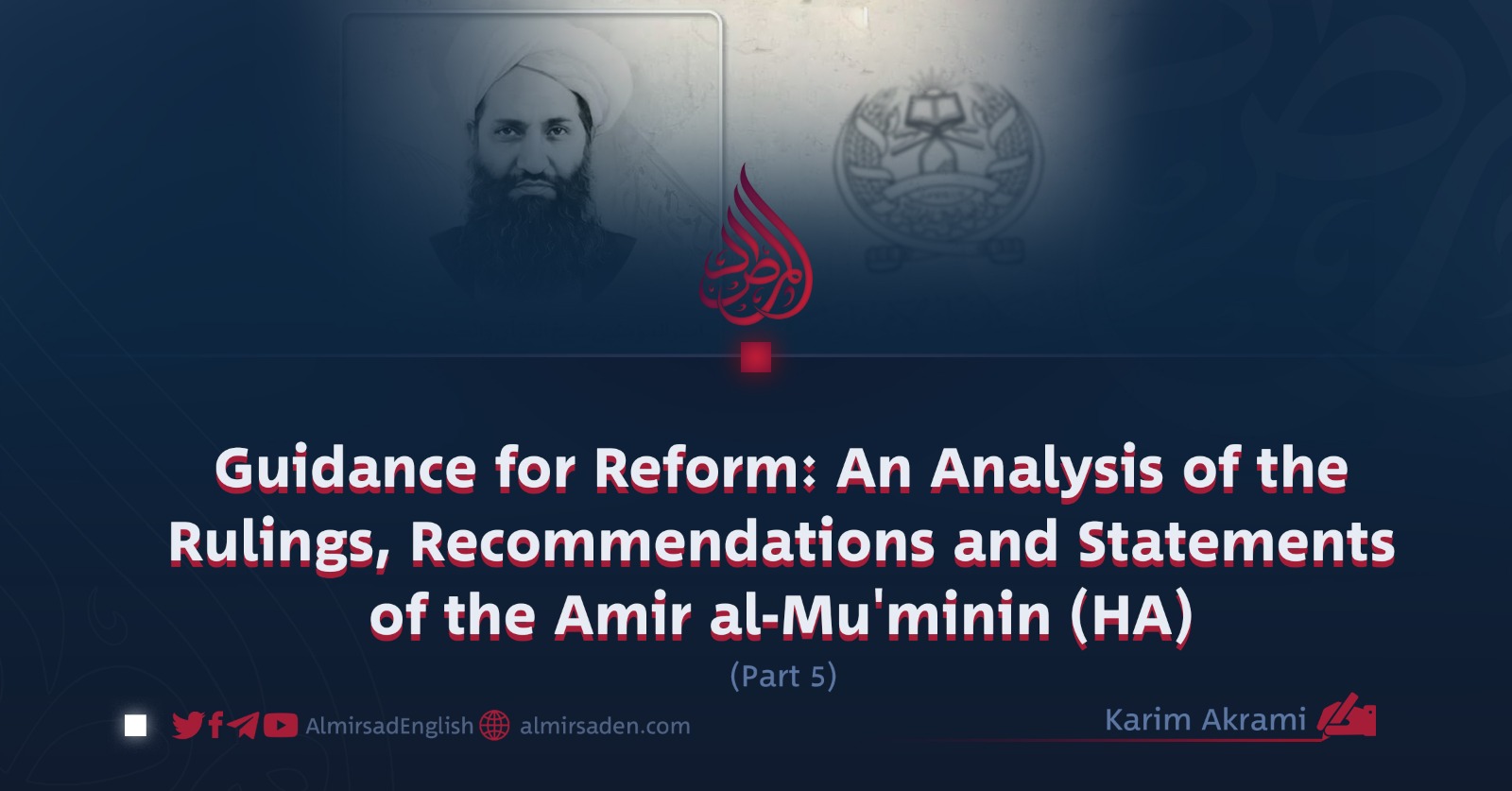
One of the core themes running through the Amir al-Mu’minin’s (HA) reform guidance is the fight against harmful customs and innovations that, over the decades, have worked their way into Afghan social culture and placed a heavy burden on families, particularly on low-income and poor households. In Decree No. 17, issued with the aim of “preventing improper social customs,” he plainly stressed the need to eliminate these practices, calling this not just a surface-level recommendation, but part of the Islamic system’s reform mission.
In reality, the decree can be seen as an important step in the leadership’s efforts to bring society back to a simple Islamic way of life and to prevent extravagance and ostentation. Such customs sometimes force families to live under the heavy weight of debt for years just to hold a wedding, weakening the foundations of the family in the process. The Ministry of Information and Culture has also described the decree’s aim, in awareness programs held across various provinces, as “reforming certain improper social customs and strengthening good ones.”
A notable point in the Amir al-Mu’minin’s (HA) recommendation is that his fight against these practices is framed around moderation and avoiding extravagance, not through imposition or coercion. Public-awareness sessions organized by government bodies have made clear that Islam is a religion of moderation, and that our social practices should stay free of extravagance, improper customs, music, the mixing of men and women, and other undesirable habits. This isn’t just a religious duty; it’s tied to people’s material and spiritual wellbeing too.
From the leadership’s perspective, reforming harmful customs needs public awareness and a shift in people’s thinking and outlook before anything else; only after that should it turn, with the cooperation of scholars and officials, into a broad social movement. He treats these customs not just as a cultural issue, but as a social affliction that, if left unchecked, can weaken social cohesion and the foundations of the family. At one awareness gathering in Logar, a local official even warned that, because of these very practices, many of our young people are forced to travel abroad and lose their lives along the way.
The decree sets out examples of harmful customs across four main areas.
First: marriage and engagement ceremonies.
Forcing girls into marriage without their consent, setting heavy, unaffordable mahrs, taking money under the name of toyana (a payment the bride’s family demands from the groom, separate from the mahr) or walwar (bride price paid to the bride’s family), holding extra ceremonies like payawazi (a follow-on ceremony held a day after the engagement) and shirini-khori (the engagement “sweets-eating” ceremony), and holding wedding ceremonies at hotels and lavish halls are all banned under this decree.
It stresses that the mahr set for the woman at the time of nikah is her own right, and no one may take it from her. Likewise, a woman is just as independent as a man in matters of nikah, and she never becomes anyone’s property.
Second: mourning ceremonies. Decree No. 17 identifies preparing food and hosting gatherings for guests on the first, third, seventh and fortieth day after a death as customs of the Age of Jahiliyyah that place an additional burden on bereaved families, and prohibits them. The decree stresses that giving charity in the name of the deceased is permissible, but it shouldn’t become a social obligation that brings blame on anyone who doesn’t give it.
Third: returning from Hajj and Umrah. Hosting expensive gatherings and distributing costly gifts after returning from Hajj or Umrah are customs that, according to the decree, have no basis in sharia, and it recommends avoiding them.
Fourth: use of government resources. Using government vehicles for private weddings and ceremonies is also among the matters banned under this decree.
Analytically, the Amir al-Mu’minin’s (HA) emphasis on avoiding these customs can be grouped into several core themes.
First: attention to families’ economic situation. Many Afghan families are forced to take on debt because of the heavy costs of weddings and mourning ceremonies, laying the ground for poverty and economic disorder.
Second: the connection between harmful customs and religious innovation. Some of these practices have roots in un-Islamic and superstitious beliefs, and their continued practice in society can weaken Islamic belief.
Third: the role of scholars and officials in reform. He has asked scholars to encourage people to live simply and avoid extravagance, and has asked officials to monitor the implementation of these recommendations. The Ministry of Information and Culture has also stressed, in numerous meetings with media organizations and journalists, the role of the media in raising public awareness about the decree.
This reflects a structured strategy for social reform, one in which every institution and every layer of society carries its own responsibility. Part Two will examine the positive results and effects of the decree’s implementation in society.