





Part 4
Karim Akrami
Commanding Right and Forbidding Wrong: The Path to a Pure Society
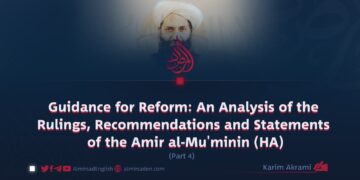
Commanding right and forbidding wrong is one of the foundational duties of Islam, playing a major role in maintaining the well-being of society and preventing the spread of corruption. In his many statements, the Amir al-Mu’minin (HA) has treated commanding right and forbidding wrong not just as an ordinary religious duty, but as one of the central aims of the Islamic system. At a meeting in Kandahar with local officials, scholars and tribal elders from the southern provinces, he said plainly that one of the principal goals of the twenty-year jihad was carrying out the duty of commanding right and forbidding wrong.
This statement shows the central place this duty holds in the leadership’s thinking; it indicates that bringing this principle into practice is seen as one of the major achievements of the Afghan nation’s years of jihad, struggle and sacrifice. Another important and recurring theme in the Amir al-Mu’minin’s (HA) statements is his organized, methodical view of commanding right and forbidding wrong: a view in which scholars bear responsibility for explaining and teaching religion, while the government bears responsibility for implementing these rulings and laying the necessary groundwork for them.
In the Amir al-Mu’minin’s (HA) view, commanding right and forbidding wrong strengthens and stabilizes the system, and carrying it out is a religious duty for every Muslim. This shows that he regards commanding right and forbidding wrong not merely as an administrative or governmental task, but as a religious responsibility for all Muslims, one whose fulfillment guarantees the survival of the Islamic system and the soundness of society. At another meeting with local officials from Paktia province, he likewise stressed enforcement of the law on commanding right and forbidding wrong, and he called the country’s current situation suitable for putting Islamic rulings into practice.
Analytically, the Amir al-Mu’minin’s (HA) emphasis on commanding right and forbidding wrong can be examined under several core themes.
First: Support for the Institution Responsible for Commanding Right and Forbidding Wrong
The law on commanding right and forbidding wrong, consisting of a preamble, four chapters and 35 articles, was published in the official gazette after the Amir al-Mu’minin (HA) signed it, and responsibility for its implementation was handed to the Ministry for the Propagation of Virtue, Prevention of Vice and Hearing of Complaints. This law obligates the ministry to command good and forbid evil in accordance with Islamic sharia and Hanafi fiqh. The ministry also carries responsibility for securing peace and brotherhood among the people and for preventing ethnic, linguistic and regional prejudice.
Second: Observing Ethical Principles When Carrying Out Commanding Right and Forbidding Wrong
Under this law, respect for people’s dignity and human worth, good treatment of them, gentle admonition and advice, avoiding the exposure of people’s private sins, and refraining from spying on them are all counted among the basic principles of hisbah. These principles show that commanding right and forbidding wrong must be carried out with wisdom, good counsel and respect for human dignity, not through violence or intrusion into people’s private affairs.
Third: The Role of Scholars in Cooperating With the Authority Responsible for Commanding Right and Forbidding Wrong
The Amir al-Mu’minin (HA) has asked scholars to fully cooperate with the relevant authorities in carrying out the duty of commanding right and forbidding wrong, and to explain matters of faith, creed and prayer to worshippers and the public every day in their own mosques. These instructions show the leadership’s structured, systematic view of commanding right and forbidding wrong, a view in which scholars bear responsibility for explaining and teaching religion, while the government bears responsibility for implementing Islamic rulings and laying the groundwork needed for them.
Fourth: The Connection Between Commanding Right and Forbidding Wrong and People’s Sharia Rights
To secure women’s sharia rights, the ministry has taken up numerous cases involving forced marriage, mahr (marital dower), maintenance and inheritance, and has taken steps to prevent cruelty against women. These steps show that, in the Amir al-Mu’minin’s (HA) view, commanding right and forbidding wrong isn’t limited to preventing wrongdoing alone; it also includes securing the rights of the wronged and supporting vulnerable groups in society.
The Amir al-Mu’minin’s (HA) emphasis on commanding right and forbidding wrong grows out of a deep understanding of this duty’s role in reforming both the individual and society. Through his support for the ministry, and by encouraging scholars to cooperate with this body, he’s working to build a structured, coordinated mechanism for carrying out this divine duty, so that Afghan society moves toward purity, piety and commitment to the rulings of sharia. That approach, paired with wisdom and good conduct, can lay the groundwork for deep changes in social beliefs and behavior, and can help the Islamic system reach its higher goals.
Experience has proven that reforming society without the duty of commanding right and forbidding wrong simply isn’t possible.
Commanding right and forbidding wrong is the firm pillar of Islamic society. If it weakens, the whole structure of society faces collapse.