




















Abdullah Aatif, graduate of Jamia Farooqia Karachi
بسم الله الرحمن الرحیم
الحمد لله، والصلاة والسلام على رسول الله!
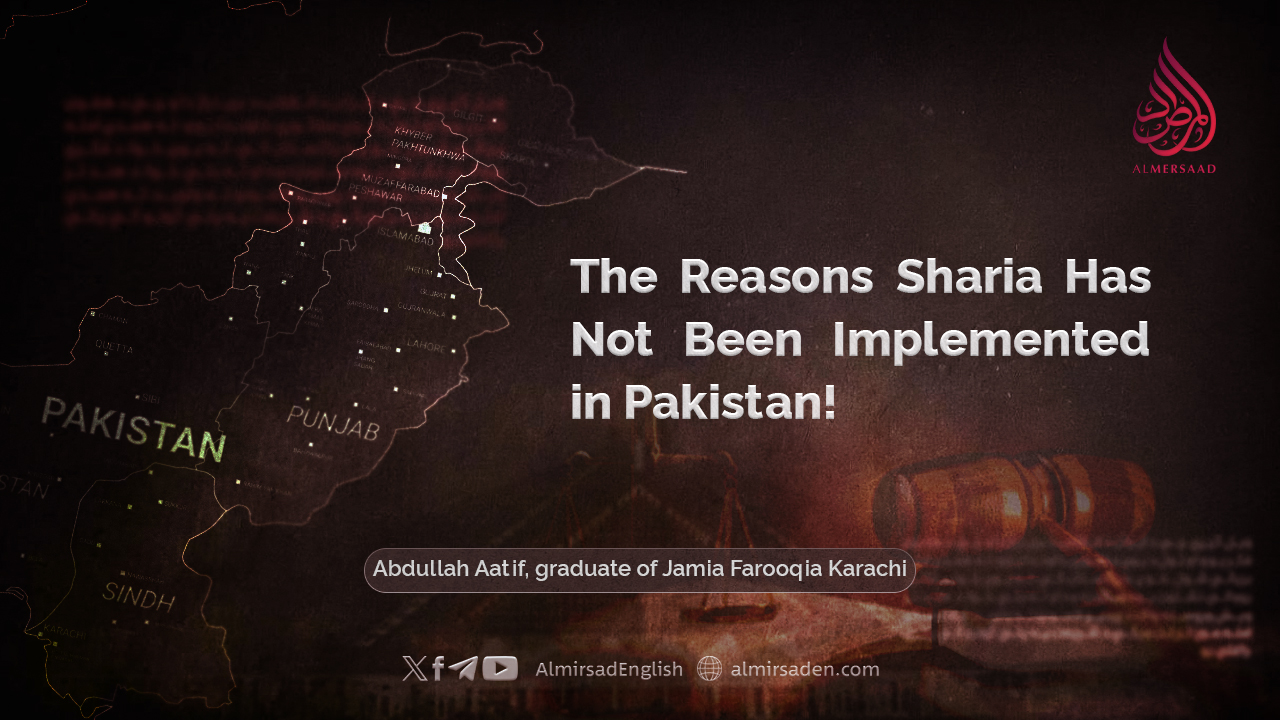
It is said that the secret of the success of the Iranian revolution was that their thinking was one, that all of them held one idea, and that is why they succeeded. But in Pakistan, on one hand there was no intellectual unity, and on the other hand, after the partition of India, power fell into foreign hands; and that is why to this day we remain behind in implementing Sharia.
Some people have discussed this topic, but since my view differs from theirs to some extent, I wanted to put forward my own view as well. This discussion does not simply revolve around why Sharia has still not been implemented in Pakistan to this day; a number of other debates are tied to it as well: the current law, choosing the path of democracy for its reform, and the insistence that the struggle for the implementation of Sharia in the country must be carried out only through non-violent and peaceful means, and so on.
For now, in this discussion, we will focus only on the fundamental reasons why we have, to this day, failed in implementing Sharia.
First reason: lack of clarity about the goal
It is said that one reason for success in Iran was that everyone there held one idea, while here in our movement people of different ideas were included; that is why intellectual unity was never formed here. But in my view, no one here actually understood the goal correctly in the first place.
The matter was this: in the War of Independence of 1857, which ended in defeat, Hindus and Muslims stood in one line. Their goal was to gain independence from the British and to form a joint government of Hindus and Muslims; establishing an Islamic system was not their goal.
The goal of Shaikh al-Hind’s (rh) movement was also not the establishment of an Islamic system, but rather freedom from the British was the main goal. That is why agreement existed between Hindus and Muslims, and both shared one common idea: that independence must be gained from the British. But at the time of the partition of India, Muslims were given the mindset that a separate state must be formed for them, and nothing more. At this stage, instead of independence from the British, far greater emphasis was placed on separation and freedom from the Hindus, when it was these very Hindus who had been our companions and partners in the struggle for independence.
This time the British, following the principle of Divide and Rule, that is “divide and rule,” split the joint strength of the two nations, and then, according to their own idea and strategy, began to rule over them. At the time of the partition of India, Muslims were told to this extent that we need a separate state. Along with this, in a few short and vague sentences, they were also told that the constitution of the new country would be the Quran and Hadith.
When the people heard this and saw Islamic signs in this movement, they began making sacrifices. Meanwhile, behind the curtain, a number of leaders, including the Quaid-e-Azam himself, had become part of the British plan. In this way they were being used according to a calculated plan; because the partition of India was in reality the offspring of British thought and strategy, and our leaders were representing that very strategy. When we had no such problem with the Hindus, then why did we think of creating a separate country? Why did we forget the basic task, that is, driving out the British together?
If the goal of creating a separate country was also to gain freedom from the British, then why, after the partition of India, did we appoint an Englishman as the Commander-in-Chief of our own army?
If we were fed up with the British and their cruelties, then why did we hand ourselves over to the very army trained by these same British? When it was through this very army that the British waged their wars, and it was the British and their trained army that played a major role in bringing down the Ottoman Caliphate as well.
So in the end what was the reason that power was handed over to this British-loyal army? Not only that, but an Englishman was appointed Commander-in-Chief of the army, and the army too was placed under the supervision of that very Englishman?
Were we not fed up with this very Englishman? Was this very Englishman not our killer? Had Muslims and Hindus not fought together against this very Englishman? Then how did this very Englishman become our well-wisher? How did we accept this murderous Englishman as our well-wisher, and how did we come to regard him as one who wished us good?
There are hundreds of questions like this, which have no answer other than that this partition of ours was the British’s own demand. Even though the purpose of this partition was shown to the Muslims as though they would be given a separate country whose constitution would be the Quran and Hadith, the truth was that the British wanted to divide India’s power through this means; because the joint actions of Hindus and Muslims had brought heavy losses upon the British, and they saw their future threatened in the unity of the two peoples.
The truth is that partition was Britain’s need. Through it they broke the strength of the Indian subcontinent, and they raised such a wall of enmity between the two nations that we have not understood the reality of it to this day. When the reality is that we were made fools of through this partition, and the process of partition was not in our own power and control, then how, and from whom, would we have demanded the implementation of Sharia? When leadership and power were in the hands of outsiders.
In this situation, how would we go about searching for the reasons Sharia was not implemented? And when implementing Sharia was not actually the real goal of this effort of ours in the first place, then the question of failure in this matter does not even arise. The heart-stirring slogans given about Islam and Sharia were only for the comfort and reassurance of the Muslims, so that they would regard this partition as an Islamic revolution and religious independence, and stay quiet.
Then what happened? The Quaid-e-Azam even became the first prime minister of this country, and that dream of the Muslims of Pakistan, which they had waited so long for, was fulfilled. But power was still in the hands of outsiders. An Englishman was appointed Commander-in-Chief of the army, oversight and control of the whole country was handed to him, and other important posts too were given to people who suited British demands. Later it so happened that the need arose to send the army to Kashmir. The Quaid-e-Azam gave the order that the army be sent to Kashmir, but where was his power? The Commander-in-Chief of the army refused the order, and the Quaid-e-Azam could do nothing about it. From this it became clear that even though Baba had been appointed prime minister, power and authority had still not been given to him; rather, authority remained in the hands of the army, and the army was under the control of that very Englishman. If you look closely at this situation, you will be astonished!
After that too, several more commanders-in-chief came who had previously served in the Royal Indian Army. They held the reins of power, and authority too was entrusted to them. They were British-loyal, not hostile to the British; while it was said that the reason for gaining a separate country was hatred of the British. But real, ultimate power never reached the true representatives of the Muslims; rather, it remained continuously in the hands of the British-loyalists. In the early years of the country, even judicial rulings were made entirely according to English law. Meaning this was not even a nominal Islamic republic; rather, pure English law ruled within it.
In this way our rulers were foreign, the system too was foreign, yet the country had been obtained by Muslims for the implementation of an Islamic system; what a strange philosophy this is!
Understand it through this example: if, after America’s withdrawal from Afghanistan, the power of that country had been handed to Ashraf Ghani’s army, which was trained by America, would anyone then ask, well, jihad happened in Afghanistan and America left too, so why then was the Islamic system not implemented? Never! Because in the end what difference is there between the Englishman and his trained army? Even if the British are not present themselves, their agents and instruments still are; that is why merely changing the faces changes nothing.
As for the rest, it is nearly a settled matter that the death of the Quaid-e-Azam was mysterious; meaning he was poisoned. After that Liaquat Ali Khan was killed, his killer too was killed on the spot, the important documents of the case that were with his lawyer disappeared, and the case has not been resolved to this day. There was certainly something behind all of this happening! These were not accidental events, but plans already drawn up which were carried out behind the curtain. The reason was that power was not in our hands; rather, we were being used by outsiders.
(A side note: the Iranian revolution succeeded because certain fundamental characteristics existed among them: first, unity of ranks; second, intellectual unity; and third, that no foreign power stood as an obstacle before them. If any organization or movement works under one banner, with one thought, for one goal, then one day it will certainly reach its goal.
A recent example of this in history is the Islamic movement of Mullah Muhammad Omar Mujahid (rh) in Afghanistan; they rose under one banner for one goal, and in the first phase no foreign power stood as an obstacle before them, so they succeeded. But in our country neither did intellectual unity exist, because some supported the partition of India while others did not agree with this idea. Even the leadership of the supporters of partition was in the hands of foreign representatives. Nor did unity of ranks exist, but rather there were numerous factions. And how could a foreign power have been an obstacle, when both the agenda and the power itself belonged to outsiders? So what could have been achieved other than failure?)
Summary of the matter: The reason for failure was not that we were people of different ideas; rather, the truth is that the goal of the partition of India was, in the first place, not what we consider it to be today, and then we sit thinking about the reasons for failure. The real goal was something else, but slogans of a different kind were given out. The people were one, but power was in someone else’s hands; that is why we never understood the real goal of the partition of India.
Second reason: the failure of the path of democracy
Our elders have made broad and serious efforts for the reform of the constitution; but the question is, are these efforts really for the implementation of Sharia? Could we succeed in establishing an Islamic system through this path? And could we make up, through this means, for the shortcomings of our past?
Does an Islamic system get implemented merely by reforming the constitution?
The reins of power are in the hands of those who were trained by the British and act on their signals. So are the affairs of the country really in the hands of parliament? When the very leader of this same field, Maulana Fazlur Rehman Sahib, says that parliament has now become the bondwoman of the establishment. He has said in another interview that our legal drafts come from abroad, and that in our own country there are people who represent the West.
Along with this, Maulana Fazlur Rehman Sahib has also said in a speech:
“People talk about the dominance of Islam, but I say this is not the time to talk about dominance; rather, we are now talking about the defense of Islam.”
From this it becomes clear that the implementation of Sharia through this path is impossible. Then why should we not lose hope? How should we keep our struggle running in this very shape, and why should we go on expanding it further? Should we then simply content ourselves with this one line, that we are not responsible for the results?
Whereas this statement is correct in a place where the chosen path is ma’murun bihi in Sharia; meaning one has been ordered by Sharia to walk it, and walking on that path alone is counted as carrying out the command of Allah (SWT). In such a case, whether the result is achieved or not, at least our whole life on that path is counted as worship of Allah (SWT). But if we think about it, this path of democracy is one that has nowhere been commanded by Sharia. This path for the implementation of Sharia is stated neither in the Holy Quran nor in the Hadith. Neither Allah (SWT) nor His Messenger (PBUH) has commanded this path anywhere. Nowhere has it been proven that an Islamic system is established through the use of the vote; so counting this path as part of the religion is a grave mistake, and this is also the view of our other elders. That is why…
Mufti Syed Mukhtar-ud-Din Shah has discussed democracy at length in his book Asrar-ul-Urooj. I quote a few sentences from his words: “Caliphate places the responsibility of establishing and implementing the religion upon the Muslim ruler; but a republic has neither any connection to Allah and His Messenger, nor any goal connected to religion and the establishment of religion. The duty of a republic is to fulfill the wishes of the people, and it is bound to make laws in accordance with their wishes.” (p. 39)
“In a republican system, in order to obtain the majority of votes, public opinion must be shaped in favor of oneself and one’s party. To win over public opinion it is considered necessary that the truth not be made clear; rather, wherever a person goes and whatever kind of people he meets, he must adopt their color, so as to obtain the votes of every kind of thought and every class of people. The necessary result of this is that the distinction between truth and falsehood disappears, and in a republican system, among the members of active parties, lying, false propaganda, flattery, dishonesty, and other such moral corruptions grow.” (p. 42)
Note: Only a few comparative points have been mentioned here. From these, judge for yourself what a republican system and a Western republic are. If it is not Dajjalism, then what else is it? Without doubt, republicanism is a deep conspiracy against Islam and the true religion. (p. 44)
“In light of the facts mentioned above, it becomes clear that hoping for the implementation of Islam through this satanic path is a useless and futile effort. That is why Muslims must not attach this deceptive, Dajjali system to Islam; rather they should try to build their entire lives upon pure Islamic principles.
Those who, out of some compulsion, take part in this system, from them we ask only this much: that they not attach the name and sign of Islam to this system, and that in their speeches and actions they not do anything that would lead people to regard the elections held under this republican constitution as a religious act or a rewardable deed.” (p. 45)
From the quotations above it has become clear that engaging in a republic is not a religious act at all, but only a compulsion. Then how can we say, do not lose hope, the results are in the hands of Allah (SWT), when we have not actually chosen the path of religion in the first place?
Another point is that even if work is done on the constitution and it, hypothetically, becomes fully Islamic, even then the goal is not merely the Islamization of the constitution; rather the real goal is the practical implementation of Islam. An even bigger problem beyond this is that implementing this constitution too is not within our power and control.
If the constitution, even after becoming Islamic, is still not implemented, then our Islam will once again remain confined and limited to a few pages; as it is now, confined only to the mosque and the madrasa. The implementation of the law again remains in the hands of those who themselves are not bound by it. A change has now come into the constitution that riba will be prevented; but first of all this is only a promise, and holds no more status than that. Shaikh al-Islam Sahib himself said during a lesson that acting on this is extremely difficult. The reason is that those who implement this law are themselves involved in usurious dealings and are not trustworthy enough.
Before this, a point worth considering is that the army, which is the real ruler of Pakistan, can bring in changes of its own choosing into the constitution behind the curtain, without even going through parliament, or can force parliament to pass them; and then those changes get implemented too, as some changes were brought in recently. Today it is said that Islam can come through this very path, and the law passed against the Qadianis is presented as an example of this. On this it must be said that the law against the Qadianis was, alhamdulillah, passed; but now it needs permanent protection and defense, because efforts to repeal or amend it are also underway.
What kind of rulers, and what kind of Muslims are these? They respect neither the constitution nor Islam. Even now Qadianis are being recruited into the army, when their ruling is that of execution; because they had become apostates. If they had accepted Islam, they should have been executed in their own time; that was the Islamic ruling, but in any case!
Third reason: counting individual acts as a social system
It is said that our ulema have preserved the religion through the madrasas, and the result of this is that today the mosques of Pakistan are thriving. Up to this point this statement is correct, that our ulema have done great services among the people; but attention must be paid to the fact that these services relate to individual life. Just as Islam has a specific direction for the individual life of a person, so too does it have a separate, complete, and independent system for social life.
Here the discussion is about the system and the implementation of Sharia; but raising the discussion of individual acts at such a time confuses the topic. We flee from the real discussion and console ourselves with a few sentences, when the acts of individual life have no direct connection with the social and governmental system. There is no ban on prayer even in America, nor on fasting, nor on zakat. If there is a ban on anything, it is on the implementation of the Islamic system. Our individual acts are very good, our mosques are thriving, and our madrasas function in a highly organized manner. The simple meaning of this is that our ulema are good; they have served their people and have taken this responsibility of governance upon their own shoulders too; but where are the boundaries of Sharia and qisas?
Fourth reason: fear of the test
It is said that an Islamic system was established in Afghanistan, lasted seven years, and then collapsed.
If the meaning of this statement is that we cannot sustain an Islamic system, then you yourselves are admitting that we are not responsible for the results.
But if the intent is that we will establish an Islamic system, but keeping it will be difficult, then I say: falling is an event and a test that certainly comes; but remaining fallen is a person’s own choice.
Look! Mullah Omar Mujahid (rh) chose a correct path, one that stood on pure Islamic principles, and so he succeeded. Allah (SWT) gave an Islamic system, and then put it to the test once again; but he succeeded in that test too. Alhamdulillah, today once again they are dominant. Today they face various tests from the Dajjali media; but they are succeeding in this because they did not abandon the path of religion and preserved the system. The real point is that we must choose the pure Islamic path.
As long as we exist in this world and claim to be Muslims, Allah (SWT) will certainly test us. It is wrong to say that the implementation of an Islamic system is difficult because of the dominance of the disbelievers. The truth is that there is no greater planner than Allah (SWT). If He orders that now is its time, then in this itself lies good and blessing. If Afghanistan remained under test for twenty years, then its government too became organized through this. Allah (SWT) separated the hypocrites from the true believers and placed the government in the hands of His righteous servants.
If the disbelievers are dominant, then defensive jihad exists for the weak, so that through it they may defeat an enemy stronger than themselves; as happened in Afghanistan. In short, nothing is difficult; we must only choose that true path which Islam has shown. Look at the current situation in Gaza and Palestine; they have chosen the path shown by Islam. Now whether they gain freedom from the Jews or not, they are themselves already victorious, and insha’Allah they will be victorious.
Allah (SWT) tests His servants, and now indeed is the time of the approach of the Day of Judgment. Acting upon Islam is like someone holding a burning ember in his hand; but the real goal is that we must not let go of Islamic principles from our hands. The promise of victory lies in walking this very path. On the Day of Judgment, the question will not be about results; rather the question will be whether we chose Islamic principles or not. Allah (SWT) says:
﴿وَأَنْتُمُ الْأَعْلَوْنَ إِنْ كُنْتُمْ مُؤْمِنِينَ﴾
“And you will be superior if you are believers.”
So the truly successful one is the one who chooses this path, frees himself from the ruined system of the West, and does not fall into its deception any further. The summary of this entire piece, in the end, is this: the path for the implementation of Sharia is not Congress, but the movement of Shaikh al-Hind.
وَآخِرُ دَعْوَانَا أَنِ الْحَمْدُ لِلَّهِ رَبِّ الْعَالَمِينَ، والسلام علیکم ورحمة الله وبرکاته.