












Part 1
By Akbar Jamal
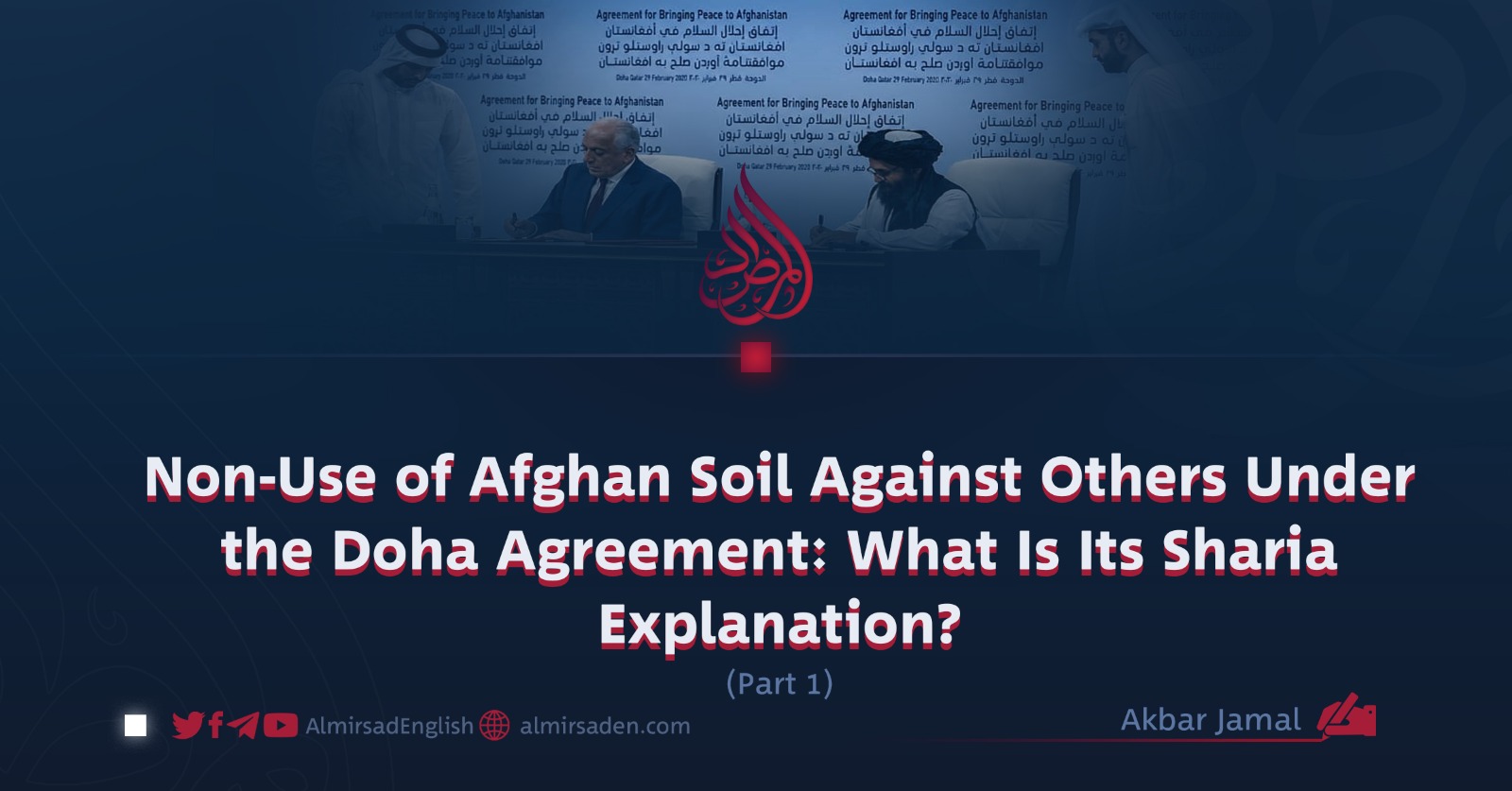
The Doha Agreement between the Islamic Emirate of Afghanistan (IEA) and the United States included a condition stating: “No one will use the territory of Afghanistan against the United States and its allies, and the IEA will not allow anyone to do so either.” To understand the religious and political standing of this condition, a basic question is often raised: Does Islam and Sharia permit putting a halt to fighting against kufr for an unspecified period, or entering into an agreement not to interfere in a war?
To properly understand this question and the issues connected to it, we need to look beyond emotional and superficial arguments and examine the objectives of Islamic Sharia, the Seerah of the Prophet (PBUH), particularly the wise approach taken at Hudaybiyyah, the allowances recognized in Islamic fiqh, and the geopolitical realities of the present age. This makes one thing clear: in Islam, war is a temporary necessity, while peace is the real and lasting objective through which a state can strengthen its intellectual, economic and administrative capabilities.
For this reason, before beginning this discussion, it is important to understand the wording of the provision itself and a few important points. The clause states: “No one will use the soil of Afghanistan against the United States and its allies, and the IEA will not allow anyone to do so.”
The question that now arises is this: Is there any basis in Islam for stopping a war against kufr for an unspecified period? In other words, does this condition, on the surface, appear to mean giving up jihad until the Day of Judgment?
Here, one point must be kept in mind: the IEA is not bound by this condition in a way that would prevent it from defending itself. If the need arises, the IEA has the full legal, religious and rational right to use its territory for its own defense, and no power can take that right away from it.
For this reason, it is not correct to understand this condition as an “unlimited ceasefire,” nor does such an interpretation fit the spirit of the agreement. “Not allowing Afghanistan’s territory to be used against the United States and its allies under the agreement” and “an unlimited ceasefire” are two different things and should not be confused.
Now, a few important points:
First, from the Islamic perspective, war is a temporary necessity, while peace is a lasting objective.
Second, the Prophet Muhammad (PBUH) said that jihad would continue until the Day of Judgment. We should therefore remember that the purpose of jihad is to remove fitnah. As the Holy Quran says:
﴿وَقَاتِلُوهُمْ حَتّىٰ لَا تَكُونَ فِتْنَةٌ﴾
“And fight them until there is no more fitnah.”
From the Islamic perspective, insecurity and corruption, whether caused by evil acts or kufr, are considered fitnah. Wherever jihad is needed to remove it, jihad will continue.
Although, according to fiqh, the objectives of jihad include defense, ending oppression, protecting the interests of the Islamic state and expanding Islamic territory, we also need to understand more deeply how these objectives are to be pursued. Once an Islamic state has been established, when and how can it achieve these objectives?
It should be remembered that the IEA has, to some extent, achieved its objectives in the areas of defense, ending oppression and protecting the interests of the Islamic state. But when it comes to objectives such as expanding Islamic territory, Islam requires sufficient strength and suitable conditions.
If an Islamic state wants to move beyond its present borders and bring other areas into its territory, it must also have the ability to defend itself against the reaction that may come from the other side. Therefore, when the necessary strength and defensive capability exist, offensive or expansionary jihad may also be possible. But if the ability to defend oneself is not there, launching offensive jihad is not a wise course according to Sharia. One of the important conditions of jihad is istita’ah, the necessary power and capability.
This is also why, when jihad becomes obligatory upon a Muslim, one of the conditions is that when he sets out for jihad, he should leave behind enough wealth to meet his family’s needs during his absence, so that his family is not forced to depend on others even for their daily necessities.
This example makes the importance of defensive capability easy to understand. In other words, until the strength and ability to defend oneself are available, taking action is not the right course and cannot be considered acceptable in light of Islamic interests. If there is no ability to defend what one already has, then, Allah forbid, there is also a danger of losing it.
Now let us turn to the important matter of the ceasefire.
To understand the Sharia standing of this provision in the Doha Agreement and the wisdom behind the approach taken, we need to move beyond emotion and examine the objectives of Islamic Sharia, the political approach of the Prophet (PBUH), and the geopolitical realities of the present age.
Behind the question often raised in society about the Sharia ruling on a ceasefire for an unspecified period is an assumption that a ceasefire with unbelievers must necessarily be temporary and for a fixed period, rather than unspecified or open-ended. In other words, those who raise this question seem to believe that “a ceasefire is only a temporary necessity, and peace is only a brief pause.”
But this understanding does not fit a complete and deeper reading of Islamic teachings. From the Islamic perspective, peace is a lasting necessity, while war is a temporary condition.
It should also be made clear that the duration of a ceasefire with unbelievers depends on the circumstances of the Islamic state and the conditions at hand. In Shafi’i Fiqh , the period of peace is generally understood to be limited to ten years, based on the Treaty of Hudaybiyyah. In Hanafi Fiqh, however, there is room for flexibility and extension depending on public interest, strength and circumstances.
Therefore, after carefully assessing its circumstances, an Islamic state may determine an appropriate period of ceasefire according to the public interest, whether that period needs to be shorter or longer.
The reason is that, in Islam, war is not an end in itself. It is an unavoidable and temporary necessity for removing fitnah and disorder. Peace, on the other hand, is the true and lasting condition that is sought, a condition in which the call to Islam can be conveyed, human life can be protected, and the practical benefits of an Islamic system can be shown to the world.
The Holy Quran and the Sunnah of the Prophet (PBUH) give us this guidance: when the enemy shows an inclination toward peace, the Islamic state should also accept it while taking the general interest into consideration. Allah Almighty says:
﴿وَإِنْ جَنَحُوا لِلسَّلْمِ فَاجْنَحْ لَهَا وَتَوَكَّلْ عَلَى اللَّهِ﴾
“And if they incline to peace, then incline to it [also] and rely upon Allah.” (Al-Anfal: 61)
This verse connects the acceptance of peace with reliance upon Allah Almighty. It does not specify how long that peace must last.