





By Ayoub Khalil
freedom is one of the important concepts in human life, and throughout history it has been understood in different ways. Some civilizations have seen freedom as the fulfillment of individual desires. Others have defined it as freedom from the restrictions of political power, while some have viewed it as a matter of human rights within the framework of social order and law.
Islam approaches the question of human freedom in a deeper and different way. In the Islamic view, a person is neither the servant of another human being nor an unrestricted master of his own desires. Islam frees a person from servitude to other people and makes him a servant of Allah Almighty, with responsibility on earth. That is why Islamic freedom is tied to Tawhid, human dignity, justice, responsibility and morality.
Allah Almighty says:
(لَا إِكْرَاهَ فِي الدِّينِ ۖ قَد تَّبَيَّنَ الرُّشْدُ مِنَ الْغَيِّ)
“There shall be no compulsion in [acceptance of] the religion. The right course has become distinct from the wrong.” (Al-Baqarah: 256)
This verse is one of the important Quranic foundations for rejecting coercion in matters of faith and personal choice. By nature, human beings resist compulsion and are inclined toward freedom.
Islam bases freedom on Tawhid and faith. Islam means submission. But submission to whom, and why? These questions reveal the spirit of Islam: rejecting servitude to human beings and man-made gods, and submitting and bowing only before Allah Almighty, who has no partner.
When a person accepts servitude to Allah alone, he finds the spiritual foundation to free himself from unjust servitude to other people, oppression and humiliation.
From the Islamic perspective, true freedom does not mean that a person can simply do whatever he wants. Rather, it means choosing how to live within the framework of truth, reason, morality and responsibility in confronting falsehood. Islam therefore does not separate freedom from responsibility.
The Islamic understanding of freedom has two sides:
First: Freedom from unjust coercion, oppression and tyranny.
Second: Freedom from slavery to the self, desires and irresponsible impulses.
Before the rise of Islam, during the age of Jahiliyyah, Arab society was marked by tribal prejudice, exploitation of the weak, violations of the rights of women and orphans, harsh conditions of slavery, and social privileges based on power. Islam confronted these problems by placing human dignity at the center:
(وَلَقَدْ كَرَّمْنَا بَنِي آدَمَ)
“And We have certainly honored the children of Adam.” (Al-Isra: 70)
According to this principle, human dignity is not tied merely to wealth, political power or belonging to a particular tribe. It is rooted in the very nature of the human being.
First: Lessons from the Conquest of Makkah and Its Historical Connection with the Islamic Emirate of Afghanistan (IEA)
In the early period of the Prophet Muhammad’s (PBUH) mission, Muslims faced intense pressure, economic blockade and social persecution. The central message of the call in Makkah was that people should worship Allah Almighty and free themselves from servitude to false gods and unjust powers.
This period was a major stage of intellectual and religious transformation in Islamic history. Muslims were taught that truth does not become truth simply because it has the support of the majority, just as falsehood does not become truth simply because it has power behind it.
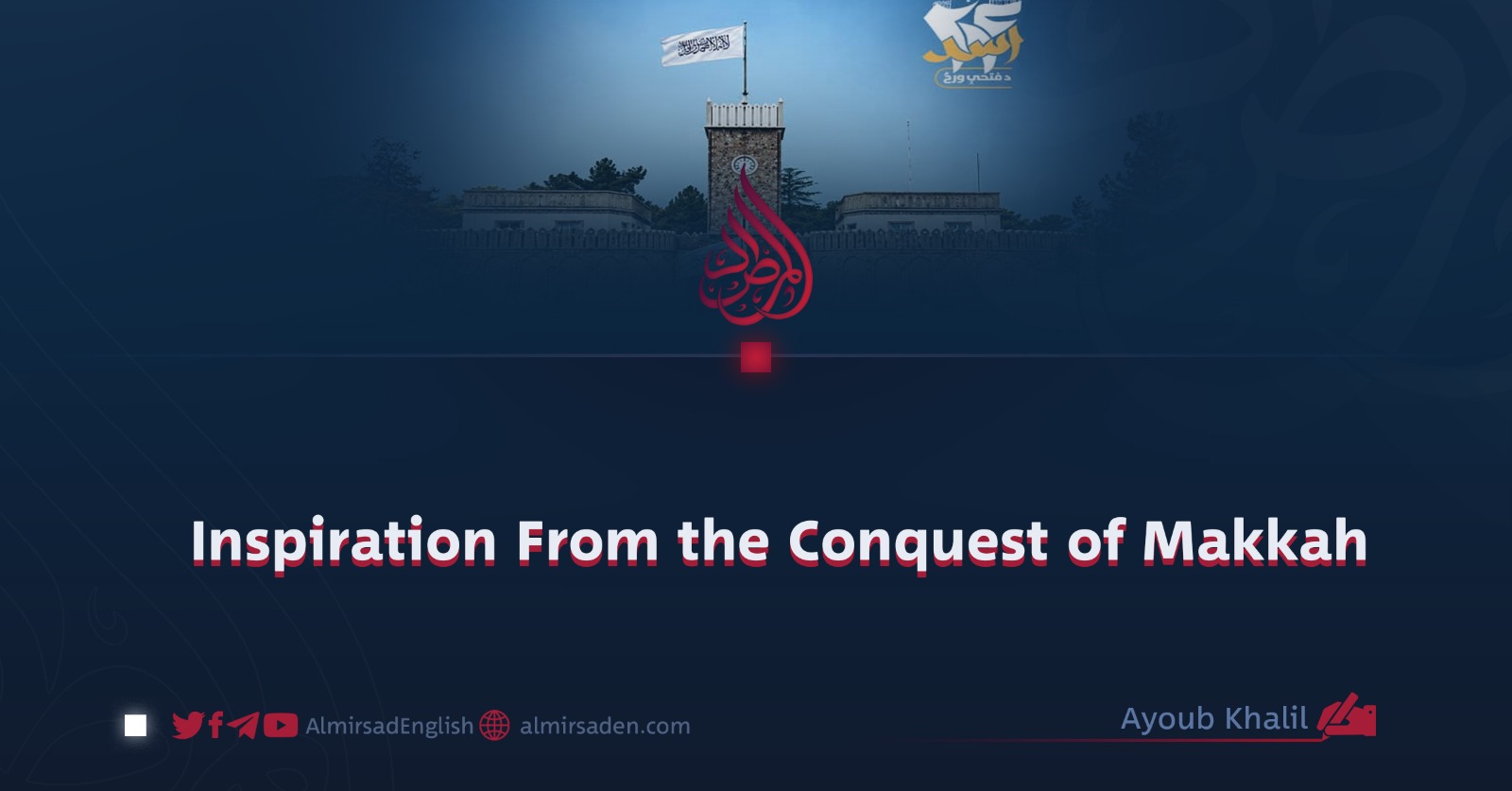
Throughout Islamic history, certain political and military events have held a special place in the memory of Muslims. The Conquest of Makkah under the leadership of the Prophet Muhammad (PBUH) in 8 AH/630 CE is one of the most important events in Islamic history. Nearly fourteen centuries later, after a long war in Afghanistan, the IEA forces entered Kabul on August 15, 2021, and took control of the country.
Both events came after long struggles. There were also important similarities between them in the circumstances surrounding them, the religious and ideological environment, the international setting, the political structure and the nature of the conflict.
The Conquest of Makkah and the Circumstances Behind It
The Prophet Muhammad (PBUH) began calling the people of Makkah to Tawhid. Muslims faced severe pressure, persecution, and social and economic restrictions. In 622 CE, the Hijrah to Madinah took place, and an Islamic society was established there.
In 628 CE, the Treaty of Hudaybiyyah was concluded. Later, an ally of the Quraysh became involved in a conflict with a group allied with the Muslims, breaking the balance established by the treaty. Following this, the Prophet (PBUH) marched toward Makkah. In 630 CE, Makkah was conquered and the Prophet (PBUH) entered the city.
One of the most famous features of the Conquest of Makkah was the atmosphere of forgiveness that prevailed instead of general revenge. Accounts of the Seerah describe at length the Prophet’s (PBUH) policy of forgiveness and his efforts to prevent bloodshed after the conquest.
The Circumstances Leading to the Return of the Islamic Emirate in Afghanistan
The IEA arose in Afghanistan in opposition to corruption and internal warfare and took power in Kabul for the first time in 1996. Although a U.S.-led international coalition occupied Afghanistan in 2001 and removed the IEA from government, its followers and the brave Afghan Mujahideen did not abandon their struggle to preserve the Islamic system.
They kept the fronts of jihad alive through sacrifice and perseverance. They never allowed the occupiers to feel at ease on this land. After 21 years of tireless struggle and war, Kabul was once again conquered and the Islamic system returned to power in Afghanistan.
In 2020, the Doha Agreement was signed between the United States and the Taliban, after which the withdrawal of foreign forces began. On August 15, 2021, the 24th of Asad, the IEA Mujahideen entered Kabul. The former puppet administration collapsed through the sacrifices of the Afghan Muslim Mujahid nation, and the IEA once again assumed responsibility for the Muslim people of Afghanistan.
The Common Ground Between the Two Events
Both conquests came after a long struggle. The Conquest of Makkah came after 21 years of the Prophet’s (PBUH) Daʿwah and political struggle following his mission. Likewise, following the method and path of the Prophet (PBUH), the IEA in Afghanistan returned to power after 21 years of war and political struggle.
In this sense, both events marked the end of a long period of struggle and the beginning of a new political chapter. Both are connected to the idea of an Islamic political order.
There are, however, fundamental differences in their historical circumstances, sources of legitimacy and international environments, including the question of forgiveness and general security. A major feature of the Conquest of Makkah was the policy of general amnesty. In 2021, the leader of the IEA, the Amir al-Mu’minin, may Allah preserve and protect him, also announced a general amnesty in accordance with the Prophetic method and Seerah.
The purpose of that announcement was to grant general amnesty to employees and opponents of the former Kabul administration and prevent acts of revenge against them. For this reason, forgiveness and limiting revenge present an important point of similarity when the two events are examined. However, the historical evidence concerning how each was implemented must be studied separately.
For any Islamic system, therefore, the greatest test after victory or taking power is not simply reaching power. It is how power is handled through justice, forgiveness, trust and responsibility. May Allah Almighty grant this system lasting strength so that it preserves this historical connection with the Prophetic method in all areas of the Islamic system.
The Difference in the Nature of the Wars and Political Circumstances
The background to the Conquest of Makkah was shaped by the Prophet’s (PBUH) Daʿwah between Makkah and Madinah, the Hijrah, the treaties and the political situation of the Quraysh.
Afghanistan, however, existed within the circumstances of the states, international organizations, foreign forces, international agreements and geopolitics of the twentieth and twenty-first centuries. The two events therefore have to be examined according to the political and historical circumstances of their own times.
The Lesson of Forgiveness
One of the greatest moral and political lessons of the Conquest of Makkah is the choice of forgiveness and the protection of people’s lives instead of revenge after victory. Allah Almighty says:
(إِنَّ اللَّهَ يَأْمُرُ بِالْعَدْلِ وَالإِحْسَانِ)
“Indeed, Allah orders justice and good conduct…” (An-Nahl: 90)
Victory Is Not the End, but the Beginning of Responsibility
One important lesson from the Conquest is that it was not merely a military victory. It marked the beginning of the responsibility to establish order in Islamic society, bring people’s hearts together, ensure justice, and strengthen the religious and social order.
Likewise, the political change in Afghanistan in 2021 was not merely the end of a war. It brought new responsibilities for building an Islamic system, including responsibilities toward the Muslim Ummah in the areas of the economy, education, justice, security, social stability and international relations.
Second: Madinah al-Munawwarah: Freedom Within Social Order
In 622 CE, the Prophet Muhammad (PBUH) migrated from Makkah to Madinah. Muslims, Jews and other groups lived together in the society of Madinah. Historical sources refer to the Sahifah of Madinah, or the Constitution of Madinah, in connection with the political and social order of the city. It sought to regulate relations and shared responsibilities among the different groups living there.
This experience shows that the Islamic understanding of society is not limited to a discussion of individual rights. Truth, responsibility, justice and social order are all connected.
Third: Freedom of Choice in Matters of Religion
From the Islamic perspective, faith has its true meaning when it comes from a person’s belief and free will. That is why Allah Almighty says:
(لَا إِكْرَاهَ فِي الدِّينِ)
“There shall be no compulsion in [acceptance of] the religion.”
This means that belief cannot be forced into a person’s heart. Faith must be based on conviction, understanding and choice. Islam calls for wisdom and clear explanation when inviting people to the faith, not for forcing a person’s heart to change.
Fourth: Freedom of Expression and the Responsibility to Speak the Truth
Islam gives value to a person who speaks the truth, but it does not separate speech from morality and responsibility. Allah Almighty says concerning justice:
(يَا أَيُّهَا الَّذِينَ آمَنُوا كُونُوا قَوَّامِينَ بِالْقِسْطِ شُهَدَاءَ لِلَّهِ وَلَوْ عَلَىٰ أَنْفُسِكُمْ أَوِ الْوَالِدَيْنِ وَالْأَقْرَبِينَ)
“O you who have believed, be persistently standing firm in justice, witnesses for Allah, even if it be against yourselves or parents and relatives.” (An-Nisa: 135)
For this reason, in Islamic culture, speaking the truth is tied to trustworthiness, honesty and justice. Freedom of expression does not mean that a person can use the name of “freedom” to legitimize lies, slander, humiliation or injustice against others.
Fifth: Individual Responsibility and Freedom
In some modern understandings, freedom is sometimes reduced to the idea of “doing whatever I want.” Islam does not accept this definition. If one person’s freedom destroys another person’s rights, then it is no longer absolute freedom. It has become a clash of rights.
For example, if someone uses freedom of expression as a reason to slander another person, damage his honor or spread lies about him, then his right to speak has become a means of violating another person’s rights.
This is one of the differences between Islam and modern concepts of freedom. Modern political thought recognizes different forms of freedom, including individual freedom, political freedom, freedom of expression, freedom of religion and civil rights. Islam shares certain elements with these concepts, but its philosophical foundation is different.
In secular thought, human will is generally regarded as an important source of lawmaking. In Islamic thought, however, human will remains connected to divine revelation, morality and the principles of Sharia.