



















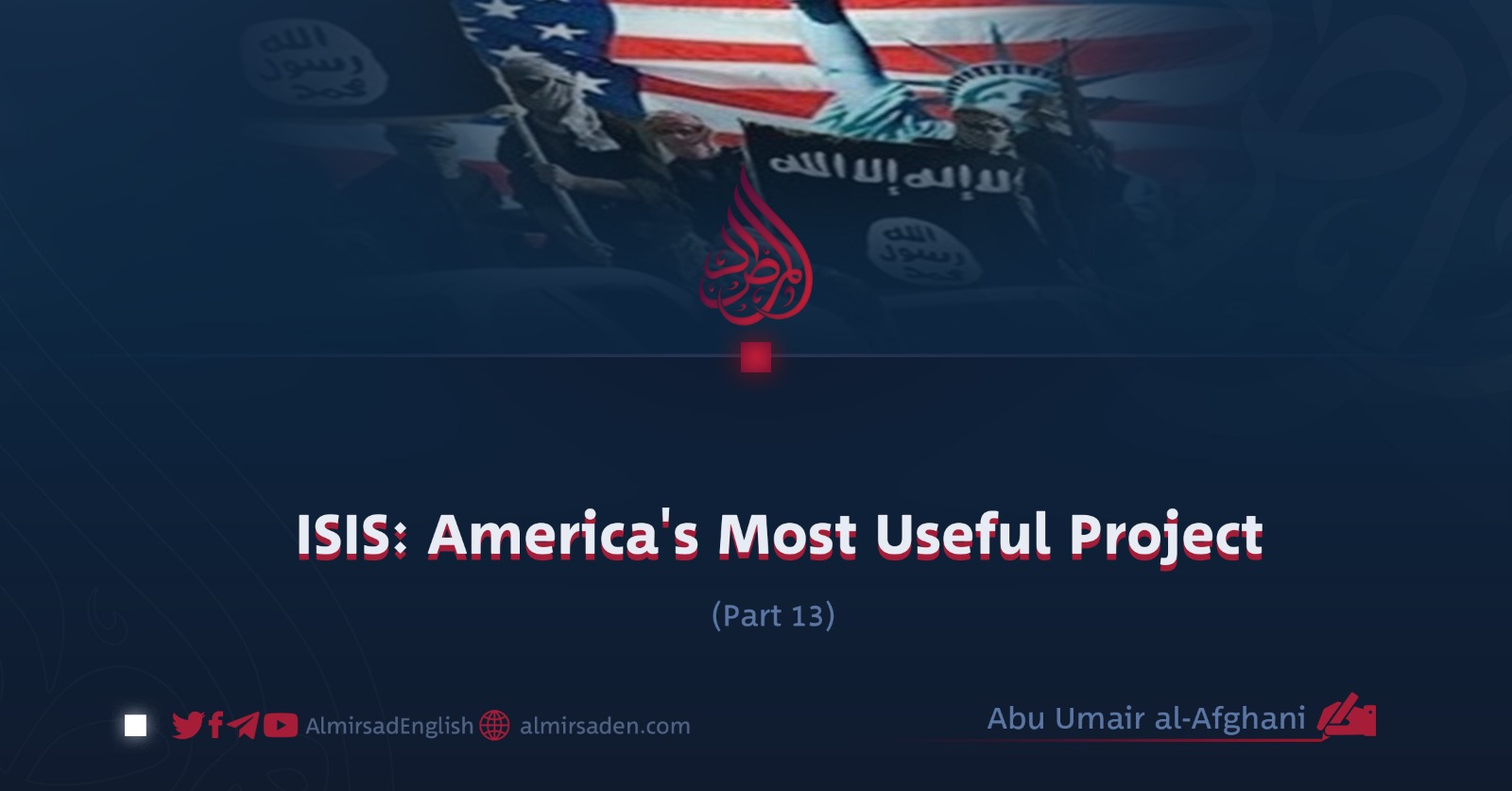
Part 13
By Abu Umair al-Afghani
Details of the West’s Objectives Behind the ISIS Project
First: Strengthening the Western claim that an Islamic system and the Caliphate are systems of oppression and dictatorship and cannot be applied in the modern age.
The West used ISIS to achieve this objective in several ways:
A. After the mid-20th century, nearly all Islamic and jurisprudential scholars supported the end of slavery, because Islam is the only religion that actively encouraged people to free slaves and promised great rewards in the Hereafter for doing so. When the international order eventually reached a point where the era of slavery came to an end, Islamic countries and scholars also accepted and supported this change. In the final years of the Ottoman Caliphate, the open markets for buying and selling slaves were shut down.
But ISIS brought this practice back and gave people the impression that if the Caliphate returned, markets for buying and selling human beings would return with it.
B. Under an Islamic system, non-Muslims who are not fighting against it and accept the laws of the Islamic state are granted specific rights. ISIS trampled all of these principles underfoot. It massacred the Yazidis of Iraq, who had lived for centuries under the protection of different Islamic states, to give people the impression that the Caliphate means nothing other than oppression and dictatorship.
C. ISIS became the first group to issue fatwas declaring jihad against nearly all other Islamist movements from the very beginning of its emergence and to launch wars against them. Its purpose was to make people believe that if a Caliphate were established, all Muslims would end up fighting one another, and that an Islamic system therefore cannot be applied in the modern age.
D. ISIS divided the Islamic world into Dar al-Islam and Dar al-Harb. It called the areas under its control Dar al-Islam and considered every area outside its control Dar al-Harb, even though it controlled not even five percent of Muslim lands.
What was even more astonishing was that it also treated Muslim women as slave women, declared much of the Muslim world to be unbelievers, and regarded their property and honor as spoils of war. The purpose of these actions was to create the impression that the Caliphate was not only a grave danger to non-Muslims, but to Muslims as well, and that it meant nothing other than oppression and dictatorship.
Under the name of the Caliphate and the Islamic system, and at the direction of the West, ISIS looted the property of Muslims, violated their honor, and carried out massacres. If one looks carefully, at the height of its power, ISIS did not cause the disbelievers nearly as much harm as it inflicted on Muslims. It also destroyed many historic monuments, shrines, and other heritage sites in Mosul.
During its rule, ISIS presented no practical system other than killing, plunder, and oppression. It did not explain to Muslims what an Islamic economic or political system would look like in practice. It did not clarify how an Islamic system should deal with non-Muslims who are not fighting it, what rights dhimmis have, or what the rules of Islamic warfare are. Nor did it explain what kind of policy the Caliphate would pursue for the welfare of humanity.
All of these matters remained unclear throughout the entire period of ISIS’s existence. This was because ISIS, acting at the direction of the West, continued these very practices to give people the impression that the Caliphate is a system of oppression and dictatorship that cannot be applied in today’s world.
And that is exactly what happened.
Before the emergence of ISIS, in many Islamic countries where young people had grown tired of secularism, the desire for an Islamic system of government was becoming stronger day by day.
But when people saw the reality of the ISIS project between 2014 and 2018, and young Muslims were shown the image that this was the very Caliphate they had been calling for, many young Muslims turned away from the idea, and support for secular thinking increased. Eventually, even mentioning the Caliphate and Islamic system became almost a crime in the minds of ordinary Muslims. In countries where Islam had been spreading steadily, the Islamic system came to be associated in people’s minds with terror and oppression.
Before the emergence of ISIS, Islamists in Egypt, Tunisia, Jordan, and Turkey had a strong drive to spread the idea of an Islamic system, and many young Muslims were drawn to that vision. But after ISIS’s actions and crimes, the influence of Islamist youth weakened, while people were made to believe that an Islamic system and the Caliphate were synonymous with ISIS’s oppression, actions, and dictatorship.
In this way, ISIS’s actions handed secularists a powerful subject and a ready-made propaganda tool against the Islamic system and the Caliphate. They could point to ISIS’s actions as an argument against the very idea of an Islamic system and the Caliphate.