









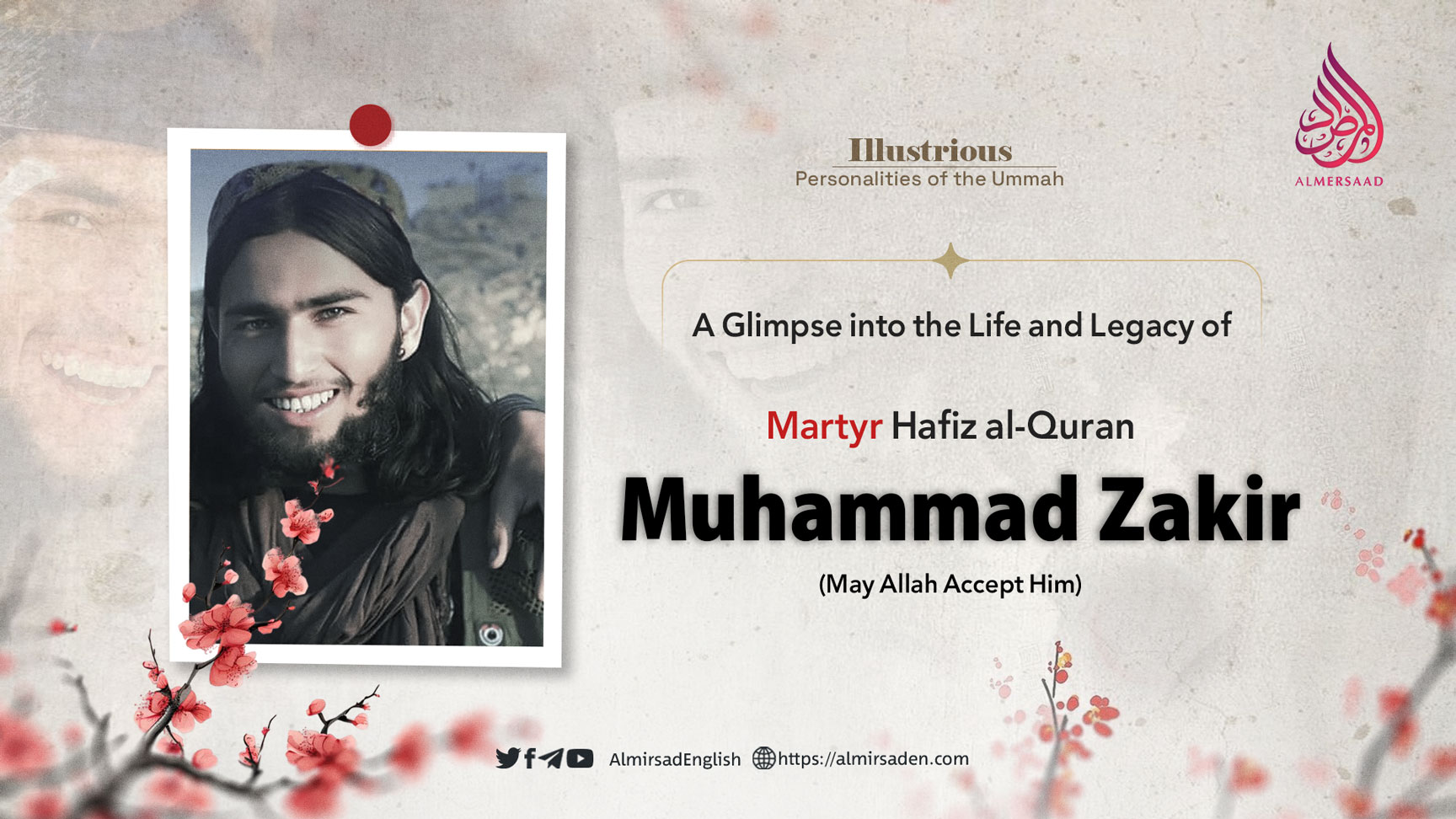
A shining star of courage, honor, and sacrifice, a young man of firm faith, deep sincerity, unwavering determination, and a true mujahid who stood for the cause of truth, Martyr Hafiz al-Quran Muhammad Zakir, son of Sardar Agha, was from Banduki village in Charkh district of Logar province. He was born in 1381 SH into a religious and mujahid family whose life was shaped by love for Islam, jihad, and taqwa. Muhammad Zakir was still a child when his heart became attached to the Book of Allah. He enrolled in the local madrasa in his village and district, where he eagerly devoted himself to the study of Islamic studies. He paid particular attention to memorizing the Holy Quran, and by the grace of Allah, he completed its memorization and earned the honorable title of Hafiz al-Quran.
Martyr Muhammad Zakir on the Battlefield of Jihad
Muhammad Zakir grew up in a family with a long history of jihad and sacrifice. Before him, his two elder brothers, Abdul Hadi and Gul Akbar, had given their lives fighting the American occupation and attained the rank of martyrdom. Their example strengthened his desire to join the jihad. Though still very young, he joined the ranks of the mujahideen and entered the battlefield alongside his companions.
To improve his military skills, he received military training in Charkh district. The training strengthened both his resolve and his experience, while also sharpening his combat abilities.
Muhammad Zakir was a thoughtful, courageous, modest, and well-mannered young man. He was firm and fearless in the face of the enemy, yet gentle, compassionate, and kind toward his companions and friends. He constantly asked his commanders to send him to the front lines. Whenever permission was granted, joy was visible on his face. If, for some reason, he was told to remain behind, sadness filled his heart and tears gathered in his eyes.
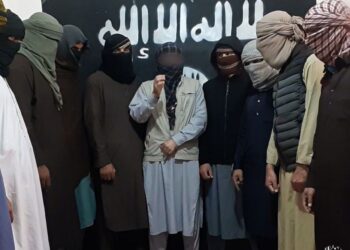
When the Khawarij fitna spread through parts of Nangarhar province and its oppression fell upon the local people, mujahideen from different provinces moved to eliminate the threat. Muhammad Zakir joined the group of mujahideen from Logar that headed for Nangarhar. He was a brave and steadfast mujahid. The commanders in Sherzad district planned an important assault on Daeshi Khawarij positions and began selecting men for the operation. Zakir repeatedly insisted, “Choose me as well. Do not leave me out of this battle.” These were not words spoken in passing. They came from deep conviction and firm determination. After repeated requests, the commanders assigned him to one of the hardest and most dangerous positions in the operation, a place where every step carried danger and every moment could be his last.
The Daeshi Khawarij had fortified themselves in strong defensive positions high in the mountains. At around ten o’clock that night, the assault force advanced toward those mountain positions. It was around one in the morning when Zakir and three of his companions reached the enemy’s strongest and most heavily defended positions. Their steps never faltered, their hearts remained firm, and their eyes were fixed on victory.
In those difficult moments, they attacked the enemy’s fortifications with remarkable courage and determination, breaking through one key position after another. What had seemed impossible was accomplished by their hands, and several important positions were wrested from the enemy. During one fierce clash, one of their companions suffered only a minor wound. Seeing this stirred an unusual wish in Zakir’s heart. He quietly said to himself, “I wish I could be wounded in this path in a way that would not keep me away from serving, a wound that would be a mark of service, not an obstacle to it.”
Only a few days later, destiny answered that wish. During another fierce face-to-face battle, near the end of the day, he too received a minor wound. It did not force him to leave the battlefield or weaken his resolve. Instead, it strengthened his determination even further.
He continued fighting in Sherzad district, where the fiercest battles were taking place. Serving on the front lines, he fought with exceptional courage. During the mujahideen’s offensives, several key positions were captured and a number of important enemy bases were destroyed. Another intense battle followed, in which many enemy fighters were killed while Zakir himself was wounded again. On the orders of his commanders, he was transferred to Logar for treatment. Once he had recovered, he immediately returned to the battlefield. This time, armed with greater experience and even stronger determination, he carried out effective attacks on enemy positions using a rifle fitted with thermal optics, killing many hired enemy soldiers.
Martyrdom
At last, on the blessed Friday of 25 Dalwa 1399 SH, at around three o’clock in the afternoon, the moment he had long hoped for arrived. During a close-range battle, after killing one enemy soldier and advancing near the enemy’s position, Muhammad Zakir attained martyrdom on the battlefield and returned to his Beloved Lord.
He departed from this world…
But his name lives on in the history of courage, faith, and sacrifice. His life became a lasting example of bravery, sincerity, and devotion.
نحسبه کذلک والله حسیبه.