









By Ehsan
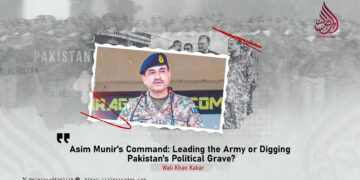
These days, Pakistan’s military regime is sinking deeper than ever into economic chaos and a widening domestic crisis. Growing public anger, rising sectarian violence, and the emergence of armed opposition groups across different parts of the country, especially in KPK and Balochistan, all show that the regime is facing serious instability.
For decades, Pakistan’s military presented itself as the guardian of the country’s security and stability. Today, however, it is under growing pressure from armed attacks and public protests, and its ability to control the situation at home is increasingly being called into question. Faced with these conditions, the regime sees only one way to ease public pressure. It shifts attention toward its eastern neighbor and tries to hide its own failures by committing aggression and crimes against the defenseless people of Afghanistan, especially innocent civilians living near the Durand Line.
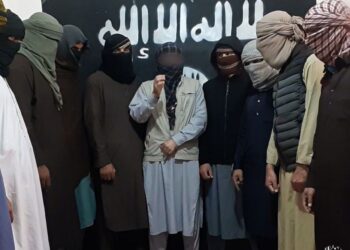
The Tehrik-e Taliban Pakistan (TTP), which has become one of Islamabad’s biggest challenges, is in fact the product of the same misguided and oppressive policies that the Pakistani regime has imposed on its own people for years. The movement was not imported from Afghanistan. It grew out of military operations, injustice, and repression carried out in Pakistan’s tribal areas.
If the TTP is now fighting the Pakistani regime, it is a direct result of the military’s own actions and the policies pursued by the government in Islamabad. How can people who have spent decades living under military rule, pressure, and repression be expected to remain silent? The Pakistani regime spent years backing armed groups across the region while oppressing its own people. In the end, it planted the seeds of rebellion in its own soil.
To escape this storm at home, Pakistan’s corrupt and failing regime has chosen to turn its failures toward Afghanistan. Through airstrikes and artillery attacks, it targets civilians living near the Durand Line. On one hand, it tries to rally its own people under the slogan of fighting terrorism. On the other, it attempts to cover up its helplessness against the TTP by putting on a show of force. It is an old and worn-out tactic that weak regimes have relied on throughout history. Instead of solving their own problems, they dump the burden of their failures on innocent neighbors and try to wash their stained image with the blood of Afghan children and farmers.
One point, however, should not be overlooked. The TTP and other armed groups have no connection with Afghanistan. They emerged inside Pakistan, and their roots lie in Pakistan’s own internal problems. Since the Islamic Emirate of Afghanistan (IEA) returned to power, Afghanistan has not only refused to support such groups but has repeatedly declared that it will not allow anyone to use Afghan soil against another country.
The IEA’s spokesman has also stated clearly: “Afghanistan has no role in Pakistan’s internal problems. It is the Pakistani government that must find a solution to its own issues.” Pakistan’s attacks on Afghanistan are nothing more than an attempt to hide its own weakness. They have no legal, humanitarian, or Islamic justification.
Pakistan’s internal crisis has now reached a point where its military is losing more of its authority with each passing day. Armed groups are expanding their influence over wider areas, while the government in Islamabad has proved unable to stop them. Yet instead of choosing reform and common sense, the regime tries to cover itself with the blood of its neighbors. Sooner or later, that mask will fall away. The oppressed people of Afghanistan will not remain silent in the face of such aggression. Allah Almighty says in the Holy Qur’an: “Indeed, Allah does not love those who spread corruption.” The end of oppression and corruption has never been anything but ruin.
In the end, one thing has become clear. Pakistan’s regime now understands that the storm rising inside its own borders is far more dangerous than any imagined threat from Afghanistan. Every new attack only deepens its own wounds while increasing the anger of the Afghan people against it. A regime once seen as a skilled player in regional affairs has become trapped in the consequences of its own baseless and criminal decisions. The only way out is a fundamental change in the way it thinks and acts.
Until that day comes, the innocent blood of Afghan children and farmers will remain a witness against this regime. It will light up the darkest pages of history and reveal its true face to future generations as a lesson in failure and disgrace. A system that has lost all sense of patience, tolerance, and humanity cannot even learn from its own destruction. That is the truth the Pakistani regime has tried so hard to hide, yet its own actions continue to write it into history.