















By Ahmad Shafaq
When a country’s security policy rests not on facts on the ground and solid intelligence, but on calming public anger and managing public relations, its entire narrative quickly begins to fall apart and the truth eventually comes to light.
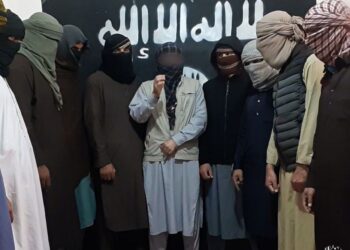
The Pakistani military circles’ response to the recent attack on the Rangers’ headquarters in Karachi was a clear example of this. In a rush to cover up their own intelligence failure, they tried to shift the blame onto Afghanistan. A detained man was presented in a so-called confession video to convince the Pakistani public that every armed attack inside Pakistan somehow traces back to Afghanistan.
Under the cover of that narrative, the Pakistani military swiftly carried out airstrikes on the Afghan provinces of Kunar, Paktia, and Paktika, killing innocent civilians. But this propaganda story began to unravel when the accent of the man in the confession video made it clear that he was not from Afghanistan at all, but from Peshawar or its surrounding areas.
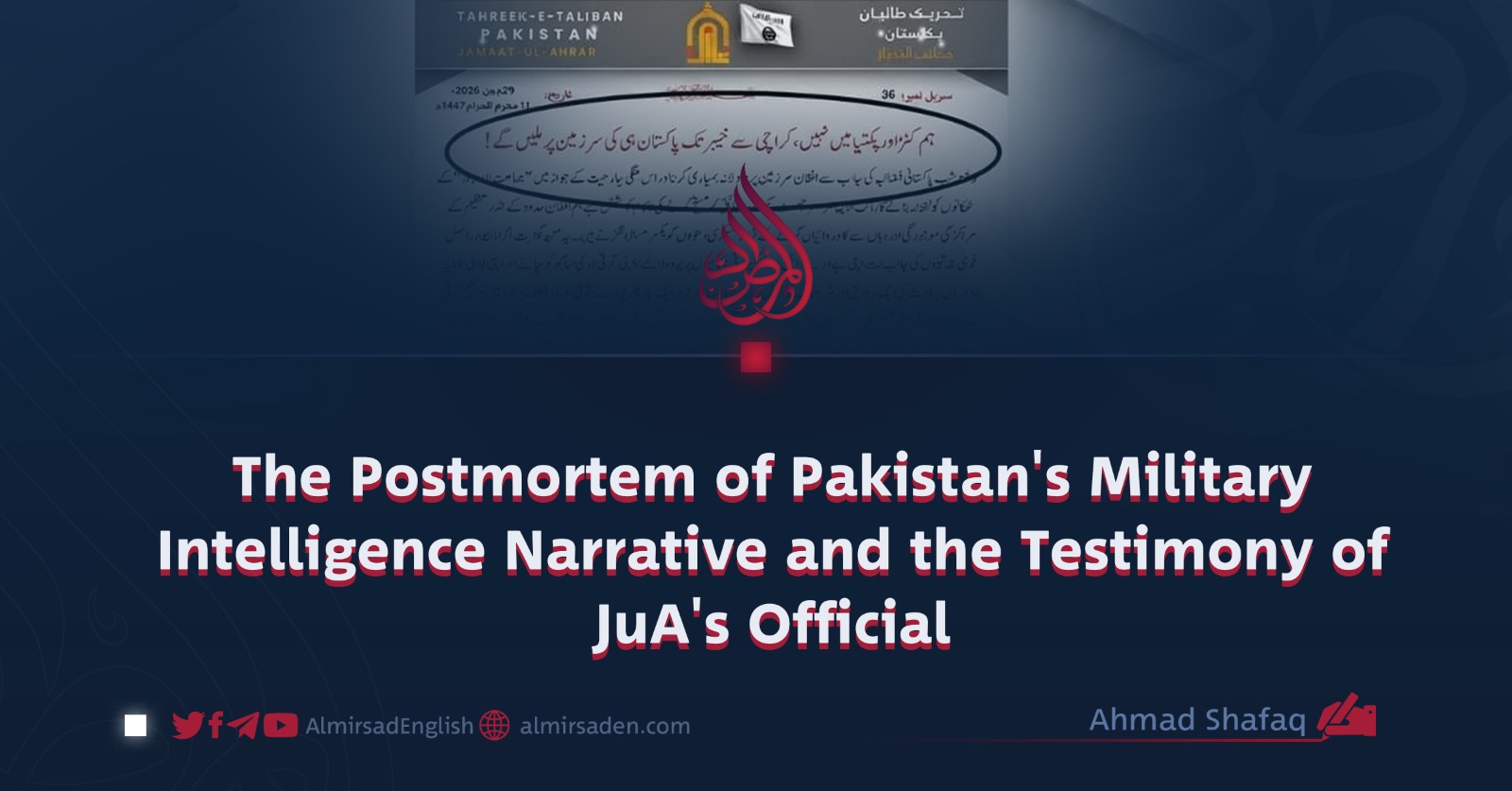
The final and most damaging exposure came on June 29, 2026, when an official and well-documented statement surfaced.
In the history of security and international affairs, few cases are as remarkable as this: the very armed group in question, Tehrik-e-Taliban Pakistan (Jamaat-ul-Ahrar), issued a statement on its own official letterhead that completely demolished the Pakistani state’s claims. Published under the title “We Are Not in Kunar or Paktia; We Are in Pakistan, from Karachi to Khyber,” the statement directly rejected the military’s long-standing claim that attacks inside Pakistan are directed from Afghanistan.
The statement dealt a heavy blow to the propaganda coming out of GHQ Rawalpindi. JuA openly declared that its military, organizational, and human infrastructure exists not in any neighboring country but inside Pakistan itself, and that it has no need to use Afghan territory to pursue its objectives. It even issued an open challenge to Pakistan’s military leadership: if they truly have the courage, stop bombing helpless Afghan civilians and instead confront the group in Karachi, Lahore, Islamabad, Quetta, and Peshawar, where its networks are active.
For any ordinary reader, the obvious question follows: if the group itself says it is inside Pakistan, then why is Afghanistan being bombed? Is this anything more than an attempt to hide failure? At the same time, the statement reinforces Afghanistan’s long-standing position that its territory is not being used against any neighboring country.
When Pakistan’s intelligence apparatus cannot track armed groups moving across nearly 1,500 kilometers of its own territory from Bajaur to Karachi, it chooses to place the burden of that failure on another country. This exposes the deep crisis of credibility and intellectual weakness within Pakistan’s military circles and much of its media. Rather than dealing with reality, they have built an artificial narrative around military talking points. It also lays bare the dangerous relationship between the military, the media, and the war economy.
Pakistan’s intelligence services loudly publicize every attack carried out by these groups to create an atmosphere of fear inside the country and fuel hostility toward Afghanistan. That climate is then used to justify larger defense budgets, preserve the privileges of the ruling elite, and maintain the military’s grip over politics and the economy. But the question remains: do the military and the media have the courage to show the public this official statement from the very same group? Or will they continue presenting only the version of events that serves their interests?
That silence reflects a deeper hypocrisy. One side of the story is amplified, while the evidence that destroys the official narrative is quietly buried. The reality is that Pakistan will never solve its security crisis by searching for enemies abroad. It must confront its own internal problems instead. If it refuses to change course, it will continue sowing lasting hostility on both sides of the Durand Line, creating a crisis that will eventually consume its own security system. History has also shown that Afghanistan, despite the harshest circumstances, has repeatedly stood firm against far greater powers. There is no path to safety except through accepting the truth.
The conduct of Pakistan’s military circles, along with the media, religious figures, politicians, and think tanks that echo their line out of fear, reflects “kick the dog” behavior, redirecting anger and aggression toward a weaker target instead of confronting their own failures. The Pakistani military elite knows perfectly well that Afghanistan still possesses neither a modern air defense system nor combat aircraft.
Yet the same military also blames India and Iran for the insurgency in Balochistan, while never daring to launch similar air operations there because it fears retaliation. That official letterhead presents Pakistan’s generals with a direct challenge: instead of using cowardly force against helpless Afghan children and civilians across the Durand Line, confront the organization where it says it actually operates, in Karachi, Lahore, Islamabad, Quetta, and Peshawar.
That document alone is enough to prove that Pakistan’s internal security crisis cannot be solved by opening new fronts against its neighbors or by spilling the blood of innocent people. The real solution lies in reforming itself and ending the injustices committed against its own people. If, even after seeing the truth reflected in this official statement, Pakistan’s military refuses to change course and continues blaming its own failures on the Afghan people, it will only deepen a lasting hatred on both sides of the Durand Line, a hatred that will ultimately drive Pakistan’s entire security system into a crisis from which there will be no escape.