










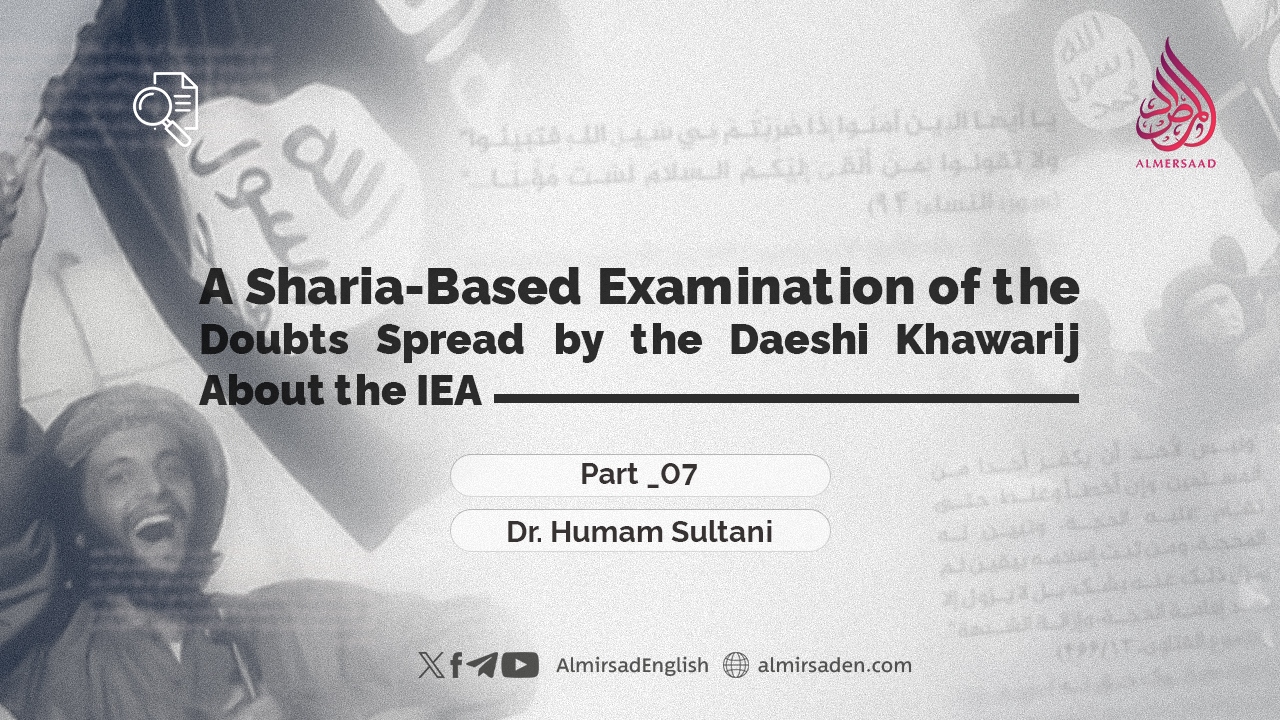
Part 7
Dr. Humam Sultani
The Maturidis and the Question of Attributing Grave-Related Beliefs
Some circles that criticize the Maturidis try to attribute to all Maturidis the disputed beliefs and customs about graves found in some circles of the Barelvi school. This kind of argument fails the test of scholarly honesty and fairness, because the particular views of some followers or groups of an intellectual school can’t be counted as the accepted beliefs of the entire school.
Counting the Maturidis and the Taliban as followers of grave-related beliefs, merely because of a Maturidi connection, is wrong. Take the supporters of some oppressive rulers and the state-aligned clerics: even if they claim a connection to Salafism, the blame for their views and actions can’t be placed on the whole Salafi school. In the same way, the particular beliefs of some Barelvi circles can’t be attributed to all Maturidis. Justice and fairness require that the beliefs of any intellectual school be understood in light of its reliable scholarly sources and the statements of its recognized scholars, and that no ruling on a whole school be issued on the basis of the views and actions of some related individuals.
Does the Maturidi Creed Rest on Disbelief?
The general claim that the Maturidi creed is disbelief lacks the necessary sharia evidence, because Maturidi scholars believe in the fundamental pillars of Islam, in the oneness of Allah (SWT), in the Prophethood of Muhammad (PBUH) and his being the final Prophet, in the truth of the Holy Quran, and in the Day of the Hereafter.
In Islamic sharia, takfir is a very sensitive ruling, tied to a decision about a Muslim’s religious standing. For this reason, sharia strictly forbids carelessness in declaring Muslims disbelievers and attributing disbelief without Sharia evidence.
The Messenger of Allah (PBUH) said:
“أَيُّمَا رَجُلٍ قَالَ لِأَخِيهِ يَا كَافِرُ، فَقَدْ بَاءَ بِهَا أَحَدُهُمَا”
[Al-Bukhari, Hadith 6104]
“Whoever says to his brother, ‘O disbeliever,’ then it returns upon one of them.”
Allah (SWT) also says:
﴿وَلَا تَقُولُوا لِمَنْ أَلْقَىٰ إِلَيْكُمُ السَّلَامَ لَسْتَ مُؤْمِنًا﴾ [An-Nisa 94]
“And do not say to one who gives you [a greeting of] peace, ‘You are not a believer.'”
Under these Sharia guidelines, a Muslim, or a Muslim group, can’t be declared disbelievers on the basis of a sectarian affiliation, a theological disagreement, or the claims of opponents alone. Declaring a specific individual a disbeliever first requires an accurate study of the sharia ruling on his statement or act, then attention to whether the conditions of takfir are met and no impediments exist. Ignorance, valid interpretation (ta’wil), coercion and other sharia excuses carry weight in this discussion according to the nature of the issue, and assessing them is the responsibility of the people of knowledge.
In this way, ruling on a statement or belief as disbelief, calling it an innovation, and applying a ruling of disbelief to a specific person are separate sharia discussions. For this reason, a general takfir of Maturidi scholars and followers of this creed, based only on theological disagreements or sectarian affiliation, has no sharia justification.
The Takfir Claim Against the IEA and the Taliban, and Its Sharia Assessment
The Daeshi Khawarij and some other takfiri groups present the Deobandi affiliation and Maturidi creed of the IEA and the Taliban as their evidence for declaring them disbelievers, but these scholarly and doctrinal affiliations alone can’t be sharia evidence for takfir.
It’s also worth mentioning that Afghanistan’s general public and most of the Taliban aren’t familiar with the details of these complex theological debates and doctrinal disagreements, and have no particular interest in these fine points. They generally follow the scholarly and doctrinal path of their scholars and elders, without being familiar with the details of every theological disagreement.
Some opponents of the Taliban, however, inflate these theological disagreements far beyond their size, exaggerating them and turning them into a tool for creating takfir and division.
Regarding the Taliban’s doctrinal conduct, it also matters that they don’t disrespect Sheikh al-Islam Ibn Taymiyya (rh), Imam Ibn al-Qayyim (rh) or the other great scholars of the ummah. The sayings and guidance of these elders were quoted in the Taliban’s official journals and scholarly publications in the past and still are today.
The Taliban’s position is also that holding a Salafi creed is not itself a cause for punishment or pursuit, and that they don’t interfere in the creeds, madrasas and mosques of Salafis merely because of a religious or doctrinal disagreement. But when some circles declare the Taliban disbelievers, or incite people against them and rise up to confront them, the Taliban take action against them.
For this reason, the general accusations that the Taliban kill and persecute Salafis merely for holding Salafi beliefs, even though they have committed no crime, can’t be accepted without specific, reliable evidence.
After the Islamic Emirate of Afghanistan (IEA) returned to power in Afghanistan, according to reports, Salafi groups also pledged allegiance to the IEA, and through this they expressed cooperation with the existing system. The strengthening of good relations and mutual trust between these groups and the IEA shows that, despite the existence of jurisprudential disagreements, Muslims can keep peaceful, constructive relations with one another on the basis of shared Islamic values, mutual respect and understanding.
The IEA and the Salafi groups believe in the fundamental tenets of Islam, in the truth of the Holy Quran and the Prophetic sunnah, and in the unity of the Islamic ummah. For this reason, the scholarly and theological disagreements between them must not be turned into a tool for enmity, takfir and internal division.
The interests of the Islamic ummah require that followers of the various scholarly and doctrinal schools, instead of deepening their disagreements, stress their shared religious values, stop baseless accusations and takfiri propaganda, and strengthen an atmosphere of brotherhood, unity and mutual trust.
Examples from Islamic History and the Demand for Fairness in Doctrinal Disagreements
Many eminent scholars of the Muslim ummah have been followers of the Ash’ari school, and Imam Nawawi (rh), Hafiz Ibn Hajar al-Asqalani (rh) and Izz al-Din ibn Abd al-Salam (rh) are among the best-known examples. Famous rulers and military commanders tied to this same school also rendered great services to Islam in history and won great conquests.
Among these figures, the name of Sultan Salah al-Din Ayyubi (rh) deserves special mention, the great conqueror who freed Bayt al-Maqdis after nearly nine decades of Crusader rule. Even today, scholars, historians, poets and writers remember this great historic service of his with pride and praise. Yet Sultan Salah al-Din Ayyubi (rh) was a firm supporter of the Ash’ari creed, and he paid particular attention to promoting it in the areas under his rule, especially Egypt.
On the other hand, the great Ottoman ruler Sultan Muhammad al-Fatih (rh) was among the famous historical figures of the Hanafi and Maturidi scholarly tradition, and his conquests, military leadership and historic services are still counted worthy of recognition and praise today.
The historical examples of these two rulers show that the figures and dynasties of Islamic history shouldn’t be assessed on the basis of their theological affiliation alone. Their beliefs, their deeds, their justice, their religious services and their influence on Muslims’ lives should also be taken into account.
The main purpose of this discussion is that Muslims shouldn’t overlook one another’s scholarly, religious and historical services over their doctrinal disagreements. The Muslim ummah needs a just government that protects people’s religion and worldly life, implements the rulings of sharia, supports the oppressed, and safeguards Muslims’ security and legitimate rights, whether its leader is a Maturidi like Sultan Muhammad al-Fatih or an Ash’ari like Sultan Salah al-Din Ayyubi.
For this reason, anyone who, whether Ash’ari or Maturidi, judges among people by the sharia of Allah (SWT), protects their religion and worldly life, doesn’t befriend their enemies, and doesn’t back anyone against the Muslims, is thousands, even hundreds of thousands of times better than a so-called Salafi who distorts the rulings of sharia, twists their original form, suspends their rulings and blocks their implementation, supports oppressive and rebellious rulers, stands beside the enemies of religion, and helps the Jews and Christians dominate Muslim countries and their wealth!
From the discussion above, it is clear that Maturidism is a recognized theological approach in Islamic creeds, with a deep historical and scholarly connection to the Hanafi doctrinal tradition. Scholars of this approach have rendered considerable services in defending Islamic creeds and in tafsir, hadith, fiqh and the other Islamic sciences, even though they disagree with other scholars on some theological issues.
These disagreements can be a subject of scholarly critique and study, but a general takfir of Maturidi scholars, followers of this creed, or the IEA and the Taliban, based only on sectarian affiliation or theological disagreement, lacks the necessary sharia evidence.
For this reason, scholarly fairness, sharia caution and mutual respect are needed in assessing the disagreements among the ummah’s scholars and intellectual schools, because baseless takfir and the creation of enmity and division among Muslims over doctrinal disagreements harm the unity of the ummah and Islamic brotherhood.