













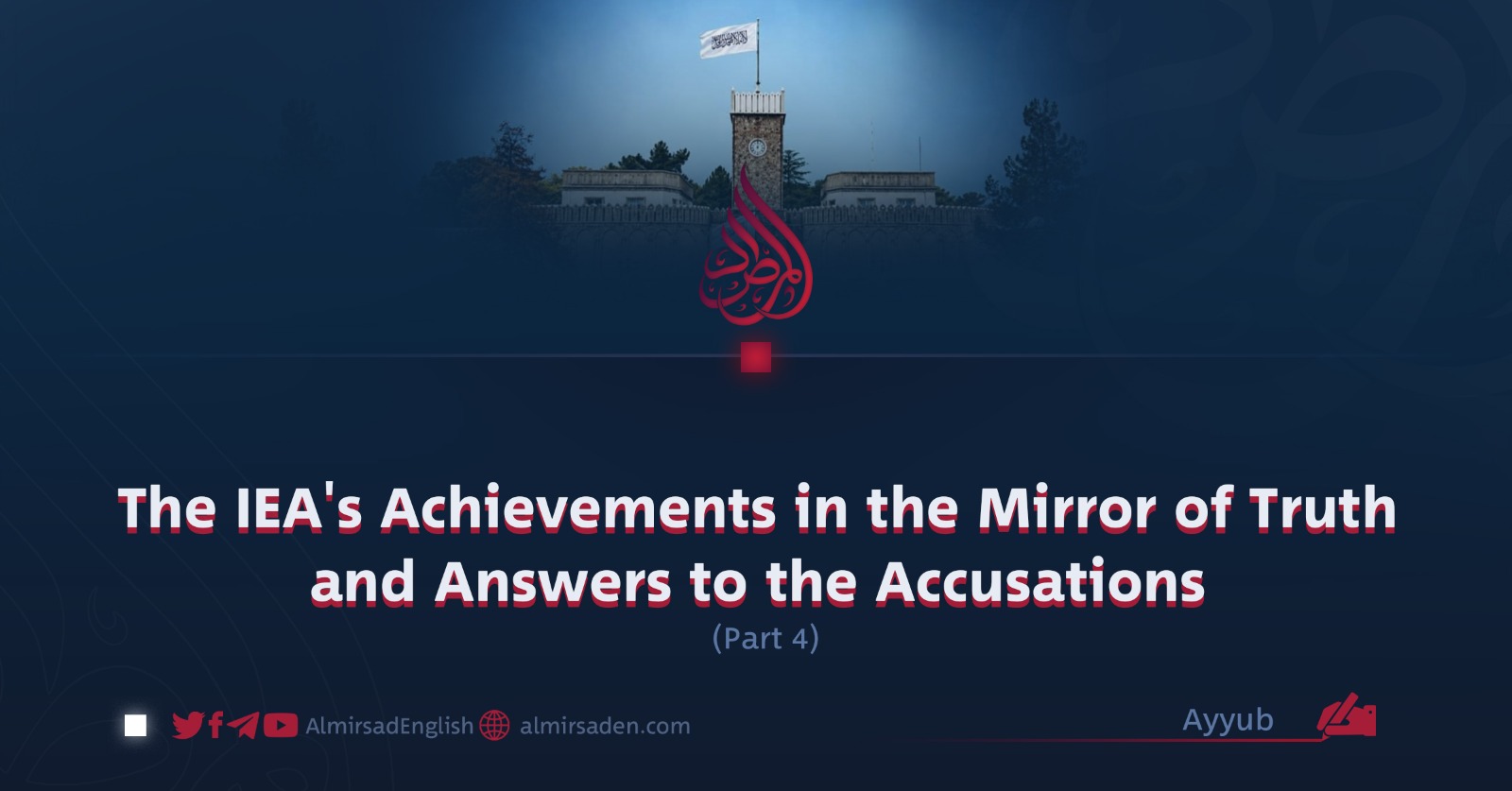
Part 4
By Ayyub
Strengthening Islamic Values and Reviving Public Rights
After the important steps taken toward establishing security and building a self-sufficient economy, one of the areas the Islamic Emirate of Afghanistan (IEA) has given special attention to is establishing the rule of law and securing justice on the foundation of Islamic sharia. From this system’s point of view, justice isn’t limited to just investigating a case and issuing a ruling in court. It’s one of the foundational pillars of the Islamic system, and it’s counted as a tool for protecting people’s rights, preventing injustice, and establishing social order. That’s why strengthening sharia courts, fighting corruption and land-grabbing, examining people’s cases, and resolving disputes through reconciliation and settlement are among the important steps taken during this period.
To understand the significance of this shift, it’s also worth recalling the judicial condition of the previous system. Back then, the judicial system faced corruption, political interference, delays in case investigation, and the influence of powerful strongmen. In certain areas, the seizure of state and endowment lands had become a serious problem, and a number of warlords and local commanders had their claws dug into public wealth. This situation had lowered people’s trust in state institutions, and in some cases forced people to turn to informal bodies, or even to violent means, to resolve their own disputes.
After its victory and after the system was established, the IEA tried to change this situation by building a judicial structure on the foundation of sharia. Activating courts at the center and in the provinces, examining civil and criminal cases, giving attention to family, inheritance, divorce, and custody cases, and insisting on resolving disputes through reconciliation and settlement, are all part of this process. In Islamic culture, mending relationships between people and putting an end to enmity and disputes hold a special place, so expanding this path can play an effective role in strengthening social calm and reducing hostility among people.
One clear example of reviving public rights is the fight against the seizure of state and endowment lands. The commission for preventing land seizure and recovering seized lands is carrying forward the process of identifying, confirming, and recovering these lands across different provinces. Recovering lands that had remained under the control of individuals and strongmen for years, alongside protecting public wealth, means, from the standpoint of public rights, returning property belonging to the people and the public treasury back to its rightful place. This process also carries a clear message: public property shouldn’t become a tool for the personal gain of specific individuals and groups.
Alongside these steps, the Ministry of Justice and other related institutions have also provided people with legal services and public awareness programs. Providing legal services to people in need, and making them aware of their sharia and legal rights and obligations, the way the country’s leader has repeatedly conveyed to people in his rulings, recommendations, and speeches, can make it easier for people to access justice. Detailed figures on these activities exist in the official reports of ministries, courts, and responsible institutions, and the relevant officials have shared these with the people on various occasions.
Despite these important, constructive steps, certain opposing media outlets, destructive individuals, and hostile circles try to portray the IEA’s judicial and legal system as entirely lacking justice and the rule of law. One of their claims is that there’s no functioning judicial system in Afghanistan at all, when the daily activities of the courts, the handling of people’s cases, the issuance of sharia rulings and documents, and the pursuit of land-seizure cases don’t line up with that claim at all.
Another claim is that the judicial apparatus is entirely subject to political considerations. This claim could be fairly weighed only if the real condition of the Republic era’s judicial system isn’t also ignored, a period that itself faced widespread accusations of corruption, political pressure, and the influence of strongmen. The IEA claims that, on the foundation of sharia, it has tried to make sharia rulings and official regulations the main standard for handling cases, and has narrowed the room for interference from foreigners and warlords.
Another claim is that the rights of women and different layers of society have been ignored. The IEA’s official position is that within the framework of Islamic sharia, citizens’ rights are protected, and courts are obligated to examine family and other sharia-related cases according to Islamic rulings. That’s why judgment about the judicial system’s functioning should be based on the actual work of the courts, documents, and reliable reports, not just on the political narratives of biased individuals and the propaganda of opposing media.
Of course, the judicial and legal system, like any other structure, still needs more effort toward greater transparency, faster case processing, and easier public access to justice. But the existence of challenges shouldn’t be a reason to dismiss everything that’s been accomplished. What matters fundamentally is that public rights are recovered from the grip of strongmen, public wealth is protected, corruption is reduced, and people can access justice without connections, bribery, or fear. From this angle, strengthening Islamic values and reviving public rights isn’t just an administrative program of the IEA’s system, it’s counted among the foundational pillars of social stability, public trust, and Afghanistan’s future. The IEA has set this as one of its own working priorities.