



By Ehsan
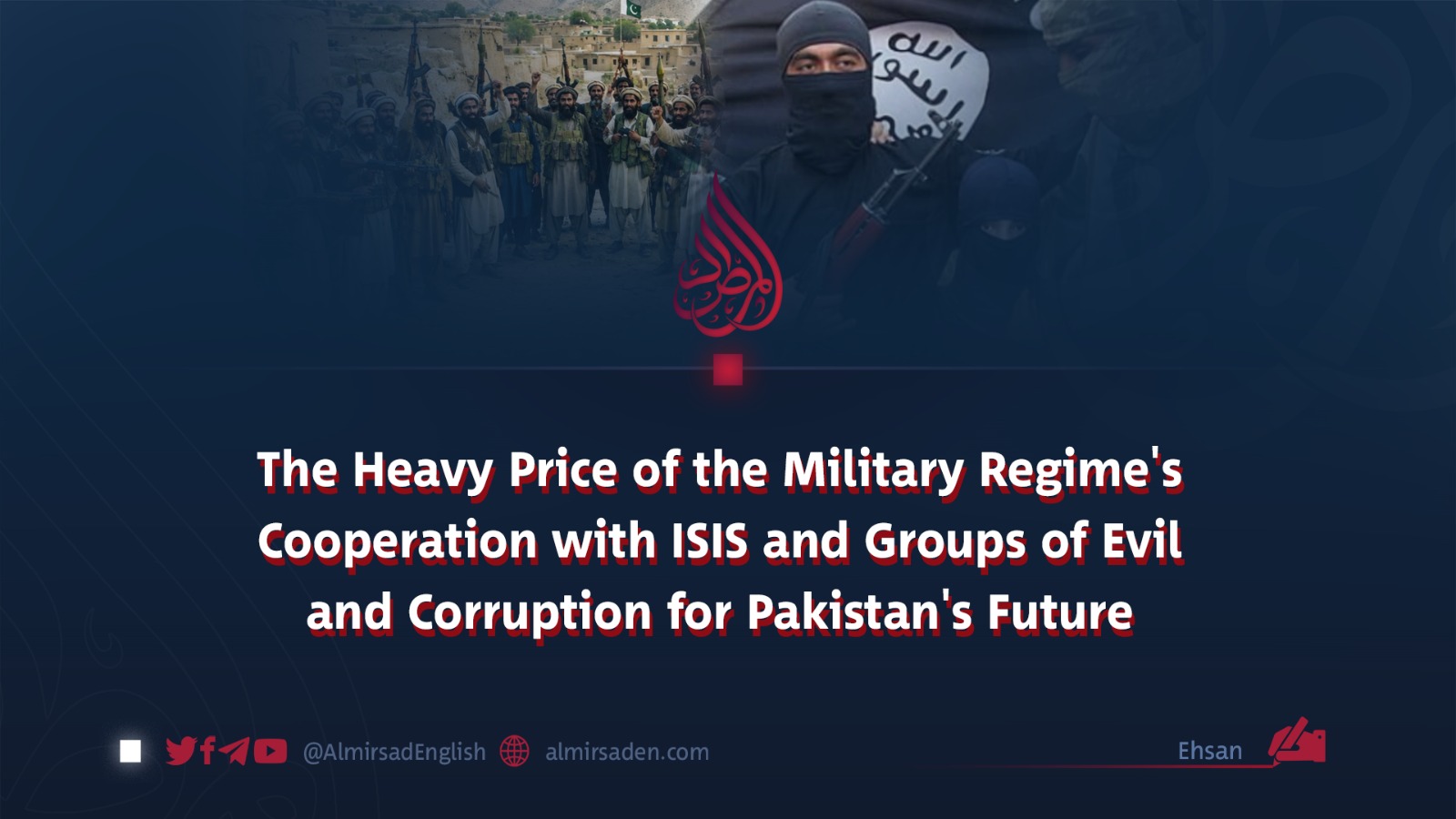
In recent years, although Pakistan’s military regime has repeatedly claimed that it is fighting terrorism, in practice it has become the biggest supporter and patron of the ISIS takfiri group and groups of evil and corruption. This double-faced, contradictory, and deceptive policy is being pursued while billions of rupees from Pakistan’s national wealth are being spent on training, equipping, and supporting ISIS and its hired elements, namely former Arbakis. At the same time, large numbers of Pakistanis are struggling with poverty, unemployment, high prices, a lack of basic healthcare, and many other problems under the shadow of this military regime.
These huge expenditures are being made in circumstances where the result has not been greater security for the Pakistani people. On the contrary, they have led to wider insecurity and greater fear of attacks. In other words, by continuing this policy, Pakistan is both wasting its national wealth and putting the security of its own people at serious risk, without gaining anything positive for the country.
One of the most destructive consequences of this policy is the loss of trust among the Pakistani people in the country’s military and political institutions. A population that sees with its own eyes the army dealing and cooperating with the very groups it claims to be fighting can no longer regard the military as a genuine protector of national security and territorial integrity. This distrust gradually spreads to the entire political system and puts the legitimacy of the government into question. In such a situation, people begin to conclude that the ruling institutions are acting not in the national interest, but to preserve their own power and personal interests.
This sense of hopelessness and distrust creates an environment for protest movements and even separatist tendencies, pushing the country toward political instability and possible collapse. History has shown that once the bond of trust between the people and the rulers is broken, no military or security force can maintain a country’s stability. Society gradually moves toward disorder and decline.
On the other hand, supporting one of the world’s largest takfiri groups, namely ISIS, as well as groups of evil and corruption, has seriously damaged Pakistan’s international standing in the eyes of public opinion in the region and around the world. A country that talks about fighting terrorism but in practice trains terrorists and uses them in other countries to achieve its political objectives will soon lose its credibility in the world and, in the long run, move toward isolation under diplomatic and economic pressure.
Today, even Pakistan’s close allies view its policies with suspicion and are trying to keep their relations with the country within the limits of economic interests rather than offering unconditional political support. This international isolation means a decline in financial and military assistance, a fall in foreign investment, greater trade restrictions, and, as a result, a weakening of Pakistan’s position in international affairs. In today’s world, where international cooperation is considered a foundation of development and prosperity, no country can continue such a policy and still expect to maintain an acceptable place in the international system. This will become one of the biggest obstacles to Pakistan’s development and reconstruction.
Perhaps the most dangerous effect of this policy is the threat it poses to Pakistan’s national unity. Pakistan was founded on a religious identity, but in reality it is a combination of many large and small ethnic groups, languages, cultures, and historical identities. Punjabis, Sindhis, Pashtuns, Baloch, and other peoples each have their own distinct identity, and any form of discrimination and structural oppression can push these identities toward separatism. Cooperation with ISIS and groups of evil and corruption can produce exactly this destructive outcome.
When the Pakistani military uses these groups to put pressure on Pashtuns and Baloch, it is in fact sending them a message that they are second-class citizens of this country and that their rights have no value. This feeling of deprivation and discrimination will, in the long run, turn into stronger separatist movements. Such movements will no longer remain silent in exchange for money and empty promises, but will fight to the very end for their rights. History has shown that multi-ethnic countries either achieve stability and progress through justice and the equal participation of all their peoples, or move toward decline and fragmentation because of discrimination and repression. Unfortunately, Pakistan appears to be choosing the second path and, by continuing these misguided policies, is preparing the ground for its own possible collapse.
What is being used today as a tool to weaken neighboring countries will, in the very near future, become a tool for weakening Pakistan itself. ISIS and other groups of evil and corruption are not inherently loyal to any state. Their loyalty is tied to money and short-term interests. Whenever Pakistan’s financial support is cut off, or they see greater benefits elsewhere, they can quickly be turned against Pakistan itself.
The groups being trained and equipped today with Pakistan’s financial support may tomorrow raise their weapons against the country’s own military and people. The bitter lessons of history have proven that nurturing proxy and paramilitary groups has never ultimately benefited those who trained them. In the end, the consequences of such a policy have returned to haunt the very country that pursued it. Pakistan will be no exception to this rule, and sooner or later it will pay a heavy price for this strategic mistake.
The IEA is closely watching such plots with full awareness and, drawing on popular support and the experience of jihad, will never allow hired and proxy groups to threaten Afghanistan’s security and stability. But the most worrying reality is that by continuing this very policy, Pakistan is moving closer every day to the pit of its own possible decline and downfall.