





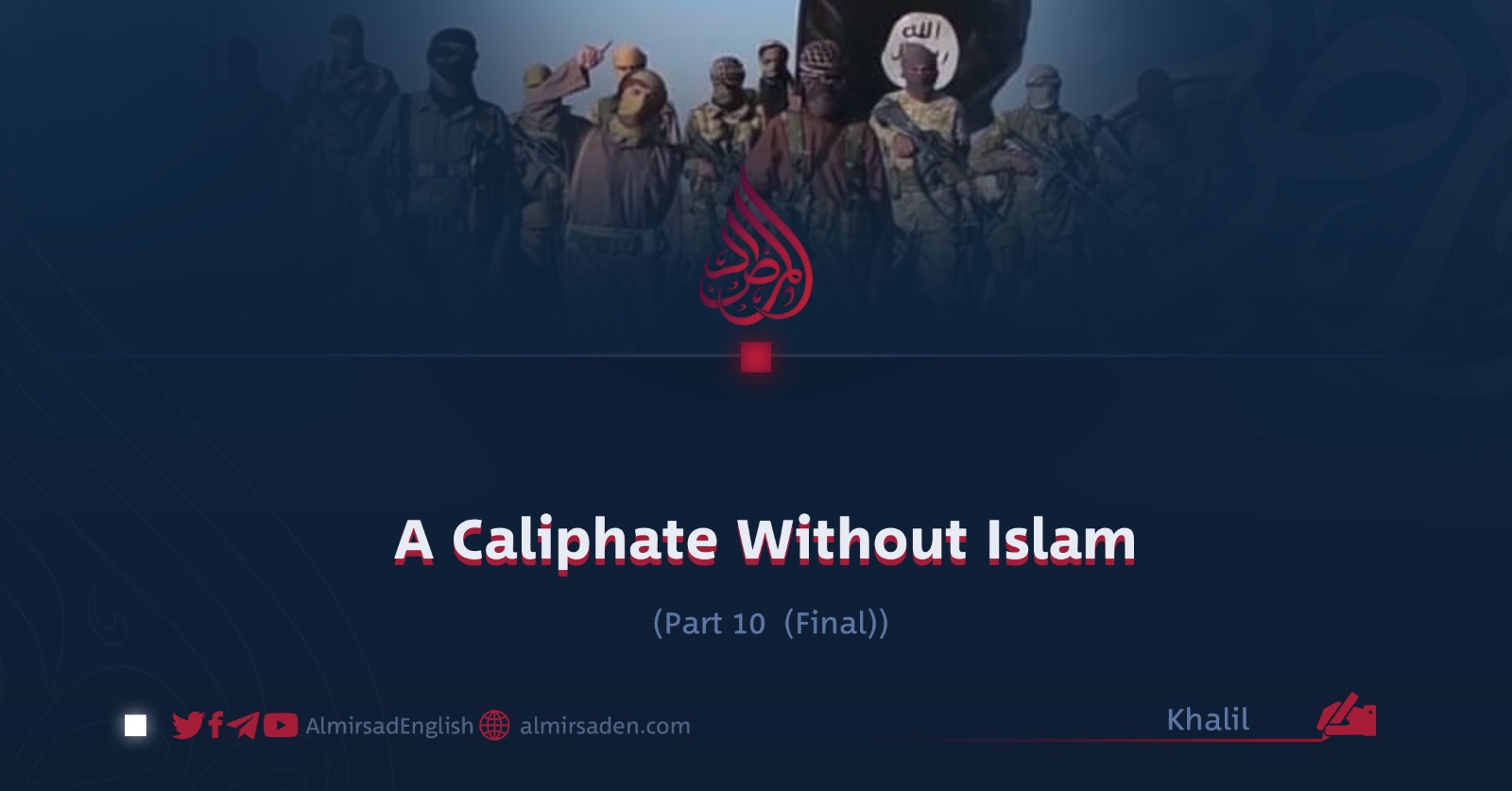
Part 10 (Final)
By Khalil
A Summary of an Ideological and Historical Deviation
With this series now complete, we can finally answer, on the basis of documented evidence and careful analysis, the central question: what connection did Daesh have with Islam?
The answer is clear. Daesh was not merely un-Islamic. It stood in direct opposition to Islam itself. What the group presented under the banner of an “Islamic Caliphate” was, in reality, a political and ideological project that exploited the sacred name of religion to justify violence, the pursuit of power, and domination.
This self-proclaimed caliphate had neither religious, moral, nor human legitimacy. It openly contradicted the fundamental principles of Islam. As this series has shown, this dark phenomenon did not emerge without roots. Its intellectual foundations go back to the deviant ideas that first appeared among the Khawarij in the earliest period of Islamic history.
The Khawarij were the first group to declare Muslims unbelievers and give violence a religious cover. They turned religion into a weapon for eliminating those who disagreed with them. Daesh followed the same deviant path, but with modern tools and even greater brutality. It claimed to be the only true representative of Islam. Anyone who differed with its ideology was branded a disbeliever or an apostate whose blood, in its view, could be lawfully shed. This was the very same doctrine of takfir practiced by the Khawarij, against which the Prophet Muhammad (PBUH) warned his Ummah as one of the greatest fitnas to come.
A close examination of Daesh’s religious methodology also shows that the group deliberately distorted the religious texts in order to justify its crimes. It separated the verses of the Holy Quran and the sayings of the Prophet (PBUH) from their historical context and from the merciful objectives of Islamic law. By quoting texts selectively and interpreting them falsely, it transformed a religion of mercy into an ideology of violence.
The context of the Quranic verses, the higher objectives of the Shariah, and the consensus of the scholars of the Ummah are all established principles in Islam. Daesh ignored them openly. That alone shows that the jurisprudence it promoted was an invented and fabricated one. It was not developed to guide people, but to deceive them and provide religious cover for terrorism. Its widespread practice of takfir, its attempts to revive slavery, its collective punishments, and its destruction of cultural heritage have no foundation in authentic Islamic jurisprudence. They were simply tools used to crush opponents and establish rule through fear.
From a moral standpoint as well, Daesh stood in complete opposition to Islam. Islam is built upon mercy, justice, and wisdom. Daesh built its path upon cruelty, deception, and takfir. The Prophet (PBUH) said that he was sent to perfect noble character, while Daesh treated brutality as a virtue and mercy as weakness. The Holy Quran declares that killing one innocent soul is like killing all of humanity, yet Daesh justified bombings in mosques, marketplaces, and public places, as well as the mass murder of innocent people, under the name of jihad.
Daesh’s judicial system was not an instrument of justice but a machine for execution. In Islam, the purpose of the judiciary is to establish justice and preserve human dignity, and the accused remains innocent until guilt is proven. In Daesh’s courts, however, the sentence was decided before the trial even began. The judge was no impartial jurist, but an executioner carrying out the orders of military commanders. The group stretched the meanings of apostasy, hypocrisy, and corruption so broadly that every opponent could be included within them. It then carried out mass executions that presented the world with a frightening and false image of Islam.
Its economy was also built not upon production and justice, but upon looting, confiscation, and extortion. It financed itself by seizing people’s property, selling smuggled oil, trafficking historical artifacts, and extracting money from civilians by force. Those unlawful revenues were then used to buy weapons and expand terrorism. In Islamic economic teaching, lawful ownership and lawful earnings are fundamental principles. Daesh replaced them with an economy designed to finance its machinery of war.
Its media campaign may have been even more dangerous than its military crimes. Through professionally produced propaganda, Daesh glorified violence and poisoned the minds of young people. Its fabricated images of life under the so-called caliphate, its videos of executions and torture, and its distorted religious narratives were all designed to deceive public opinion and recruit new followers. This propaganda machine portrayed Islam before the world as a religion of bloodshed and violence, causing enormous damage to the true image of a faith built upon mercy. In the end, the central truth that emerges from this series is that Daesh was a caliphate without Islam. It exploited the name of Islam while having no connection to its spirit, its values, or its fundamental principles. It was not the true heir of the Messenger of Allah (PBUH), nor a continuation of the path of the Rightly Guided Caliphs. It was the product of hatred, historical grievances, religious ignorance, and the ambitions of those who sought power.
A system built on bloodshed, lies, and fear cannot call itself a caliphate. It is nothing more than a face of death and destruction. A genuine Islamic system is founded upon justice, mercy, morality, and respect for human dignity. Any caliphate that is empty of those qualities is also empty of Islam, no matter how many times it invokes the name of Islam.