

















In the final decade of the twentieth century, when the Red Army was defeated within the territory of Afghanistan and a new Islamic government emerged as a result, the Muslims of the entire world saw a glimmer of hope for their aspirations. The global Islamic Ummah looked forward to a new era of revival. However, at that very moment, the world’s other superpower, the United States, found this Islamic government in Afghanistan intolerable. Consequently, under various pretexts, they sought to topple this Islamic administration and bury the rising hopes of a global Islamic movement in the dust.
To carry out this plan, the United States needed a reliable and compliant government in the region, one that shared a border with Afghanistan, had common interests, and could provide necessary logistical support. In the region, only Iran or Pakistan could have fulfilled this role. However, the United States’ previous rivalry with Iran made it unsuitable, and Pakistan’s problem was that its government represented the people and could not, like the great infidel America, blindly support the overthrow of the Islamic government.
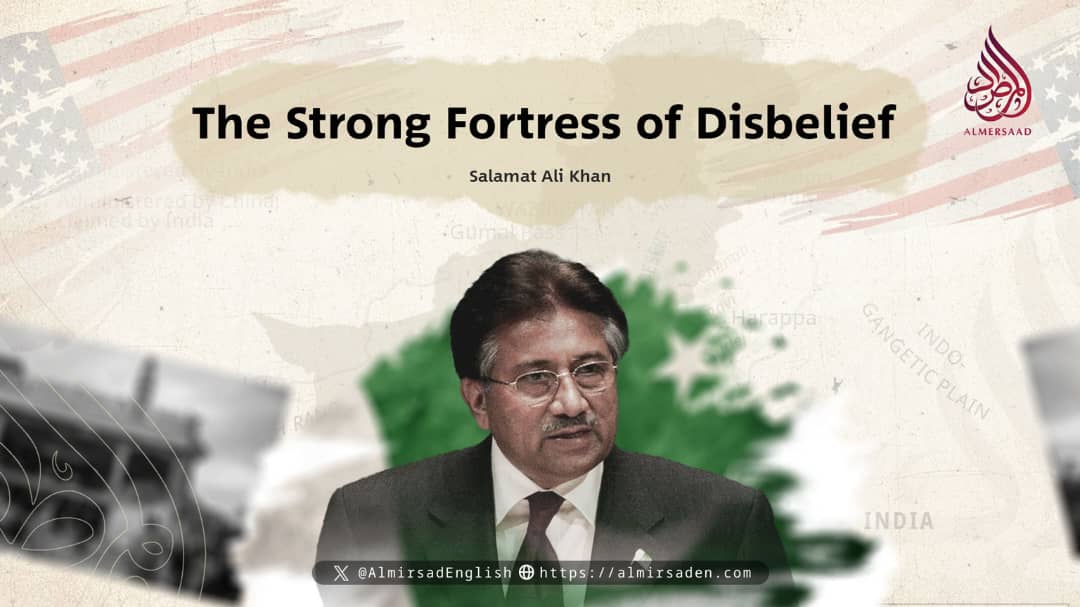
As a result, through a joint plan between the United States and the Pakistani military, the representative government was toppled, and a Pakistani general, Pervez Musharraf, took control of the government. His role was to impose on the people, by sheer force, decisions that the representative government could not have implemented due to popular opposition.
In this context, a major decision against Afghanistan’s Islamic government was the granting of bases inside Pakistan to the United States, a move that Musharraf carried out shamelessly, without the consent of the Pakistani people. He handed over Pakistan’s airfields, airspace, sea ports, and land routes to America, while brazenly threatening the population that anyone who opposed even a single aspect of this arrangement would be erased from the face of the earth.
It was obvious that the people of Pakistan are deeply religious and maintain strong ties with their faith, and Musharraf’s actions were completely unacceptable to their conscience. Yet, out of fear and oppression, they remained silent. Nevertheless, to the extent possible, they did not withhold their sympathy and support for Afghanistan’s Islamic government. In this process, particularly the proud and faithful people of the tribal areas stood out, striving through their cooperation to show the Islamic government of Afghanistan and the dignified Muslim population that they had no part in the decisions of the Pakistani military general, and that he had handed over their territory to serve the cause of disbelief.
Pervez Musharraf was aware of this sentiment and wanted to demonstrate to the United States that he was so loyal to its interests that he could oppress, humiliate, and even kill his own people. Initially, he imprisoned people from the tribal areas under various pretexts, then imposed a series of restrictions, including curfews every other day, to signal to America his readiness to serve. Yet, his ruthless adherence to U.S. interests did not stop there; he went further and officially demolished mosques, madrasas, and villages to demonstrate his absolute loyalty.
They began the bombardments, killing or causing the martyrdom of the local people. The story escalated further as the entire tribal region was thrown into turmoil by U.S. drone strikes. Over the years, these drones patrolled the areas, constantly targeting the local population.
In this situation, the people of the tribal areas held multiple jirgas, presented the realities of Allah’s law to the government and military generals, and took all legitimate steps in accordance with republican principles, but all efforts proved futile. They faced even greater persecution, increased suffering, and escalating displacement at the hands of the military. Frustrated and exhausted, they concluded that they must now find a way out of this difficult and crisis-ridden situation, at any cost.
To this end, tribal elders and religious and local leaders convened meetings to assess the situation. They carefully evaluated the reality they were facing, examined its Shariah-based background, and considered it from every angle. Ultimately, they concluded that their honor and dignity had been trampled by the military generals, their homes destroyed and bombed, their religious symbols, mosques, madrasas, Qur’ans, and other religious texts, burned in the flames of explosives. Their elderly leaders had been dishonored, humiliated, and beaten; their women were dishonored in their homes and compounds; their youth had been forcibly disappeared under various pretexts, some still missing; their brave young men were buried unjustly, thrown into prisons, and subjected to every other form of misfortune brought upon them by the military generals.
They were convinced that all these actions by the military generals were carried out to safeguard U.S. interests and, in doing so, to achieve their own personal agendas. They believed that the generals were torturing the tribal areas to prevent the sacred jihad in Afghanistan. Consequently, in accordance with their national, religious, and tribal duties, they resolved that it was now necessary to rise against the military generals and defend their honor, dignity, and religious symbols.
For this purpose, in 2003 and 2004, movements were launched across various tribal areas under different names to resist the oppression and tyranny of the military generals and to respond to their actions in defense of the people. In this context, local uprisings began in Swat, Wana, Waziristan, Khyber, and Mohmand agencies. Wherever the military generals committed religious persecution or assaults on honor, the locals engaged in armed resistance against them.
Instead of recognizing the seriousness of the situation and stepping back from their oppressive actions, the military generals, intoxicated by power, resorted to force and expanded the circle of repression. They also sought assistance from the United States, using American drones to drop bombs and explosives on their own people. In the tribal areas, they ignited a new fire of infamy, subjecting villages and homes to a storm of bloodshed, leaving women widowed, men killed, children orphaned, and buildings destroyed.
As a result, the various local resistance movements, each previously limited to its own area and lacking coordination, united in the face of the generals’ oppression and the formal intervention of the United States. By 2007, they established a well-organized structure covering all the regions, appointed a central leader, expanded their activities against the generals across Pakistan, and engaged in large-scale confrontations with the military authorities.
Although the military generals had seized the media and public discourse through force and coercion to justify their oppressive actions, and propagated narratives that sought to portray their crimes as legitimate while labeling the people’s resistance as criminal, the public, scholars, politicians, and people from all walks of life saw everything with their own eyes. The military’s direct support for the United States, the handing over of land, airspace, and seas to America, and the destruction of a pure, sacred Islamic government were realities that no one could conceal.
At the same time, the military generals displayed such open hostility toward religious sanctities throughout Pakistan, and especially in the tribal areas, that anyone wearing a beard, turban, or traditional attire was labeled a terrorist, targeted, and arrested. This was something the entire nation was ready to hold accountable.
When the official armed uprising began, the people felt as if their deepest aspirations had finally been realized. The call for resistance spread to every corner of Pakistan and was welcomed by local populations. In major cities such as Karachi, Lahore, Islamabad, and Peshawar, young people prepared to join the struggle, contributing both manpower and funding. They targeted major centers, carried out significant operations against the military across Pakistan, and even brought the resistance’s anger to the airport of the international city of Karachi, where they engaged in bloody clashes with the army.
Yet the military generals still did not face the reality of the situation and refused to acknowledge the truth, believing that by suppressing and oppressing their own people under various pretexts, they could gain advantages from the United States. Consequently, they escalated their use of coercion and tyranny against the resistance. Across the country, thousands of young people were imprisoned on baseless charges, and thousands more were ruthlessly killed under false accusations. Entire villages and homes were emptied and destroyed, forcing the people of all tribal areas to abandon their homeland and migrate. As a result, thousands of families became internally displaced or refugees abroad, and even today they continue to endure the hardships of displacement.
Yet the policy of the military generals remains the same today: they continue to exercise coercion and oppression, with the sole aim of presenting their country as a stronghold of disbelief to the non-Muslim world and securing personal advantages from it. To justify their actions, they also level accusations against neighboring Islamic countries, spread falsehoods, and, whenever possible, create obstacles and carry out attacks against them, presenting these acts to the world as “evidence” of their claims.
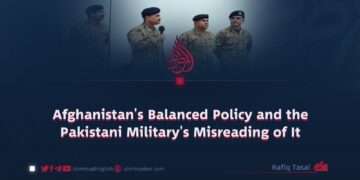
The military generals even enter into agreements to hand over their own people to foreign powers. Hundreds of individuals, such as Aimal Kansi and Aafia Siddiqui, have reportedly been delivered to outsiders in exchange for money, while dozens or even hundreds more have been killed on orders from foreign powers, right here in their own homeland. On this basis, many analysts believe that the current senior military general, Asim Munir, has received directives from the United States and formulated his policies accordingly. As a result, on one hand, he carries out brutal, indiscriminate bombardments in the tribal areas, and on the other, he instills terror in Afghanistan.
But they must understand that oppression is the beginning of the decline of power. The very injustices that you have carried out over the past three decades at the behest of foreign powers and for your own personal gain will become a source of disaster for you, and ultimately, the disbelievers will watch your downfall without offering you any benefit.