


Mawlawi Abdul Samad Shakir
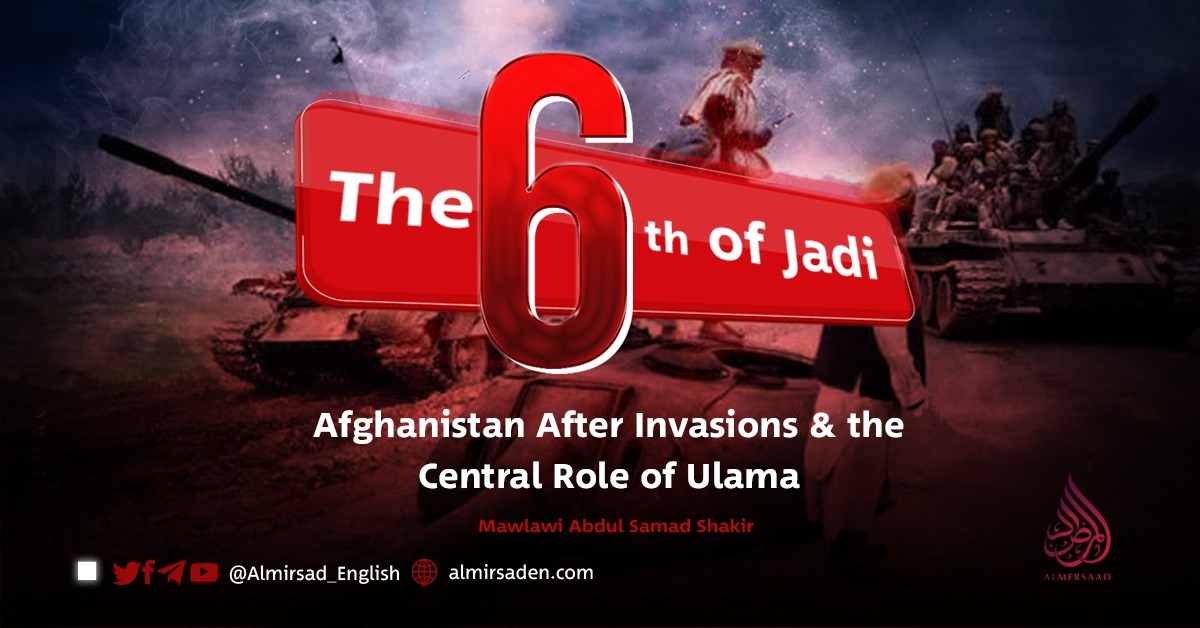
Under the white banner of the Islamic system, Afghanistan has reemerged after decades of war with a renewed sense of independence and purpose. This rebirth did not come easily. Modern Afghan history is marked by repeated invasions, occupations, and ideological assaults that left deep scars on the land and its people. Among the most decisive of these events was the Soviet invasion on the Sixth of Jadi.
The Sixth of Jadi did not simply mark the beginning of a military occupation. It represented the forceful imposition of a false global ideology, communism, upon a deeply religious and independent people. Decades later, the twenty-year American occupation repeated the same pattern in a different guise, not through overt ideology alone, but through soft power, cultural engineering, and political manipulation.
Drawing on these experiences, this article examines Afghanistan after invasions and occupations and highlights the central and irreplaceable role of the religious scholars.
Occupation Is More Than Military
History leaves no doubt that occupation is never confined to tanks, aircraft, and armed troops. It is a comprehensive assault on a nation’s intellectual foundations, its beliefs, culture, traditions, and sense of identity. The Soviet invasion sought to implant communism; the recent occupation introduced liberalism, secularism, and a consumerist worldview. Despite their differences, both shared the same goals: to weaken faith, undermine the will to resist, and replace independent thinking with dependency and submission.
For this reason, the end of occupation cannot be measured solely by the withdrawal of foreign forces. When the soldiers depart, the most difficult struggle often begins, the struggle over values, ideas, and moral direction.
The Staff and the Tank: Faith Over Power
The concept of the “Staff and Tank” from Noor Muhammad Taraki’s era, which stands as a golden chapter in the proud Afghan nation’s illustrious history, is not merely a heroic memory. Rather, it represents a profound principle of Islamic struggle. A stick may represent weakness in material terms, but when it is held with faith and reliance upon Allah, it can overcome even the most powerful armies.
This principle demonstrates that the outcome of conflict is not determined by the weight of weapons, but by the strength of belief. Afghanistan witnessed this truth twice in recent history, first against the Soviet Union, and later against NATO. In both cases, occupation collapsed when it lost legitimacy in the eyes of the people, and such delegitimization was achieved not through arms alone, but through faith, conviction, and adherence to truth.
The Danger After Liberation
There is a moment more dangerous than occupation itself. It comes when foreign forces depart, but foreign ideas remain. When political control ends but cultural influence continues, a society enters a fragile and uncertain phase. In such moments, justice can give way to revenge, unity can fracture into internal conflict, and exhausted people may begin to trade their values for comfort or stability.
Freedom is not just a victory to celebrate. It is a test. It reveals whether a nation will remain faithful to its principles or slowly abandon them.
The Responsibility of the Scholars
During resistance against occupation, every mujahid stands at the forefront. After liberation, responsibility shifts. The greatest burden then falls on the scholars. Their role becomes critical precisely when weapons are laid down and guidance is most needed.
First, scholars must help heal a society wounded by years of war. This healing is not only physical, but intellectual and spiritual. It requires patience, wisdom, and compassion.
Second, they must maintain a principled relationship with authority and with the people. Scholars should neither become tools of power nor sources of fitna. Their duty is to offer sincere advice, speak the truth, and avoid personal ambition or rivalry.
Third, they must serve as guardians of unity. Afghan history repeatedly shows that defeat has come from internal fragmentation before it came from foreign aggression. Scholars must therefore act as the final line of defense against division, not as voices that amplify personal opinions or exploit public platforms for narrow agendas.
Fourth, scholars must clearly define the Islamic meaning of independence. Independence does not mean only the absence of foreign troops. It means that laws, policies, culture, and public life are shaped by Islam and by the moral conscience of the nation. No group is better equipped to articulate and protect this understanding than the scholars.
Finally, silence is not an option. When scholars withdraw from their responsibility, history moves on without them, and often repeats its darkest chapters. Silence creates space for ignorance, and where guidance disappears, oppression takes root. In this sense, the silence of scholars can be more damaging than occupation itself.
By the grace of Allah Almighty, the occupations and invasions of Afghanistan’s modern history were ultimately defeated through courage, sacrifice, and steadfast faith. These victories, however, come with lasting lessons. True independence can only endure if three things remain strong: a faith-based spirit of resistance among the people, continued reliance upon Allah in national decisions, and scholars who act as healers and unifiers, not as sources of division.
If these elements remain united, Afghanistan will never again become the target of foreign domination, insha’Allah. Among all segments of society, it is the scholars who are best positioned to ensure this future, and it is a responsibility history will not allow them to abandon.