


























By Mustaghfir al-Hanafi
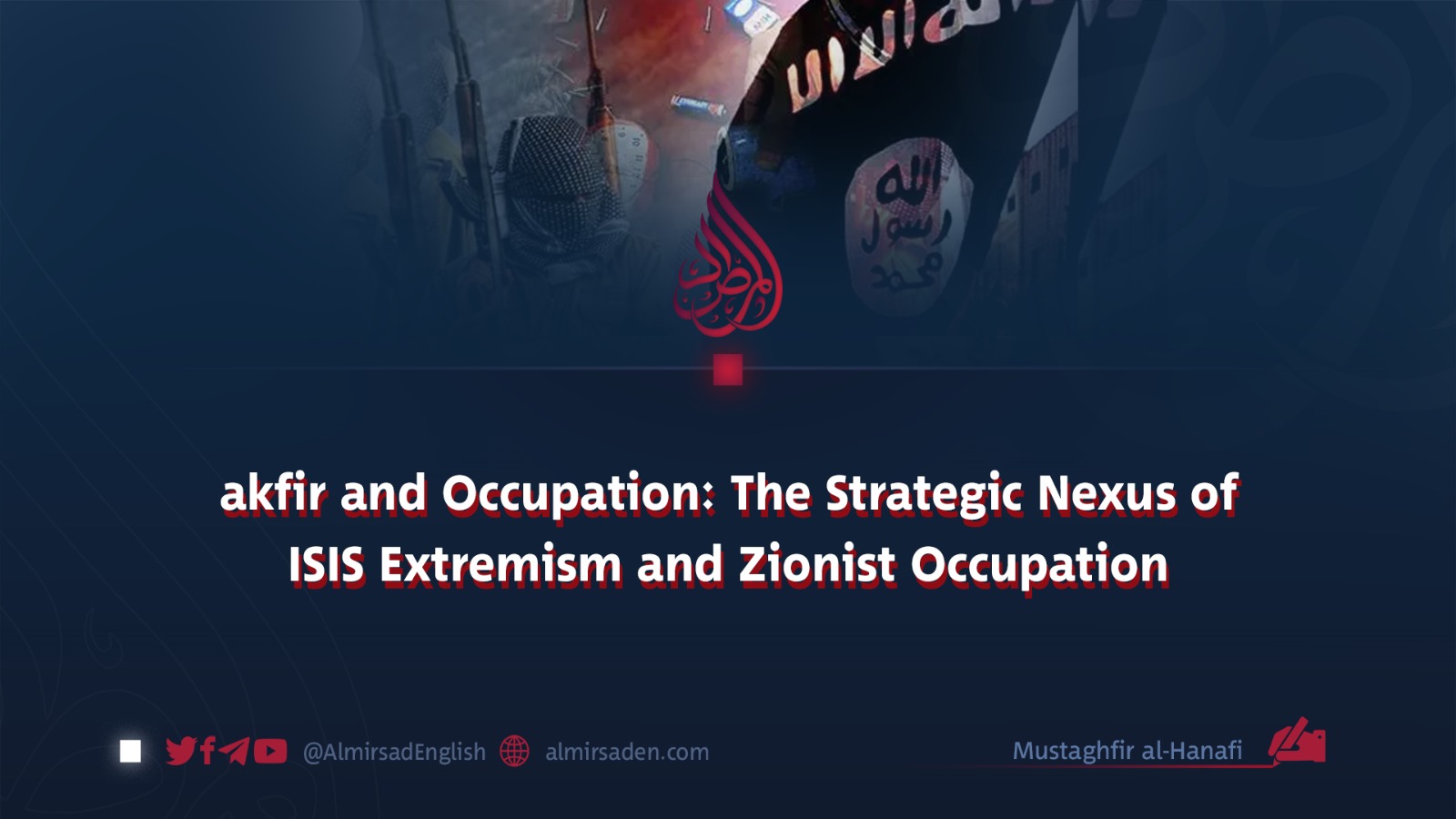
For years, a game under the name of ISIS has been ongoing in the region and the world. People are being killed, prominent figures are being assassinated, Muslim scholars are being martyred, divisions are being fomented among Muslims, Muslims are being labeled as apostates, homes and cities are being destroyed, and Muslim blood is being shed. All these crimes are carried out by a group (ISIS) of unknown identity and unclear objectives, under the name of Islam and the Islamic Caliphate.
Throughout history, many Kharijites have appeared. However, the difference between those historical Kharijites and the ISIS Kharijites is that the former became Kharijites due to their extreme beliefs and did not maintain covert or overt relations with disbelievers and polytheists. The ISIS Kharijites, however, are different. Their extremist ideology is not a product of their own understanding; rather, it is an extremist interpretation manufactured by the Zionists, which was instilled into the ISIS Kharijites after brainwashing, and through which they pursue their objectives.
Dear Muslim brothers,
When, in 1948, an occupying Zionist regime (Israel) was established in occupied Palestine, centered in Tel Aviv, in violation of all human and international laws, it provoked widespread reactions across the Arab and Islamic world. Some people began armed struggle, while others sought to resolve the contentious issue of Israel and Palestine through dialogue and international pressure. However, resolving this issue was far from simple.
Day by day, the oppression of the Palestinian people by Israeli Jews increased, until in 1967, six Arab nations, led by Egypt, launched an attack on Israel in an attempt to liberate Palestine. This conflict, historically known as the Arab-Israeli War, resulted in the defeat of the Arab coalition and further strengthened the Israeli regime.
Although Israel was able to defeat its opponents in this war, permanently existing in a region surrounded by hostile neighbors proved to be a significant challenge. As a result, Israel neither relinquished Palestine nor did the neighboring countries withdraw. Israel perceived its survival to depend on creating turmoil and conflict in the Middle East, thereby embroiling the neighboring Islamic countries in disputes while securing its own safety.
For this reason, Israel has implemented numerous projects in the Middle East to embroil regional countries in mutual hostilities. Among these projects is the ISIS Kharijite initiative. As initially observed by the United States and Israel, all neighboring countries, whether Shia or Sunni, held antagonistic positions toward Israel.
Consequently, they first attempted to ignite conflicts between states, such as the eight-year war between Iraq and Iran.
However, over time, the United States and Israel realized that rather than inter-state wars, creating ideological rifts, specifically between Sunnis and Shias, proved far more effective. Conflicts between countries can eventually be resolved, but a fire ignited between two sects or ideological groups is far more difficult to extinguish.
This is how the United States initially promoted the ideology of takfir in the Middle East, and subsequently, through its intelligence agents, established the ISIS Kharijite group. This group, ideologically, fragmented the Middle East and embroiled it in internal conflicts.
Although the Qur’an makes it clear that the Jews are staunch enemies of Islam, the ISIS Kharijites shifted their priorities. Instead of fighting the occupiers, they labeled other Muslims as apostates, turning what should have been a struggle between Muslims and Israel into a broad conflict between Shias and Sunnis. This shift caused countless harms to the Islamic world.
When the United States and Israel realized that the ISIS Kharijite project was effective in weakening Islam in the Middle East and securing Israel, they extended this project to other regions of the Islamic world. If you reflect, just a few years after ISIS emerged, the group became active in many areas.
Was this due to ISIS’s own capabilities? If so, why could ISIS move from Iraq to Afghanistan but not to Israel? There were even situations in Syria where only a wall separated ISIS Kharijites and Israeli forces, yet no direct attacks occurred. ISIS can carry out attacks in Kabul, Moscow, Turkey, Lebanon, Baghdad, Damascus, India, Tehran, and Egypt, but not in Tel Aviv. This demonstrates that their operations are controlled by intelligence networks; they are strengthened when necessary and weakened when not.
As tensions between Iran and Israel have recently increased, Israel is attempting to ignite conflict between Shias and Sunnis in South Asia, just as it has done in the Middle East. The aim is to engage Muslims in internal conflicts while Israel remains secure. All Muslims must understand that the current disputes among Muslims, often under various labels, are part of Zionist-designed projects aimed at dividing the Muslim community, and Muslims must safeguard themselves from them.