












By Rafiullah Shafiq
Islam is a religion rooted in selflessness, sacrifice, and unwavering devotion. From the very beginning, this path demanded endurance. When the Messenger of Allah (PBUH) was entrusted with the heavy responsibility of Prophethood, he faced relentless hardship while conveying the truth, spreading the message of Islam, and standing firmly against polytheism and idol worship. Beside him stood his noble Companions (may Allah be pleased with them) who lived through the harshest days of da’wah, persecution, and confrontation with falsehood. They did not merely observe these trials; they carried them upon their own bodies.
Women, too, made sacrifices according to their strength and ability. Throughout it all, the Messenger of Allah (PBUH) remained completely focused on his mission. The pain he endured never distracted him from his purpose. When a Companion or a close supporter was martyred, their loss did not weaken the resolve of the believers. Rather, it strengthened them, increasing their sincerity, determination, and steadfastness on the path they had chosen.
This reality reflects one of the divine laws established by Allah Almighty: the preservation and advancement of the religion require sacrifice. Without sacrifice, faith cannot progress. Some believers are granted the honor of witnessing victory with their own eyes, and Allah bestows upon them clear and beautiful assistance. Others are honored in a different way, by receiving the honor of martyrdom before victory arrives. Both are successful, because the Muslim lives by the principle of ihda al-husnayn: one of two outcomes, either martyrdom or victory.
Islamic history bears clear witness to this reality. Many Muslims and mujahideen endured immense trials and suffering for the sake of Islam’s triumph, yet were martyred before that triumph became visible. Among them were Sumayyah and Yasir, may Allah be pleased with them, who were martyred in the earliest days of Islam, even before the migration to Madinah. Likewise, Sayyiduna Hamzah and Mus’ab, may Allah be pleased with them, drank from the cup of martyrdom before the conquest of Makkah ever came.
In modern history, the sacrifices of the Palestinian people stand as a powerful example. Their steadfastness is unmatched, firm like mountains that do not tremble. The martyrdom of their leaders does not break their spirit; it strengthens it, deepening their resolve and commitment.
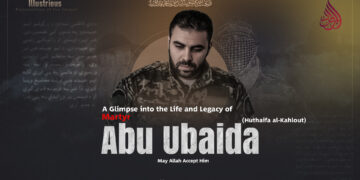
If today Hudhayfah Samir Abdullah al-Kahloul (Abu Ubaidah), along with some of his companions, were to attain martyrdom, this would not be something new for the Muslim Ummah. Many before them walked the same path, offering their lives as Hamzah and Mus’ab once did. Their blood is not shed in vain. It nourishes the sapling of Islam and allows it to grow stronger.
For a true mujahid, the greatest hope is that Allah grants him the honor of martyrdom. The hardest fate is to spend a lifetime striving in the path of jihad, only to pass away quietly upon a bed of natural death. The most beautiful aspiration is to be elevated by Allah through the dignity of martyrdom.
This longing was held even by the Messenger of Allah (PBUH) himself. Imam al-Bukhari (may Allah have mercy on him) narrates in his Sahih that the Prophet (PBUH) said:
“By Him in Whose Hand is my soul, I wish that I be killed in the path of Allah, then brought back to life, and then killed (again).” (Sahih al-Bukhari)
Our responsibility, therefore, is not to guarantee results, but to advance with sincerity and steadfastness. We are commanded to strive, not to secure visible or immediate victory, for victory belongs to Allah alone. Whoever offers himself upon this path, whether he witnesses the outcome or not, is, in the truest sense, victorious.