

















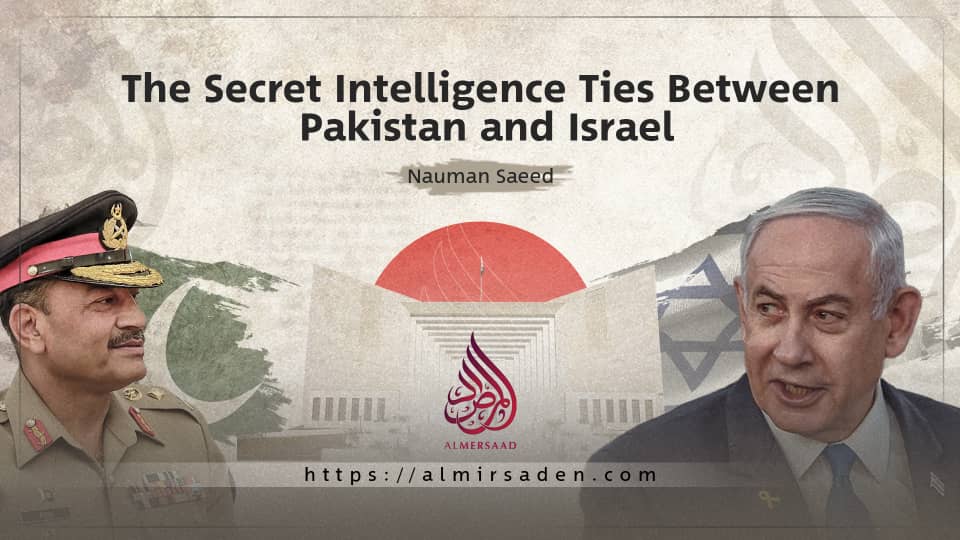
By Nauman Saeed
Nine months after the creation of Pakistan, in 1948, another similar country emerged on the world map.
This country was the world’s only Jewish state Israel. Both nations were created on the basis of religion, and Britain made immense sacrifices to ensure the birth of both. During the emergence of these two countries, floods of blood from millions of people were shed.
In 1947, Britain ended its control over India; but why did it create two separate states, India and Pakistan? Due to the conflicts between Hindus and Muslims, mass migration took place on a vast scale. According to the United Nations High Commissioner for Refugees, millions of people were displaced as a result of this partition.
Hindus and Sikhs moved to India, and Muslims to Pakistan. It is estimated that around one million people were slaughtered in the riots of this partition. The League of Nations handed Britain the responsibility to control Transjordan and Palestine.
Then in 1948, the geographical partition of Palestine and Transjordan took place, and Israel was brought into existence. Due to the creation of Israel, Palestine was torn into two parts. A large portion of Jews in Israel were the displaced Jews of Europe, and later, another 800,000 Jews were transferred there, while the citizens of various Arab countries were forcibly driven out of their homes.
Pakistani General Zia-ul-Haq says: ‘Pakistan is an ideological state just like Israel; if Judaism is removed from Israel, this state will collapse as swiftly as a house of cards. Similarly, if Islam is removed from Pakistan and it becomes secular, it too will perish very quickly.
Based on this ideology, Zia-ul-Haq took some basic, symbolic, and time-bound Islamic measures to preserve Pakistan. This was because both countries share a common religious philosophy, and religion is deeply rooted in the individual and social lives of the people of both nations. Although Israel is a secular nation, when it comes to Judaism, the entire nation becomes a single fist. In this way, Zia-ul-Haq saved Pakistan from collapse by exploiting the religious and ideological sentiments of Islam and Muslims.
Another similarity is that both of these countries are nuclear powers, yet interestingly, they have never harbored any intention of destroying one another. A media outlet named Azriel Bernet states in an article: ‘Pakistan is the first Muslim nuclear power that has never intended to destroy Israel, nor does it support terrorism within Israel.
There are also reports that whenever a conflict arises between Pakistan and India, Pakistan seeks assistance from Israel, so that Israel may use its influence in Washington to pressure India and control the rivalry between the two nations. In return, Pakistan has assured Israel that it will never interfere in the Arab-Israeli conflict and will even support Israel.
During the war between Palestinians and Israel in the 1970s, the pro-American King of Jordan, King Hussein, grew fearful that the heroes of the Palestinian liberation struggle might pose a threat to his rule. Consequently, to rid himself of the Palestinian refugees, Jordan launched operations against them in September. These operations were brutal and deadly, becoming infamous in history as the ‘Black September’ operations.
Throughout these operations, spies from Israeli intelligence agencies provided full assistance to Jordan, while the monitoring, control, and leadership of the operations were handled by a military contingent sent from Pakistan, led by a military officer, Brigadier Zia-ul-Haq.
These brutal, murderous, and destructive operations against the Palestinians, carried out through the joint cooperation of Israel and Jordan under the leadership of Pakistani military personnel, resulted in the martyring of more than thirty-five thousand (35,000) oppressed Palestinian refugees in an act of pure barbarism and terror.
”Although Pakistan has not recognized the Israeli regime to this day, it has on many occasions taken steps that have brought the two countries even closer. Despite the fact that no official diplomatic-level relations have been established between the two nations thus far, after the creation of Israel, its first Prime Minister, David Ben-Gurion, sent a message to the founder of Pakistan, Quaid-e-Azam, proposing the establishment of official ties. However, Jinnah feared that the Arab world might become displeased and the public might revolt; therefore, he did not provide a definitive response.
In 1952, American diplomats arranged a meeting between Pakistan’s then-Foreign Minister, Zafarullah Khan, and Israel’s ambassador to the United States, Abba Eban. Sir Zafarullah told Abba Eban: ‘The future of relations between our two countries (Israel and Pakistan) is not yet very clear, but I emphasize that the Pakistani government harbors no enmity toward Israel and considers the Middle East a matter that requires consideration.’ Furthermore, he expressed the potential for exchanging experts, students, and teachers across various fields between the two nations.
An Israeli general writes: During the 1948 war against Israel, the Israeli embassy in Washington was informed that Pakistan had provided military assistance to the neighboring Arab countries. It was reported that Pakistan was sending a battalion to fight alongside the Palestinians and had purchased 250,000 rifles from Czechoslovakia to give to the Arabs for the war. It was also said that Pakistan had bought three Italian fighter jets for Egypt. Later, it was claimed that during the 1973 war, Pakistani Air Force pilots flew Jordanian and Syrian aircraft, attacked Israel, and shot down three of Israel’s top fighter jets.
However, all of these were merely symbolic maneuvers and rumors; because at the end of the 1970s, General Zia-ul-Haq was the only choice for Israel and Jordan to crush the Palestinian liberation movement. This was because he had nurtured close ties with Israel and had established and solidified secret relations with Israeli intelligence through various channels.
The Israeli general further writes: In 1970, General Zia led critical operations in this war as a Brigadier, known as ‘Black September.’ Zia’s role in these operations was extensive; he commanded the Second Brigade, which performed the most pivotal role in Black September.
Israeli General Moshe Dayan states: ‘Israeli soldiers could not have killed as many Palestinians in twenty years as were slaughtered in the eleven-day operations of Black September.
Upon his return to Pakistan, Brigadier Zia-ul-Haq was further promoted. Zulfikar Ali Bhutto, the ruler of Pakistan at the time, viewed these operations, in which over 10,000 of Yasser Arafat’s comrades alone were martyred, as a routine matter, despite maintaining relations with Yasser Arafat as well.
Within six years, General Zia rapidly ascended from Brigadier to Chief of Army Staff. Following Black September, both America and Israel fell completely in love with Zia; consequently, he further strengthened the chords of this ‘love’ with both.
Charlie Wilson, who served twelve times as a Democratic Congressman in America, once told General Zia-ul-Haq: ‘There is a vast amount of Russian-made weaponry in Israel, captured from the Palestinian PLO, which would be extremely useful in your region. If I convince the CIA to purchase these weapons from Israel and give them to you for use there, would you (Zia) have any problem?’ At this, General Zia smiled and, as a sign of agreement, replied: ‘Just ensure that the Star of David is not on the weapon crates.
During the war between Afghanistan and Russia, because Israel and America did not want Russia to advance into Pakistan and destroy their strategic ally, Israel provided unprecedented assistance to the Pakistani military in every field.
The deep official, intelligence, and strategic ties between Pakistan and Israel deepened further in 1981. With General Zia’s permission, a secret pact was signed between the Pakistani intelligence agency (ISI) and the Israeli intelligence agency (Mossad), and both established their offices in Washington, D.C., in close proximity to one another. The pact included intelligence training for Pakistani generals by Mossad and the supply of weapons to the military and this pact remains in force even today.
Israel has carried out numerous joint missions with the Pakistani military; thus, Pakistan and Israel serve as identical allies of America, one in the Middle East and the other in South Asia.
When Afghanistan came under Russian invasion, General Zia traveled to America. Congressman Charlie Wilson, a staunch supporter of Pakistan, advised General Zia to establish relations with Israel. This proposal was made during a private dinner organized in General Zia’s honor by a 48-year-old Israeli woman, Joanne Herring. General Zia had a relationship with this woman and maintained a personal interest in her; due to this personal infatuation, Herring was even referred to as the ‘Honorary Consul General of Pakistan.
Following the death of General Zia-ul-Haq in 1988, Israel once again extended a hand of friendship to the Pakistani leadership. During both of her terms as Prime Minister, and again during her 2008 election campaign, Ms. Benazir Bhutto held the view that open diplomatic relations should be established with Israel. She worked with great seriousness and eagerness on the idea of securing the services of Mossad for her own protection.
The Hebrew-language newspaper ‘Maariv’ wrote at the time: Benazir Bhutto told Mossad, the CIA, and Britain’s Scotland Yard that she was participating in the January 2008 elections but her life was in danger; therefore, they must protect her. Benazir Bhutto had complained that General Musharraf could not provide the necessary security for her protection; thus, she saw herself as an easy target and an attack was imminent.
In the 1990s, relations cooled slightly, yet efforts were soon made by the leaders of both countries to improve ties once again. Israel sought a friend like itself in South Asia, but the situation was such that Pakistan’s economic condition was deteriorating and its relations with America were not warm, primarily due to Pakistan’s nuclear program.”
”However, during both of Nawaz Sharif’s terms (1990–1993 and 1997–1999), the restoration and warming of relations practically began. Pakistan’s then-President Rafiq Tarar and Pakistan’s representative to the United Nations, Jamsheed Marker, held warm meetings with Israel’s then-President Ezer Weizman and Prime Minister Yitzhak Rabin.
In 1993, Pakistan’s then-Prime Minister Nawaz Sharif dispatched Ajmal, the Minister for Religious Affairs at the time, on a crucial but secret mission to Israel. According to the Israeli newspaper ‘Maariv,’ this six-member delegation spent a week in Tel Aviv and Jerusalem, holding intense and warm meetings with several Israeli political leaders and high-ranking foreign ministry officials. On this occasion, Ajmal told the Israeli Foreign Minister that official Islamic tourism to Israel should be initiated. Upon returning from the trip, Ajmal advised Prime Minister Nawaz Sharif that Pakistan should recognize Israel as soon as possible, stating, ‘We have no further need for the wars of others (the Palestinians).
These ties became so overt that in September 1997, Nawaz Sharif’s special representative, Siddiq-ul-Farooq, stated in an interview with the Asian magazine ‘The Muslim’: ‘There is no harm for Pakistan in recognizing the Jewish state (Israel).
Then, in 1996, eight Pakistani journalists traveled to Israel together. This was the first official visit by Pakistani journalists; however, this trip was also kept hidden, as a prominent and powerful political figure was behind this mission.
In 1997, a prominent Israeli businessman, Yaakov Nimrodi, traveled to Pakistan and met with the then-Foreign Minister Gohar Ayub Khan. They held discussions regarding trade, health, agriculture, technology, aircraft spare parts, and facilitating tourism and pilgrimages to religious sites between the two nations.
In 1998, the then-Prime Minister of Pakistan, Nawaz Sharif, received a message from his Israeli counterpart, Benjamin Netanyahu, delivered through a special envoy, urging him not to provide nuclear technology to Iran.
In 2001, the Pakistani government of that time, through its intelligence agency (ISI), reported to Israel that Gulf countries, Iran, and Libya were making efforts to acquire nuclear technology.
In 2003, General Musharraf raised the issue of establishing open diplomatic relations with Israel during a cabinet meeting. In 2005, a formal meeting took place between the foreign ministers of the two countries.
During General Musharraf’s era, negotiations between the two countries continued extensively at both diplomatic and non-diplomatic levels. In 2005, intense and warm meetings took place between Pakistan’s Foreign Minister Khurshid Mahmud Kasuri and his Israeli counterpart, Silvan Shalom.
General Musharraf was the first Pakistani Muslim leader to be interviewed by an Israeli newspaper in London, and the first Muslim leader to address the World Jewish Congress in America, where he emphasized the importance of establishing diplomatic ties with Israel.
On May 7, 2006, Benazir Bhutto celebrated the birthday of the Israeli figure David Ben-Gurion—m,the first Prime Minister and founder of the Israeli state, in New York’s most luxurious hotel, and she paid the bill herself. Prominent politicians from Washington, D.C., and Tel Aviv specifically attended this gathering. Subsequently, several leading figures of the Pakistan Peoples Party invested in Israeli bonds, as the tax on such investments is low in America.
In 2007, a prominent figure of the Pakistan Peoples Party (who has now passed away) traveled to New York and Washington, and from there, made a journey to Tel Aviv, Israel.”
”Even deeper relations exist, specifically between the Pakistani military and its intelligence agency (ISI) and Israel’s intelligence agency (Mossad); there are both professional ties and organized journals between them, and both regularly share all types of intelligence information with one another.
The Pakistani intelligence agency (ISI) constantly provides intelligence to Mossad; one significant instance occurred between September and November 2008, regarding a potential threat to Israeli citizens in India. Based on documents leaked by WikiLeaks, the then-head of the ISI, Lieutenant General Shuja Pasha, maintained direct and constant contact with Mossad. According to WikiLeaks, in 2010, an American diplomat sent a cable to Washington stating that Shuja Pasha was in direct communication with Israel and was reporting to them that their citizens were facing the risk of attacks in several locations across India.
In 2013, the British Department for Business and Skills stated that in 2011, Israel had been supplying military equipment to Pakistan through Britain, which included electronic warfare systems and aircraft spare parts; however, both Pakistan and Israel denied these reports.
The relations between Pakistan and Israel are not limited solely to military and intelligence cooperation; they have extended even into the realm of sports. Dyne Castell, a trainer and physiotherapist for the Pakistan cricket team, was an Israeli Jew who had served three years in the Israeli military and previously served as the physiotherapist for the Sri Lankan cricket team.
Similarly, in 2015, an Israeli scientist participated in a conference at the Pakistan Academy of Sciences in Lahore. In short, Pakistan’s political, military, and intelligence leaders have always maintained ties with Israeli officials. From Pakistan’s first Foreign Minister Sir Zafarullah, to military rulers Ayub Khan, General Yahya, General Zia, General Musharraf, General Bajwa, and Marshal Asim Munir, or civilian leadership like Benazir Bhutto and Nawaz Sharif, all have had ties with Israel in one way or another.”
These contacts mostly take place in Washington, London, the United Nations headquarters in New York, the Middle East, Caracas, Ottawa, Brussels, and Rome. Furthermore, Pakistani diplomats have directly held meetings with Israeli officials in Tel Aviv, and these continue to this day.”
”Pakistan does not openly recognize Israel due to three primary obstacles:
Solidarity with Muslim nations, particularly Arab states; a country with a religious ideology is compelled to align its foreign policy accordingly.
Establishing diplomatic ties with Israel would turn Arab nations against Pakistan.
Religious factions in Pakistan remain more powerful than secularists, and any form of relationship with Israel would trigger a severe backlash from them.
However, secret ties still exist. Current indicators, such as Asim Munir’s movements, including a three-day meeting with Mossad in Jordan, involvement in the U.S. Board of peace, and delegating every major Pakistani decision to Western powers, suggest that these hidden relations may soon become overt.
An organization named the ‘Pakistan-Israel Alliance,’ which publishes content in several languages and operates within Pakistan, invites the Pakistani public to consider how both nations can cooperate to eliminate extremism for mutual benefit. Israel has made immense strides in desert agriculture through advanced technology, which Pakistan could utilize to improve its own agricultural sector.
Pakistan could export fruits, cotton, and precious stones to Israel, receiving advanced military assistance in return. The core message of this organization’s content is that both the state of Pakistan and the state of Israel are realities. Israel has never been Pakistan’s enemy, is not now, and always holds well-wishes for Pakistan. Palestine is a political issue tied to collective diplomacy, where both Pakistan and Israel could jointly mediate.
Pakistan could mediate in the Palestinian issue, while Israel could mediate to improve Pakistan-India relations. A rapprochement could rehabilitate Pakistan’s international reputation regarding terrorism. Both nations face terrorism and can combat it more effectively together.
The Pakistan-Israel Alliance further writes that since Pakistani generals, politicians, and intelligence chiefs have maintained personal and other ties with Israel, the time has come for the conscious people of Pakistan to not only accept these relations openly but also to pressure their leaders to make these ties public. This would initiate a new political era aimed at Pakistan’s prosperity, as the alignment of both countries is a necessity of the time. The day is not far when Pakistan-Israel relations will enter a new phase, and both nations will share mutual love and respect.