


Part 7
By Aziz Jalal
2014: The Year That Shook the World
(The Fall of Mosul and the Rise of Raqqa)
The year 2014 marked a defining rupture in the modern history of the Middle East. It was the year in which ISIS emerged from the shadows of takfir and violent extremism and, to the shock of the world, seized control of vast stretches of territory in Iraq and Syria. On June 10, 2014, the fall of Mosul, a city of immense strategic, political, and symbolic weight, sent shockwaves across the region and shook its artificial borders.
Mosul, the capital of Nineveh Province and Iraq’s second-largest city, collapsed with startling speed. Iraqi security forces, despite years of training and billions of dollars in foreign support, offered little resistance. Within days, ISIS fighters had overrun the city, capturing military bases and seizing large stockpiles of advanced American-made weapons. The images that followed, soldiers abandoning their posts, uniforms discarded, and armored vehicles left behind, became enduring symbols of the total breakdown of Iraq’s post-2003 security architecture.
The loss of Mosul was a catastrophic blow to Baghdad. Its significance extended far beyond military defeat or economic loss. It was a profound psychological and symbolic failure. A state built and sustained with international backing appeared hollow and unable to defend its people or its territory.
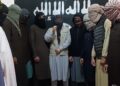
ISIS capitalized on this momentum with ruthless efficiency. Barely a month later, on July 4, 2014, Abu Bakr al-Baghdadi appeared at the Grand al-Nuri Mosque in Mosul and declared himself the “Caliph of the Muslims.” The announcement, carefully staged and widely disseminated through ISIS media channels, marked a turning point. ISIS was no longer presenting itself as a militant faction or insurgent movement. It was claiming the mantle of statehood.
Al-Baghdadi’s appearance was calculated in every detail, from the black robes to the measured cadence of his voice and the historic setting. For supporters, the image carried the illusion of legitimacy and continuity. For opponents, it was a chilling signal of ambition. The choice of the al-Nuri Mosque was deeply symbolic, an irony later sealed in 2017 when ISIS destroyed the same mosque as it retreated and erased the very stage on which its caliphate had been proclaimed.
Across the border in Syria, Raqqa emerged as the administrative capital of the self-declared caliphate. Though it fell under ISIS control earlier, in January 2014, its transformation into the group’s command center revealed a fundamental shift in ISIS’s identity. Once a relatively quiet provincial city, Raqqa became the nerve center of a project that claimed to resurrect an Islamic empire.
In Raqqa, ISIS began constructing the outward machinery of governance. Courts were established, taxes were imposed, and municipal services were organized. On the surface, this semblance of order was designed to project stability and authority. Beneath it, however, lay a system of terror, including public execution squares, secret prisons, and indoctrination camps where children were trained for war. Raqqa became a testing ground for ISIS’s most extreme interpretations of power, where medieval punishments were enforced with a level of violence rarely witnessed in the modern era.
The rapid rise of ISIS in 2014 provoked sharply divided global reactions. Thousands of foreign fighters, drawn from across continents, streamed into ISIS-controlled territory, captivated by its propaganda and promises. At the same time, governments and international institutions struggled to comprehend the scale and speed of the threat before them.
ISIS propaganda portrayed a disturbing fusion of modernity and regression. Videos showcased fighters equipped with advanced weapons while enforcing archaic punishments. Bureaucratic offices operated with digital efficiency, even as practices such as sexual slavery were openly legalized. This contradiction was not accidental. It was central to ISIS’s strategy. The group sought to be both ancient and modern, both seductive and terrifying.
In retrospect, 2014 represented the peak of ISIS’s power. Yet the very speed of its expansion carried the seeds of its collapse. By seizing territory so aggressively and declaring itself a state, ISIS drew the focused attention of regional and global powers alike. The response, once mobilized, proved overwhelming. What had been built through violence and spectacle unraveled just as rapidly, exposing the caliphate not as a durable political entity, but as an illusion sustained by fear, chaos, and momentary momentum.