

By Zaid Adham
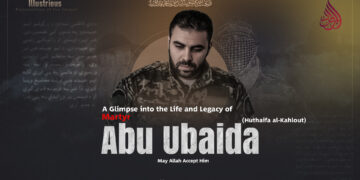
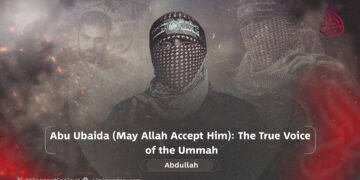
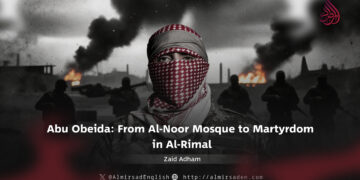
Abu Ubaida was the masked figure who, in the aftermath of October 7, surged with startling force to dominate headlines and command the media landscape. A veiled presence, his words became a healing balm upon the wounded hearts of the Ummah and a piercing arrow driven deep into the hearts of its enemies. He appeared concealed, yet in doing so he exposed the truths hidden behind many unveiled faces.
On October 2, 2004, inside Al-Noor Mosque in the Jabalia refugee camp, Abu Ubaida delivered his first address as the official spokesperson of the Izz ad-Din al-Qassam Brigades. He concluded with a line that would come to define both his message and his legacy:
“وَ إِنَّهُ لَجِهَادٌ، نَصْرٌ أَوِ اسْتِشْهَادٌ”
“Indeed, it is jihad: either victory or martyrdom.”
Each utterance of this phrase carried profound weight. It articulated a sacred path whose end admitted only two outcomes, victory or martyrdom, and in both cases, triumph for the believer.
The Zionist regime was never ignorant of the power embedded in Abu Ubaida’s words. From the outset, silencing him became a priority within its security and military measures. Threats multiplied. Attempts were made to uncover his identity. Cyber intrusions and sustained psychological warfare followed in succession. All of this revealed a stark truth: the enemy feared the word more than the weapon, the word that inspires, shapes consciousness, forges narratives, and alters the balance of conflict.
Those relentless efforts eventually reached their aim. On August 30, 2025, Abu Ubaida was martyred in an airstrike that struck a building in the Al-Rimal neighborhood of Gaza City. Yet the question lingered with renewed force: who was the man behind the mask, the voice that breathed hope into Muslim hearts and sent tremors through the ranks of Zionists and their allies?
His name was Hudhayfah Samir Abdullah al-Kahlout, known publicly as Abu Ubaida and also by the kunya Abu Ibrahim. Particularly after October 7, he stood as one of the most prominent media figures of the Palestinian jihad. He appeared consistently in military attire, a red keffiyeh draped over his shoulders, his face hidden from view. He was born on February 11, 1985, in the Gaza Strip. His family originated from the village of Ni’ilya, displaced during the 1948 war and forced into exile in Gaza, where they later lived primarily in Jabalia camp and other parts of the Strip.
Abu Ubaida emerged alongside the earliest media efforts of the Qassam Brigades and swiftly became their defining voice. His official public role began with the October 2, 2004 press conference at Al-Noor Mosque, where the “Days of Rage” operations were announced.
From there, his responsibilities steadily expanded. He oversaw the media department, directed psychological and cyber operations, issued official statements, supervised the release of operational footage, and delivered messages concerning captives and deterrent warnings. Over the years, his disciplined language, steady tone, and commanding voice placed him at the center of many of the most consequential moments in the Palestinian struggle.
He announced the “Breaking the Illusion” operation and the capture of Gilad Shalit. He articulated decisive positions during debates over the annexation of the West Bank and during the confrontations of 2021. Most notably, he played a central role in the October 7, 2023 operation known as “Al-Aqsa Flood,” an event that reshaped the trajectory of the conflict.
One of the clearest exposures of hollow Western slogans lay in the sanctions imposed on Abu Ubaida by the United States and the European Union as early as 2007. His offense was not violence, but speech. He spoke openly about the suffering of a people held captive for decades under occupation, oppression, and systematic brutality. These measures were imposed by the very governments whose proclamations of freedom of expression echo endlessly across the world.
As the Islamic Ummah waited in hope to hear his voice once more, the Zionist regime succeeded, through an airstrike, in targeting one of the most influential media figures of the Palestinian resistance. The blow was significant, striking at the Qassam media apparatus, yet it failed to break the will of the mujahideen or divert their course.
Yes, Abu Ubaida was martyred on August 30, 2025, in Al-Rimal. At the time, the Qassam Brigades chose silence. Months later, on December 29 of the same year, they formally confirmed his martyrdom, disclosed his true name, Hudhayfah Samir Abdullah al-Kahlout, and affirmed his kunya, Abu Ibrahim.
The Zionist regime may have succeeded, after countless attempts, in silencing Abu Ubaida’s voice. But as he himself once declared, within this Ummah one commander is replaced by many, one soldier by ten, and one martyr by a thousand mujahideen. This land continues to raise its fighters and bear its fruit, as steadfast and enduring as the olive trees rooted deep within its soil.