
















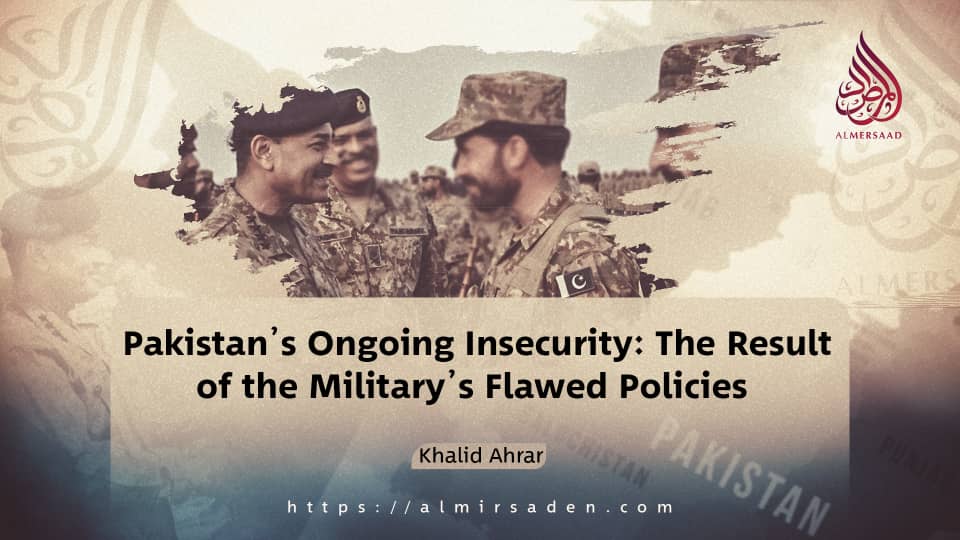
Over the past two decades, the attacks and unrest in Pakistan have stemmed from a long and complex political crisis and misguided policies, with roots going back to the rule of General Pervez Musharraf.
Musharraf supported the United States’ occupation of Afghanistan. As a result, serious abuses and violations of human rights occurred in Pakistan’s tribal areas. Drone strikes, bombings, and military operations in these regions caused thousands of tribal youth to go missing, many to be killed, and forced families to leave their homes, villages, and homeland.
Pakistan sacrificed regional stability to please the United States. These policies not only undermined peace in the region but also laid the foundation for insecurity in exchange for dollars from Washington. Today, these harmful policies are widely regarded as the main cause of ongoing unrest in the country.
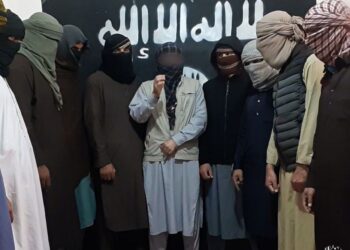
The current domestic instability in 2025–2026 has reached unprecedented levels. Recent attacks in Khyber Pakhtunkhwa and Balochistan by Tehrik-i-Taliban Pakistan (TTP) and Baloch separatists are clear examples, resulting in significant casualties among Pakistan’s security forces.
Even if the Pakistani military claims that dozens of militants have been killed in its operations, these incidents reflect internal weaknesses and political crises. The military establishment, which benefits from continued unrest, has not adopted reasonable or practical approaches to resolving issues between Afghanistan and Pakistan. Instead, it conceals its domestic challenges—such as conflicts with political parties, power grabs, the imprisonment of some political leaders, economic crises, and the perpetuation of insecurity—while seeking external scapegoats. For this reason, the Pakistani army has relied on a policy of war and pressure instead of negotiations.
In contrast, the Islamic Emirate of Afghanistan (IEA) has consistently sought to resolve problems through peaceful negotiations, particularly in the context of Afghanistan–Pakistan relations. Along the so-called Durand Line, the IEA has not caused any incidents. It has implemented multiple measures to maintain regional security. These include convening a council of scholars to address issues through religious guidance and imposing strict regulations to monitor and control tribal refugees, including relocating them from sensitive areas near the border.
Importantly, the IEA has always been prepared for a peaceful resolution of these issues. However, Pakistan has largely ignored these efforts. In the past, when Pakistan launched attacks, the IEA retaliated only once but refrained from retaliation on numerous occasions to preserve the possibility of negotiations.
Following the Pakistani attacks in October 2025, a temporary ceasefire was arranged through the mediation of Qatar, Turkey, and Saudi Arabia. It largely held, but direct negotiations in Istanbul and Doha failed due to the intransigence of the Pakistani side.
The core issue is that Pakistan demands the IEA completely expel the TTP from its territory. The IEA has consistently denied providing shelter to the TTP, repeatedly emphasizing at the official level that Afghan soil must not be used against any party.
Now, as Pakistan targets innocent civilians in Afghanistan, Afghan patience is reaching its limit. Historically, Afghans have never sought revenge lightly. Should this situation persist, the Pakistani military establishment may face severe repercussions.
For a lasting solution, Pakistan must address its domestic challenges and return to the negotiation table. Establishing peaceful relations between the two countries would not only guarantee regional stability but also promote economic growth and the well-being of the population.
The Islamic Emirate has consistently advocated resolving disputes through diplomatic dialogue, demonstrating a responsible approach. Yet, ongoing attacks and accusations weaken these efforts. Pakistan should seize this opportunity and choose peace over war, as conflict benefits only malicious actors. This situation underscores how harmful historical policies continue to affect current generations. Leaders of both countries must prioritize the interests of their people and take concrete steps toward a peaceful resolution, ensuring a brighter future for the region.