



















By Syed Jamal al-Din Afghani
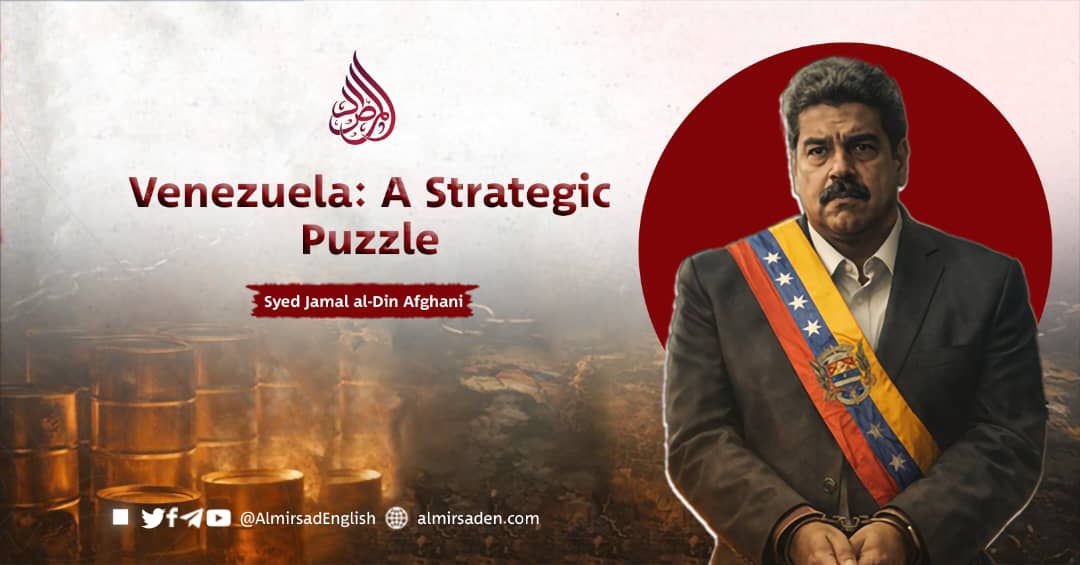
In recent days, the President of the United States issued an extraordinary order: the sitting president of Venezuela, a South American nation, along with his wife, was to be seized from their palace in broad daylight, placed in chains, and taken into custody. Acting on this directive, American Delta Force units carried out a meticulously planned operation, capturing both individuals and transporting them to Washington.
The incident sent shockwaves across the globe and ignited an international uproar. From China to Morocco, and from Moscow to Singapore, observers around the world were left stunned. Reactions varied in intensity, yet despite the magnitude of the event, no response from any quarter rose to the level such an unprecedented action demanded.
Tensions between Washington and Caracas had been simmering since the immediate aftermath of Donald Trump’s electoral victory. Over the past several months, however, those tensions escalated into something far more complex and volatile. Many expected open conflict. Talk of confrontation and even war filled political discussions. What proved truly astonishing was the ease with which American forces achieved their objective. There was no fighting, no resistance. It unfolded as effortlessly as if a bride were being willingly escorted from her in-laws’ home. What forces and calculations lay behind such an outcome?
For the moment, we will set that question aside. The more pressing issue is this: how did relations between the United States and Venezuela deteriorate to such an extreme point?
In situations like these, it is common for official narratives to emerge that are designed less to explain reality than to obscure it, to throw dust in the public’s eyes or offer emotionally charged explanations that spread quickly. Accordingly, when the Venezuelan president was detained and removed, his vice president claimed that America’s real problem was Venezuela’s oil. Oil, as a subject, resonates instantly with the public and stirs powerful emotions, which is precisely why this explanation gained traction. But is oil truly the core issue?
Let us examine this more closely.
When oil is mentioned, the mind immediately turns to the Middle East, Iran, or Russia. Yet the reality is that Venezuela possesses the largest proven oil reserves in the world. From this perspective, it is not far-fetched to assume that the United States might wish to bring these resources under its framework of control. Beyond this, analysts have long argued that Washington intends to pursue a major strategic game in the Middle East, and that its objectives in the region raise serious concerns. If relations were to deteriorate further and Middle Eastern states gained the ability to exert oil-based pressure on the United States, such a scenario would pose a serious concern for Washington. It is for this reason that the United States appears determined to take preemptive measures, freeing itself from potential leverage and clearing the field to pursue its broader strategic agenda.
Standing in the way of this objective was the Venezuelan president himself, a leader unwilling to surrender his country’s natural resources to American authority.
At the same time, some analysts argue that this dramatic move was also intended as a message to Iran. The signal, they suggest, is unmistakable: defiance will be met with humiliation. They point to recent large-scale protests in Iran, the open and explicit support those protests received from Israel, and Israel’s clear admission that it stood behind them. Added to this was Donald Trump’s declaration that if Iranian authorities used force against demonstrators, the United States would intervene to protect them. Taken together, these signals suggest that Washington no longer considers the Iranian challenge tolerable and has begun laying the groundwork to address it. The first step is to cultivate widespread public resentment against Iran’s ruling establishment. Once that resentment reaches its peak, the United States, according to this view, would take a step even harsher than the one taken against Venezuela.
Yet beyond these interpretations, there is a point on which most international observers agree, one firmly supported by the historical record of recent decades: the global dominance of the contemporary American system itself. The background is instructive. In the 1990s, when socialism collapsed in Afghanistan and the capitalist system surged forward worldwide, it was precisely at that moment that Venezuela’s former president, Hugo Chávez, sought to revive a dead ideology. He invested all his political energy in resurrecting socialism. From that point onward, friction with the United States became inevitable.
Chávez paid a price for this defiance. His authority was curtailed through internal unrest and political pressure. Yet his popularity carried him back to power through elections. Rather than align with Washington, he strengthened ties with China and Russia.
Moscow offered assurances of military support and strategic counsel, while Beijing pledged to purchase Venezuelan oil and participate in major infrastructure development projects. For the United States, this alignment was unacceptable. Washington waited patiently for the moment when it could move decisively. Although the United States shares no land border with Venezuela and lies roughly two thousand kilometers away by air, it nonetheless views Venezuela, by virtue of its location in South America, as falling squarely within its sphere of influence. From this perspective, the growing presence of China and Russia was seen not as diplomacy, but as intrusion into what Washington considers its own backyard.
Globally, the United States has long sought to prevent nations from entering the China-Russia bloc, a pattern evident over the past several decades. When that bloc’s influence began to take hold within America’s perceived sphere of control, it became intolerable. Washington simply waited for the right moment. That moment appeared after Chávez’s death in 2013, when his vice president, Nicolás Maduro, assumed the presidency. Yet Maduro maintained the same strategic orientation as his predecessor.
Meanwhile, the China-Russia axis continued to strengthen. Russia tightened its grip on Ukraine. China intensified its pressure on Taiwan, surrounding the island and conducting nearly daily military exercises. Iran received increasingly overt diplomatic and strategic gestures from both powers. Venezuela’s closeness to this bloc grew steadily, and anti-American rhetoric reached unprecedented levels. When the United States finally perceived this convergence as a looming threat at its doorstep, it acted decisively, discarding international legal norms in the process, in order to silence a growing disturbance at its gate.
Aside from all these analyses, another interesting point was Donald Trump’s statement. Trump called the abduction of Venezuela’s President and his wife a major victory and said that during our withdrawal from Afghanistan, where we saw humiliation, we compensated for it by demonstrating our resolve and discipline in Venezuela.
Amid all these analyses, one additional detail stands out: a statement made by Donald Trump himself. Trump described the abduction of the Venezuelan president and his wife as a major triumph. He declared that the humiliation the United States had endured during its withdrawal from Afghanistan had been redeemed in Venezuela through a display of resolve and discipline.
This statement is laden with meaning. One interpretation is that when the United States seeks to project power across the globe and falters at any point, it turns inward, reproaching its leadership for negligence. Another interpretation is more ominous: not every country can become another Afghanistan, nor should it attempt to do so. Those who try may well face a fate similar to that which befell Venezuela.