













By Sayyid Jamal al-Din Afghani
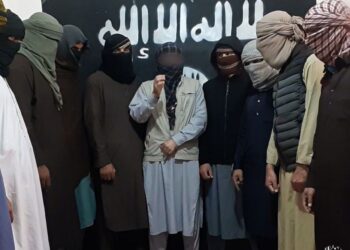
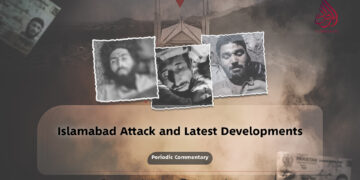
On Saturday, February 21, an explosion rocked Bannu, reportedly claiming the lives of two senior officers of the Pakistan Army along with eleven soldiers accompanying them.
In the immediate aftermath of the incident, the Pakistan Army issued a statement on its official social media platforms, presenting it as a response to the attack. However, rather than conveying sympathy, the statement appeared largely composed of formal, formulaic remarks.
News commentators and analysts were quick to point out that the Pakistani military now finds itself struggling to contain the deteriorating security situation and appears intent on shifting the blame for its setbacks elsewhere. According to experts, what once remained confined to rhetoric may now take on a more tangible form, as the army’s repeated failures compel it to divert public attention from its own shortcomings.
In fact, the military’s statement regarding the Bannu incident carried a rather unusual tone. Its very first line, issued in the aftermath of the blast, read: “Afghanistan has once again failed to prevent terrorism.”
It seemed as though Afghanistan were responsible for Pakistan’s security, or as if the taxes and budget of the Pakistani people were being given to Afghanistan instead of their own army. As though whenever an incident occurred in Pakistan, Afghanistan should be asked why it had not fulfilled its responsibility.
It even appeared as if claims of being a nuclear power, defense agreements with Saudi Arabia, slogans of victory against India, and all other such privileges were linked to Afghanistan rather than Pakistan, whereas all these claims are made by the Pakistani army itself.
Another part of the statement was even more striking, declaring:
“We will take revenge and show no restraint.”
It was expected that the army would confront armed groups directly within its own territory or move to eliminate them. Yet, while the world was still watching, late at night Pakistani fighter jets left their own airspace and entered Afghan territory. There, they carried out bombardments at five locations, targeting defenseless and innocent civilians.
In these strikes, seventeen members of a single family were martyred, as they had retired after breaking their fast and were resting for the next day’s fast. Mosques and madrasas were also struck, and religious books, containing clear injunctions regarding such acts, were burned.
Now, both Arab and non-Arab observers are asking what Pakistan seeks to achieve by targeting innocent civilians and sacred places.
It is evident that the primary objective of the Pakistani military is to consolidate its authority on the shoulders of the nation, expend their resources, and resort to any inhumane and un-Islamic measure to preserve its power, while continuing to absolve itself of responsibility. For this very reason, over the past eight decades it has kept the public preoccupied with the issue of Kashmir; yet neither has Kashmir been liberated, nor has any tangible outcome emerged. Under the banner of that slogan, however, the nation has paid a heavy price.
In this context, a well-known Pakistani analyst, Qamar Cheema, stated that what the United States had left unfinished, Pakistan was now completing. The world is well aware of what the United States did in Afghanistan: bombardments, killings, prisons, plunder, and the destruction of the country.
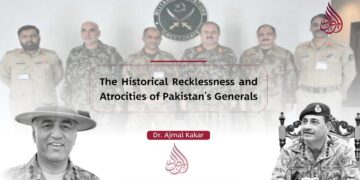
The Pakistani military, which is regarded as disregarding all ethical values and principles of humanity, Islam, and neighborly conduct, can eliminate even a benefactor of the nation while in custody for its own personal interests.
As it is said, the honor that once existed “disappeared from Timur’s house”, following the same logic, it is capable of causing the death of a Army Chief in the incident of a plane crash.
So will the killing of a Muslim, the destruction of mosques and madrasas, and the desecration of Islamic symbols evoke any shame for them? Will the trampling of the dignity of children and women awaken even a trace of honor?
This is precisely why it is said that they adopted such a policy with apparent enthusiasm, in exchange for a few coins from the Trump administration. Yet they must not forget that despite the oppression and tyranny of Trump and his supporters, they were ultimately defeated. How, then, can the Pakistani military consider itself victorious or expect to rejoice?