












By Akbar Jamal
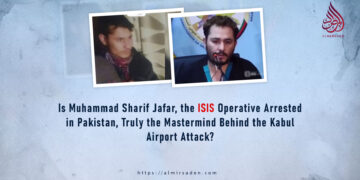
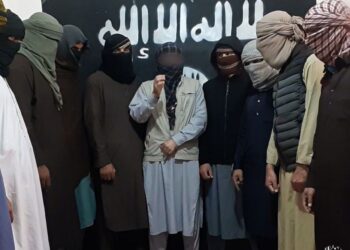
In light of the current security situation in Pakistan and the changing dynamics of the region, the relationship between the state and the ISIS Pakistan branch has once again become a central topic of discussion at both international and domestic levels. In recent years, numerous incidents and pieces of evidence have emerged that have further strengthened the perception that the Pakistani military and its intelligence agencies, the ISI and MI, are using terrorist elements such as ISIS as a tool to achieve their specific strategic interests.
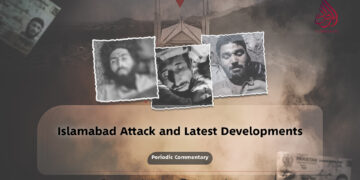
In this regard, the killing of a man named “Muhammad Iqbal son of Muhammad Shamdar” in the Orakzai region of Khyber Pakhtunkhwa and the documents obtained from him have played an important role in exposing this hidden connection. This revelation that a person was simultaneously working for the ISI and also responsible for supplying resources to ISIS, has been considered a confirmation of earlier allegations and narratives that the roots of militant groups present in Pakistan are, in some form, linked with state support.
According to the report by Al-Mirsaad, these documents also suggest that certain individuals within intelligence agencies are active under different names within the foundational structure of ISIS, with the aim not of eliminating terrorism, but of directing its activities in accordance with their own objectives.
Another part of this chain includes the martyrdom of Sheikh Idris (RH), as well as a suicide attack on a place of worship of the Shiite community in Islamabad a few months earlier. Analysts view these incidents in light of increasing cooperation between ISIS and Pakistan’s military and intelligence agencies, as well as internal contradictions.
From these incidents it appears that whenever a certain group or individual is no longer needed by the Pakistani military, or becomes an obstacle to a larger plan, they are removed from the path through hired killers such as ISIS.
For a long time, Pakistan has been accused of using terrorism as a tool of its “foreign policy.” The continued activity of ISIS in the region is also considered part of an effort to show the international community, especially the West, that the region faces severe threats, in order to obtain security assistance and political concessions.
This approach is seen as a continuation of earlier patterns from the eras of former President General Zia-ul-Haq and General Pervez Musharraf, when the Pakistani military followed similar policies in relation to Afghanistan in line with U.S. objectives.
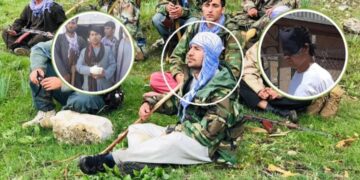
It is also worth noting that the situation in the Tirah Valley of Khyber Pakhtunkhwa is considered as a practical example of cooperation between the Pakistani military and ISIS.
In severe winter conditions, local residents were forcibly evicted from their homes under the name of “operations,” while at the same time reports of ISIS presence in the area began to emerge, followed by the activation of ISIS elements. This is seen as a sign of a coordinated state plan.
Local sources and analysts claim that people were forcibly displaced with the objective of providing secure hideouts for ISIS-Khawarij and to organize their presence in a structured manner.
This is also why, after the displacement of people from those areas, a sudden increase in ISIS activities and attacks has been observed, which has raised serious concerns among local tribal communities.
Even if there is no ideological similarity between the Pakistani military regime and ISIS, similarities can certainly be seen in terms of “interests and practical actions.” Both, for their own objectives, are accused of justifying violence and the targeting of religious figures.
In Balochistan, reports of ISIS training centers in the Mastung area being targeted and destroyed by Baloch independence-seeking organizations indicate that ISIS is now being shifted from Khyber Pakhtunkhwa to other regions, in order to open new fronts against neighboring countries.
One objective of these actions by the Pakistani military is also described as an attempt to show the world that Pakistan itself is a victim of terrorism, while behind the scenes the same violent elements are being used for Pakistan’s strategic interests.
All of this evidence points to the bitter reality that peace and stability in the region are being sacrificed for certain vested interests, in which groups like ISIS and Pakistan’s state military and intelligence institutions appear as two sides of the same coin.
The attack on a place of worship of the Shiite community in Islamabad, along with incidents ranging from the Tirah Valley to Orakzai in Khyber Pakhtunkhwa, are all considered different aspects of this dangerous and controversial proxy game attributed to the Pakistani military establishment.