
By Sultan Muhammad Saqib
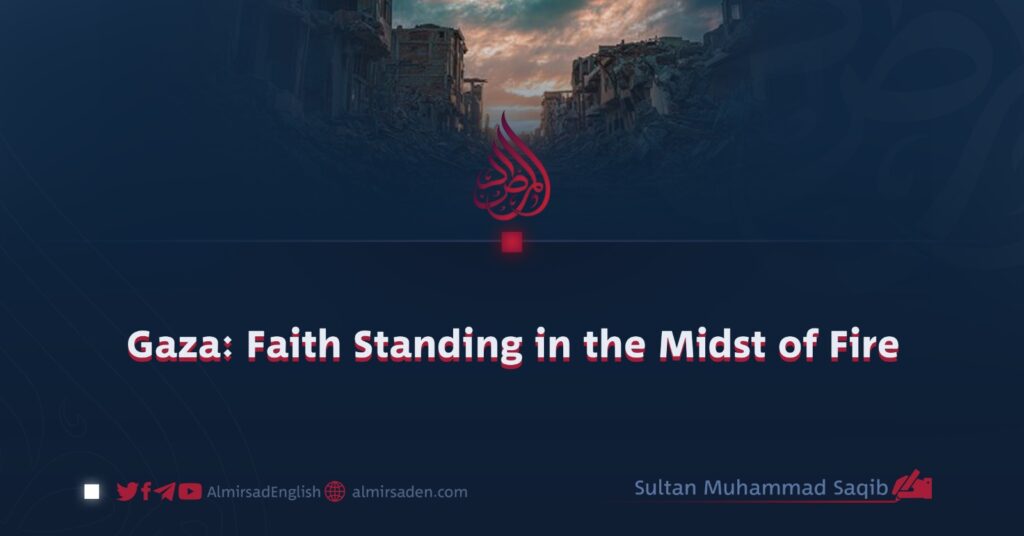
Gaza is a wound that has not healed. This small but defiant strip of land has endured nearly two years of intense Israeli bombardment. Hospitals, schools, and mosques have been targeted. Thousands of women and children have been martyred. Journalists, rescue workers, and aid workers have paid with their lives. Humanitarian corridors have been shut off, and scenes have unfolded that shake something in every human being who still has a conscience. The world watches in silence. The so-called human rights institutions have made themselves deaf and blind.
This long-suffering corner of the Middle East has always known hardship. Homes collapse. Roads close. Children are orphaned. Mothers bury their children. And yet from that same soil, instead of cries of surrender, rises “Allahu Akbar.” This is a land where even under the shadow of bombs, the light of faith does not go out. It burns brighter. What the people of Gaza have offered is not only a sacrifice for the history books. It is a jolt to the conscience of the entire Ummah.
In any honest account of Palestinian resistance, Hamas cannot be ignored. Whether one approaches it from a political angle or from the raw reality of human suffering, one truth holds: this region has remained standing, through prolonged siege, through war, through devastation, in defense of its identity and its existence.
From the perspective of those who support it, Hamas is not merely an organization. It represents a distinct political and resistance tradition. At a time when most political leaders are shackled by calculation and silence, the youth of Gaza are still raising the banner of resistance. Their message to the world is simple and unrelenting: faith and will are a stronger shield than any weapon.
However savage the Zionist operations become, however many homes are destroyed and lives taken, history keeps returning to one truth: ideologies/ideas cannot be bombed out of existence. The historical record shows that occupying forces, sooner or later, always fall. The will of oppressed peoples endures. The hope of a free Palestine grows stronger through every sacrifice, inshallah.
The responsibility of the Ummah today is to make Palestine’s pain its own. Through du’a, through solidarity, through raising their voices in every legitimate way possible, Muslims must stand beside this people. Palestine is not just a name on a map. It is a shared matter of faith, dignity, and history. In Gaza, death has stopped meaning an ending and started meaning a continuation. From every drop of blood springs new conviction, new resolve, new fire. This unbroken chain of martyrdom has only deepened the certainty of Gaza’s people: freedom does not come without sacrifice.
The Martyr of the Oppressed Al-Aqsa
Among the defining figures of Gaza’s resistance is Izz al-Din al-Haddad, known as the “Ghost of Qassam,” one of the senior commanders of Hamas’s military wing. He served as the brigade commander of Gaza City and played a central role in its military structure. By most accounts, he was among the core figures of Hamas’s military apparatus, commanding several units under his leadership.
He gave his life to this cause, and on that same path, alongside some members of his own family, he attained martyrdom. May Allah accept him.
Gaza today is not just the name of a war. It is the name of a humanity that refuses to yield even under the most crushing conditions. Where bombs fall, prayers also rise. Where rubble accumulates, new signs of hope emerge. The message running through all of it is the same: when a people stand firm in their faith and will, no material power can break them forever.