
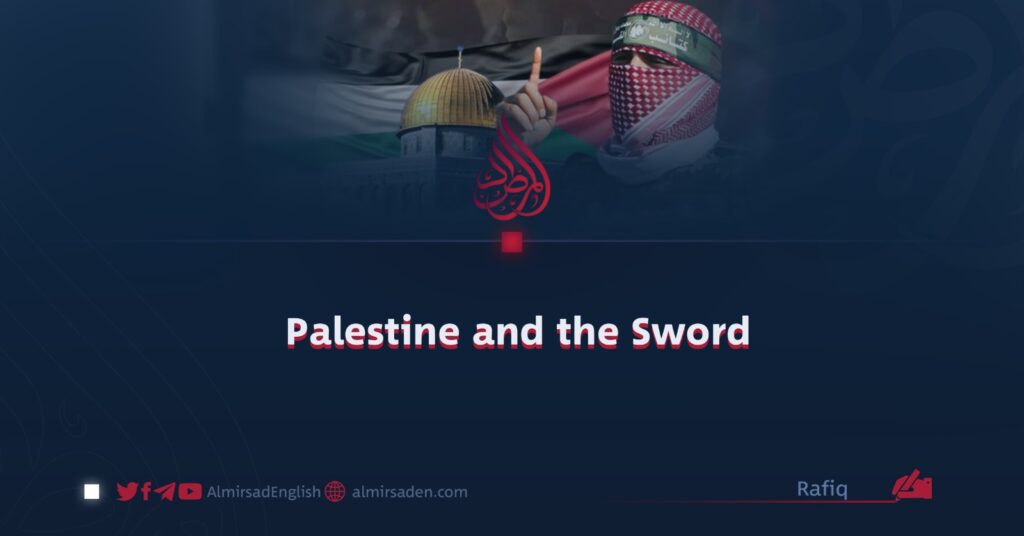
By Rafiq
Today, the liberation of Islam’s first Qibla stands as a cause greater than the strength and capability of both Arabs and non-Arabs alike. For decades, a resistance and a force have emerged within Jerusalem in such a way that, as in ages past, Jews, Crusaders, so-called Muslims, and Zionists have united against it.
Before this force and the call for the liberation of Al-Aqsa, the forces of disbelief once again raise the same cry: Choose either them (Palestine) or us.
That very proclamation and alarm so utterly overwhelmed the so-called Muslims that, in the face of the brutality and oppression inflicted upon the Muslims of Gaza by the forces of disbelief and falsehood, they not only defended the oppressors, but failed even to condemn their crimes.
Famine and thirst descended upon Gaza, yet these same Muslims neither provided water nor food; instead, they branded the sincere defenders of the Ummah as “terrorists.”
When the Ummah was left disillusioned by the occupiers, the foundations of a long and steadfast resistance were laid, a resistance so formidable that the entire camp of disbelief mobilized itself to contain and suppress it.
They reduced Gaza to rubble, yet these sincere and courageous Mujahideen of the Ummah never regarded the hardships of daily life as an obstacle to their struggle and resistance. Rather, through their remarkable steadfastness, they compelled the disbelievers and Zionists to seek guarantees for their own security from them.
This is a testament to the strength of the Palestinian resistance, which, as in the past, has demonstrated the power of the faithful to those who have sold their faith for worldly gain. We are that force of the era whose sword, shining with the light of Iman (faith), breaks the fortresses and defensive lines of disbelief. Today, Palestine has therefore been given the title of the “Sword of the Ummah,” as it embodies the Ummah’s duty toward Bayt al-Maqdis (Jerusalem), the first Qibla.
Throughout history, the Islamic Ummah has never been devoid of brave figures such as Khalid ibn al-Walid and Salah al-Din al-Ayyubi. From the martyr Yahya Sinwar to Izz al-Din Haddad, this serves as a reminder of the same sacrifices for which Nur al-Din Zangi dedicated himself, thereby reviving the resolve and spirit of the Ummah.
Today, the martyrdom of Haddad is seen as another continuation of the sacrifices repeated throughout our history. It is this continuity that strengthens us, and it is this chain of sacrifice that keeps us united and awakened in the face of Zionists, Jews, and Crusaders.
The loss of the martyr Izz al-Din Haddad is a heavy blow. His absence leaves us with a sense of orphanhood and grief. However, we will never become lost or disappear in the face of the Zionists and Jews for as long as Bayt al-Maqdis exists, and as long as it exists, so will we.
We will continue to carry forward the history of martyrdom, bravery, and sacrifice. This continuity will not tire us, but it will put many among the disbelievers and followers of falsehood to the sword.
This is the secret of the Ummah’s ranks and the formations of its Mujahid forces: Though the Mujahideen may fall in small numbers, the disbelievers and the followers of falsehood are destroyed in such a way that they fill the voids of the battlefield with their own downfall.
The Palestinian jihadist resistance will never grow weak or vanish, because in this very land, successors and heirs to personalities such as Khalid ibn al-Walid and Salah ad-Din al-Ayyubi have been born.
A land upon which the footsteps of the brave of the Ummah have been placed can never become a place where the Muslim nation is erased or extinguished. We shall remain, and the First Qibla shall remain as well.
May Allah accept the martyrdom of Izz al-Din Haddad.