
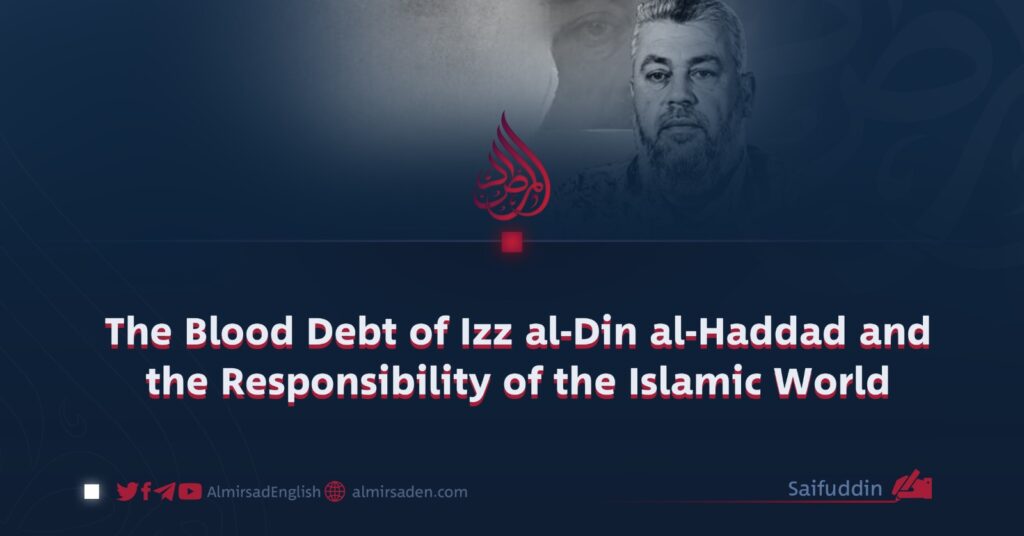
By Saifuddin
History has always been written in the blood of those who gave their lives for their homeland, their faith, and their honor. In the blessed land of Palestine, the martyrdom of the military leaders of Hamas stands as one of the clearest examples of this glorious history.
From senior commanders to young fighters, the men who have fallen in the defense of Gaza have etched their names into the proudest chapters of the Muslim Ummah’s history. Izz al-Din al-Haddad (RH) was not the first commander to attain martyrdom. Before him, many of his brothers-in-arms had already risen to that lofty rank, one after another.
These courageous men offered sacrifices of such magnitude that their legacy will continue to shine for generations to come. We congratulate them from the depths of our hearts on attaining martyrdom. Through their faith, resolve, and steadfastness, they proved to the world that conviction and determination are stronger than any material force. Every drop of their pure blood heralds the dawn of freedom, and their memory will remain a torch of resistance for future generations.
On the battlefield, the repeated failures of the Zionist occupying regime drove it to unleash its fury on Gaza’s defenseless civilians. Women, children, and the elderly became the targets of blind bombardment. This criminal regime has trampled every international and humanitarian norm. Its attacks on hospitals, schools, mosques, and refugee camps are clear signs of both its brutality and its desperation.
What is unfolding is not war in any legitimate sense. It is a systematic campaign of genocide that will forever stain the pages of history with disgrace. We condemn these ruthless attacks, which stand in direct violation of every human and moral principle.
Yet the greatest tragedy lies elsewhere.
In the face of this immense atrocity, much of the Muslim world, both rulers and ordinary people, remains trapped in a shameful silence and debilitating weakness. The blood of Izz al-Din al-Haddad (may Allah accept him) is a trust upon the shoulders of the entire Muslim Ummah, a debt that cannot be ignored. Today, more than one and a half billion Muslims live across the globe, yet they continue to suffer humiliation and powerlessness.
The root of this condition is painfully clear. Muslims have become entangled in ethnic rivalries, racial divisions, linguistic disputes, and fruitless sectarian quarrels. They have forgotten that the Ummah is meant to be one body. Instead of directing their collective strength against their common enemies and toward the defense of their sacred causes, they exhaust themselves in internal discord.
This fragmentation remains one of the greatest sources of the Ummah’s weakness. Time and again, it has been exploited as a bridge to undermine and dismantle Muslim societies and governments.
Amid these dark and disheartening circumstances, the leaders of the Islamic Emirate of Afghanistan are a source of hope and a symbol of sincere solidarity with the Muslim Ummah. The IEA has not confined its support for oppressed Muslims to words alone; rather, it has sought to demonstrate in practice its readiness to stand with fellow Muslims despite immense international pressure.
Through political prudence, strategic patience, and practical wisdom, the leadership of the IEA may be able to help guide this storm-tossed vessel of the Muslim Ummah toward safer shores. Their approach rests on several principles: Muslims must rise above internal divisions and recommit themselves to unity. They must act with wisdom and discipline, taking measured steps grounded in the realities of the region and the world rather than in emotion alone. The Ummah must regain its political and military independence. Only under the shelter of this kind of strong wisdom can the Ummah find a path to real salvation and reclaim its dignity in the eyes of the world.