
By Khalil
The endurance and authority of a genuine Islamic system do not depend on military strength or international backing. Rather, they hinge on the extent to which the ruling administration remains committed to Islamic principles in all its policies and how much the people are satisfied with and support it. In the ongoing conflict with the Pakistani military regime, Afghans face two stark realities: first, a force that, through coercion and brutality, deploys its mercenary, contractual, and project-based army to serve foreign objectives, all while shamelessly concealing the weaknesses within its own ranks and seeking to demonstrate military capability in pursuit of international projects and financial gain.
On the other hand, the mujahideen of a genuine Islamic system have risen to defend their country, despite a tragic history in which hundreds of innocent civilians, children, women, and the elderly, have suffered martyrdom. These civilians were not killed in their homes by any American, Western, or British soldier during the blessed month of Ramadan; rather, they were sacrificed under a so-called “nuclear power” that claims to be the tenth strongest in the world. The leaders of the military regime have consistently sold themselves as cheap mercenaries for international interests in exchange for money, the latest example being the proposal to deploy them to Gaza to support and protect the Israeli occupying army.
This military not only has no history of protecting, serving, or supporting its own nation, but on the contrary, it has repeatedly tested its weapons and projects on the entire non-Pakistani population. Its record is so disgraceful that it even sold a Muslim woman named Aafia Siddiqui to the U.S. and other dollar-driven markets.
Even now, in Pakistan, numerous protests and demonstrations are being suppressed, those aimed at challenging the dominance of the country’s military elite, condemning the brutal attacks on Afghanistan, and claiming basic rights.
Neither the media nor political analysts are allowed to raise their voices against the army’s oppressive and anti-Afghanistan policies, nor are the international norms and treaties, which they themselves have signed in the name of global cooperation, respected.
On the other hand, Afghan security forces avenge their oppressed people through retaliatory operations and step forward to defend their sacred homeland, a land that yesterday they saved, at the cost of lives and property, from the harsh and systematic occupation by NATO and American forces, and in history, they have recorded yet another golden chapter of victory.
All military analysts and observers of the past twenty-year jihad are astonished at how the Taliban mujahideen, with bare hands and under impossible conditions, were able to reestablish the governance of an Islamic system on their own land and implement the principles of the IEA on themselves and their society, despite the entire world standing in opposition. The answer to this question is simple: this struggle was deeply rooted in the overt and covert support of their own people.
Without the support of the people, it would have been impossible for a force, whose weapons and supplies were barely functional, to succeed against the world’s most modern and extremely dangerous military technology.
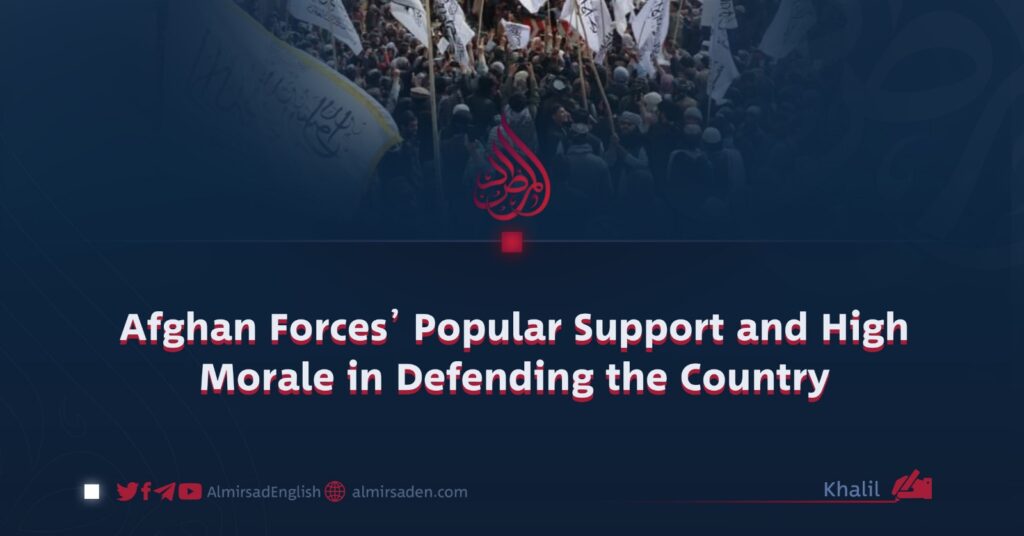
This contemporary historical event teaches the Pakistani regime and its military that wars are won through morale and conviction, and that the most crucial secret to lasting success is the decisive backing of the people. Since the day Afghan brave forces launched retaliatory operations, “Rad al-Zulm” to defend their land and people, simultaneous gatherings of popular support have been held across the country, with civilians placing flowers beside their defending troops and offering iftar meals and prayers for them.
This contrast, on one hand, the people see their oppressors as sources of evil and killers, and on the other, regard their own security forces as guardian angels and protectors, sends a very clear message: no one should view Afghanistan with hostility or as a target of invasion.
Today, in Afghanistan, a system has been established that does not operate based on foreign projects, directives, or advice, but rather relies on its own Islamic approach and popular support. It carries a history of defeating great empires and can hold the heads of their minor puppets and subservients under control.
It would be better for the Pakistani regime to acknowledge its mistakes, respect its own people, seek solutions to its problems within its own borders, and allow the Afghan people to play their part in the ongoing bright process of rebuilding and developing their country. If any neighboring or regional state has issues with the IEA, or feels threatened by Afghan territory, the proper course is to raise these concerns diplomatically, so they can be addressed through dialogue and mutual understanding. In this regard, the IEA has a clear foreign policy and maintains official and open representations in over forty countries worldwide, each of which can serve as a center and address for constructive talks.